

Most people tap their phone to pay for coffee and call it a day with NFC. I get it, contactless payments are the obvious use, and they work well. But your phone’s NFC chip can do a lot more than process transactions, and ignoring that feels like a waste of hardware you already own.
NFC tags cost next to nothing, and once you start programming them, you realize how many tedious phone interactions you can skip entirely. Here are six ways I actually use mine.
Automate everyday tasks by tapping an NFC tag
One tap replaces a dozen manual steps
NFC tags are small, passive chips that store data and transmit it when a phone gets within a few centimeters. They don’t need batteries as they draw power from your phone’s NFC reader during the tap. A pack of rewritable NTAG215 stickers costs a couple of dollars, and you can program each one to trigger a specific action on your phone.
On Android, you can use a tag-writing app like NFC Tools along with automation apps such as Tasker, one of the most powerful automation tools on Android, or Samsung’s Modes and Routines to react to NFC tag scans. On iPhone, the Shortcuts app supports NFC as a trigger natively. You tap the tag, and your phone executes whatever you’ve assigned to it — toggling Do Not Disturb, launching a playlist, setting a morning alarm, or opening a work app.
The actual value is in placement. Stick a tag on your nightstand to activate a bedtime routine, on your desk to silence notifications, or in your car mount to open Google Maps. These are actions you’d otherwise do manually every single day, and tapping a sticker is faster than unlocking your phone and navigating through menus.
Share your Wi-Fi password without saying it out loud
Encode your credentials onto a cheap sticker
Credit: Gavin Phillips / MakeUseOf
Every time someone visits, the same routine plays out. They ask for the Wi-Fi password, I spell out a string of random characters, and they mistype it twice. It’s a small annoyance, but it’s one you can eliminate with an NFC tag.
Using a free app like NFC Tools (available on Android and iOS), you can encode your network’s SSID, encryption type, and password onto a tag. When a guest taps their phone against it, a prompt appears asking them to join the network automatically.
I keep mine stuck to a shelf near the router. You could also place one by your front door or embed it in a small frame — some Airbnb hosts already use NFC tags for guests.
The tag stores the password as plain text, so anyone who scans it can read the credentials. That’s fine for a home network with trusted visitors, but you wouldn’t want to use this for a business network with sensitive access.
Verify product authenticity before you buy
Your phone can spot counterfeits for you
Counterfeit products are a real problem, especially in resale markets for sneakers, electronics, and luxury goods. A growing number of brands now embed NFC tags directly into their products or packaging as a countermeasure, and your phone can read them without installing anything extra.
When you tap your phone against an NFC-equipped product tag, it opens a verification page from the manufacturer confirming whether the item is genuine. Nike has experimented with this in select footwear lines, and several luxury brands have adopted it for handbags and accessories. The technology behind this relies on unique, cryptographically signed chip identifiers that can’t be cloned easily. Unlike a QR code, which anyone can reproduce, an NFC authentication tag is tied to hardware that’s difficult to replicate. That said, NFC isn’t without its own security risks, so it’s worth understanding them as well.
This isn’t something you need to set up or configure. If a product has an embedded NFC tag, your phone will detect it automatically when held close. It’s a passive feature most people don’t look for, especially when buying secondhand.
Use your phone as a transit card in supported cities
Google Wallet and Apple Wallet can replace your physical fare card
If you’ve ever fumbled for a transit card while a line builds behind you, this one’s worth knowing. Many cities now let you tap your phone at fare readers instead of carrying a separate card, and it works through the same NFC chip you use for payments.
Google Wallet and Apple Wallet both support virtual transit cards. In some systems, you can add a digital version of an existing card. Japan’s Suica and New York’s OMNY all work this way. Once loaded, your phone behaves exactly like the physical card at turnstiles and bus readers. You don’t even need to unlock the screen in most cases.
Even in cities without dedicated virtual cards, open-loop transit systems accept standard contactless payments. That means any NFC-enabled phone with a linked debit or credit card can be used to tap through.
The practical advantage here is consolidation. That means one fewer card in your wallet. Unlike a physical transit card, your phone notifies you when your balance is low and lets you reload without visiting a kiosk. It’s a small convenience, but it adds up if you commute daily.
Quickly pair Bluetooth devices with a single tap
Skip the Bluetooth settings menu and let NFC handle the handshake
Credit: Jowi Morales / MakeUseOf
Bluetooth pairing is one of those things that should be simple but often isn’t. You enable pairing mode on the device, open your phone’s Bluetooth settings, wait for it to scan, hope the right name shows up, and then tap to connect. It works, but it’s clunky, especially when you’re switching between multiple devices.
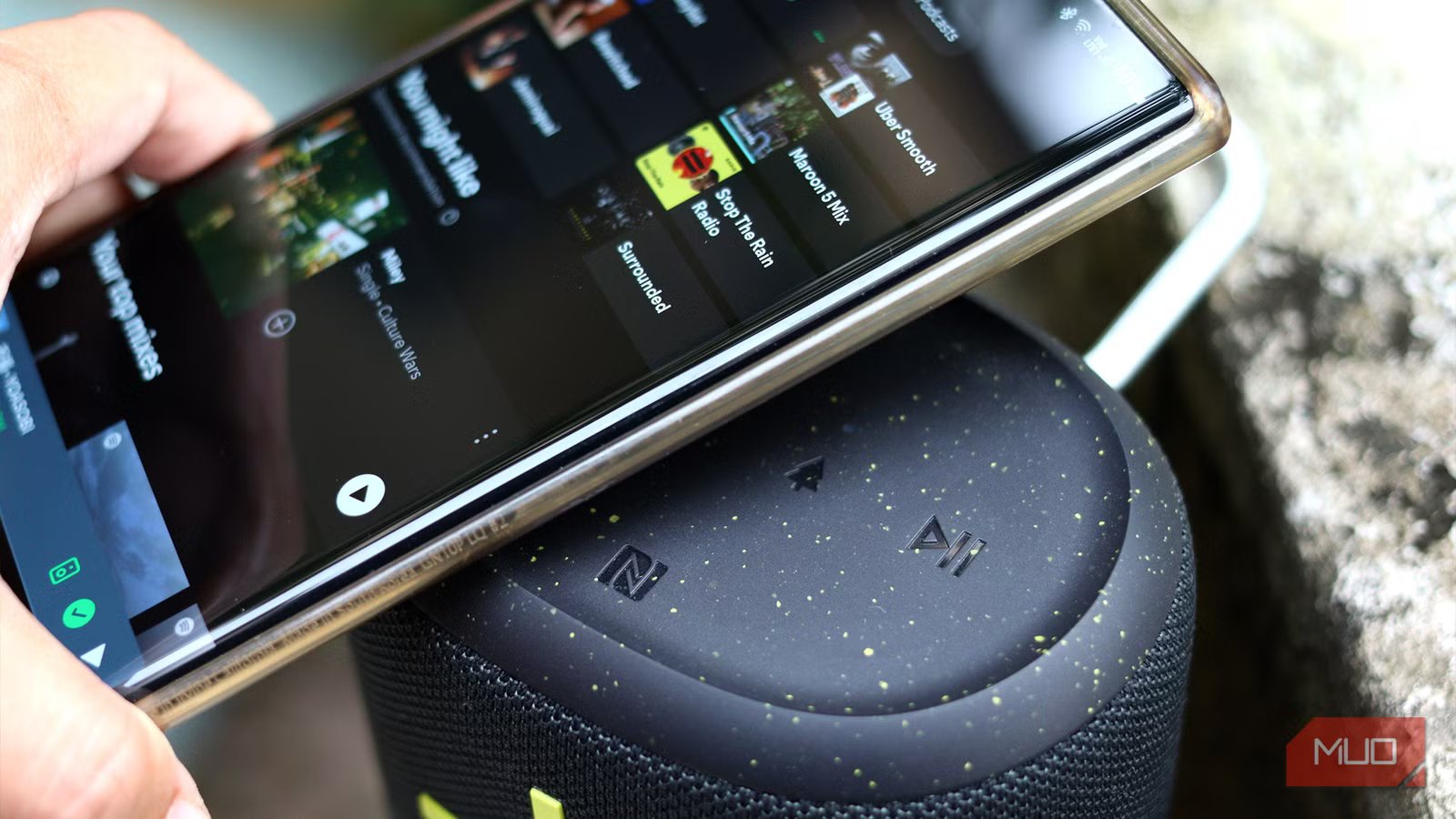
NFC pairing skips all of that. Many Bluetooth speakers, headphones, and even some smart home devices have an NFC contact point built in. Tap your phone against it, and the two devices pair instantly without navigating any menus. The NFC chip exchanges the Bluetooth connection details in a fraction of a second. Sony, JBL, and Bose offer NFC pairing on many of their mid-range and premium audio products. You’ll usually find a small NFC logo printed somewhere on the device — that’s where you tap.
The catch is that this feature is limited to Android. Apple doesn’t allow third-party NFC-initiated Bluetooth pairing on iPhones, so you’re stuck with the manual process there. If you’re on Android, though, it’s worth checking whether your current audio gear already supports it; there’s a good chance it does.
Create a digital business card that anyone can tap
Rewritable, paperless, and always up to date
Paper business cards are easy to lose and tedious to update. If your phone number or job title changes, every card you’ve handed out becomes outdated. An NFC-enabled business card solves both problems. The recipient taps it with their phone, and your contact details appear instantly, ready to save.
You can go the DIY route to make your own NFC business card by encoding a vCard file onto a blank NFC card or sticker using an app like NFC Tools. A vCard stores your name, phone number, email, website, and social links in a standardized format that both Android and iPhone can read natively. No app required on the other person’s end.
If you’d rather buy something ready-made, products like Popl and TapTok sell pre-built NFC business cards that link to a customizable profile page. These let you update your information anytime without reprogramming the card itself — the NFC chip just points to a URL.
The best part is that NFC business cards are rewritable. If you switch jobs or change your details, you reprogram the tag in seconds rather than ordering a new batch of printed cards. It’s cheaper and less wasteful.
A few more ideas worth trying
NFC tags can also store medical information for emergencies, automate laundry tracking, or launch specific app profiles for guests on your tablet. They can trigger smart home scenes, such as dimming lights and starting a movie, when you tap a tag on your coffee table.
The hardware is already in your pocket, and the tags cost almost nothing. Pick up a pack, experiment with a couple of automations, and you’ll likely find uses specific to your own routine that nobody’s written about yet. NFC is flexible enough to fit whatever you need it to do.
