

Every room in your house can benefit from some smart switches and plugs, but some rooms are better-suited to more specialized accessories. Here are some accessories you might want to add to your bedroom, and the ways they can make your life a little easier.
Motorized blinds or curtain closers
Credit: Tyler Hayes / How-To Geek
Motorized blinds are perfect for any window, but they have a new level of utility in the bedroom. With a simple automation, you can wake up gently by slowly raising the blinds in the morning to simulate a sunrise. This works great in the summer when the days are longer, and the sun is up before you are.
You can buy motorized blinds, or you can retrofit regular blinds with motors that make use of existing mechanisms. Curtains are a little simpler with devices like the SwitchBot Curtain 3 ($90) coming in a range of styles to suit all rail types (with a bulk discount available).
Adding motors to window coverings also allows you to block out the sun during the hottest time of day, perfect for summer months to keep your bedroom cool, particularly in harsh midday and afternoon sun. You can also forget having to draw the curtains or lower the blinds manually ever again when nightfall comes, which simplifies your evening routine.
Just remember that custom-made blinds are already expensive, and adding motors to them can further push the price up.
Dimmable smart bulbs
Smart bulbs aren’t always a great move, since switches and plugs offer better value on account of the fact that bulbs have a shorter lifespan. That said, dimmable bulbs in the bedroom make a lot of sense, and the price of smart bulbs with this capability has reduced a fair amount (particularly when choosing brands like IKEA).
Like motorized window coverings, dimmable bulbs allow you to wake up gradually with a simulated sunrise by slowly increasing the brightness over your wake-up window. If your bulbs include adjustable white temperature, you can go even further by simulating warmer sunrises and sunset conditions.
You can also automate these bulbs to only turn on at very dim levels in the middle of the night, so that you don’t blind yourself or your partner if you happen to switch the light on. Color-changing bulbs aren’t necessary here, but they can be fun for mood lighting.
Colors
Multicolor
Connectivity
Wi-Fi & Bluetooth
For inexpensive but reliable color changing bulbs, it’s tough to beat Govee. The bulbs are bright and colorful, and the Govee app has a ton of fun patterns for every mood and season.
Smart buttons and remotes
Credit: Bertel King / How-To Geek
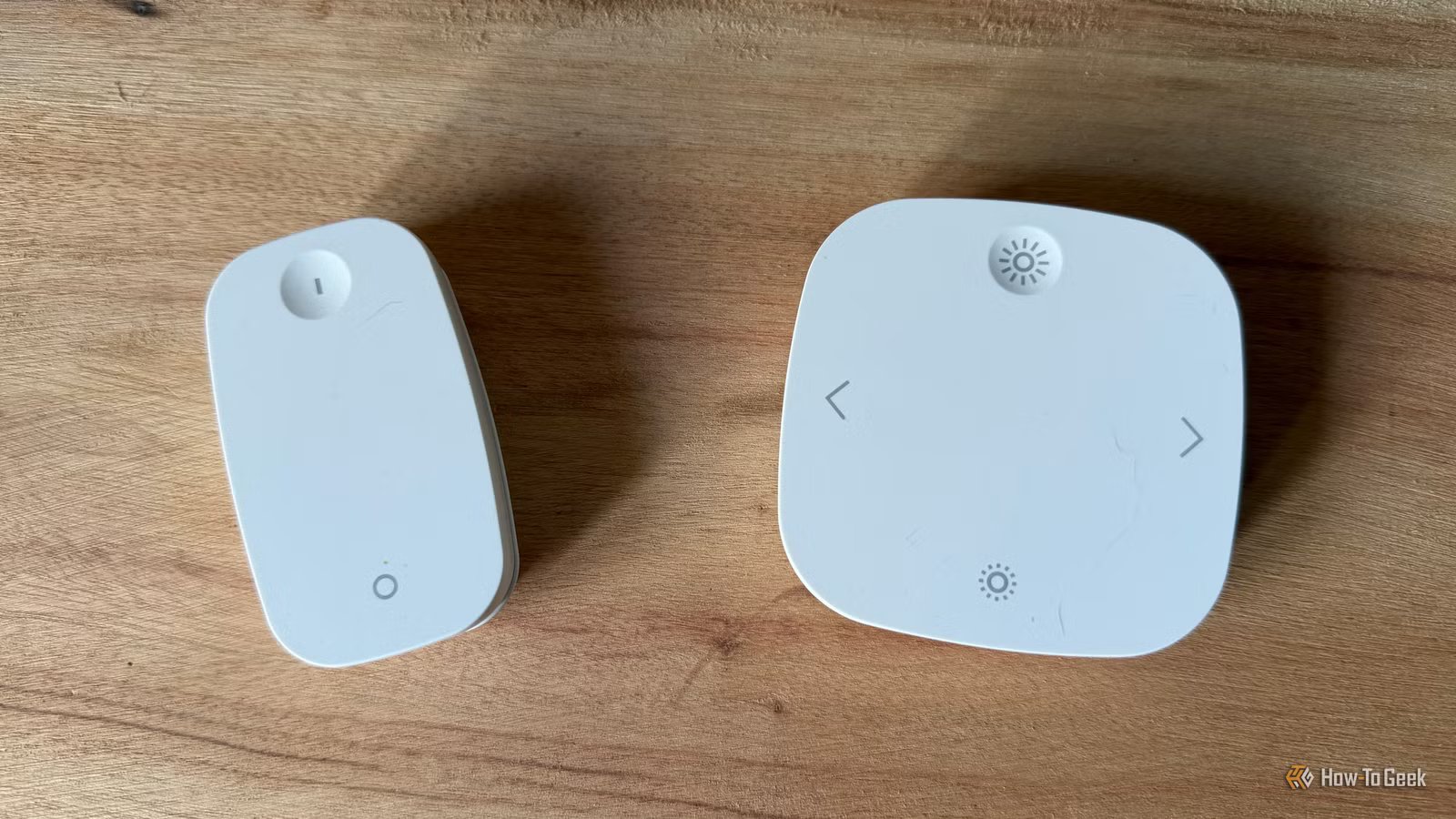
Smart buttons and remotes are battery-powered wireless devices that are perfect for very specific tasks, like turning on those dimmable bedroom lights. Use them to trigger goodnight routines that switch off every smart device in your house, so you don’t have to do it manually. Use a remote to adjust the overhead fan or trigger a dehumidifier without having to get up.
Many of these devices support multiple inputs like single presses, double taps, or long-presses, so you can assign a range of different automations to them. I’m of the opinion that every smart home needs a few remotes and wireless buttons, even if they just bridge gaps for your guests.
Dimensions (exterior)
51 x 29 x 8mm
Compatibility
Android, iOS
Flic Duo is a smart home controller that can serve either as a fixed button or a portable remote. It integrates with smart home devices via Matter or third-party smart home platforms, allowing you to control lights, music, fans, and more. The top button includes swipe and rotation gestures intended for granular controls like dimming lights or adjusting volume.
Credit: Tim Brookes / How-To Geek
Contact sensors are two-part battery-powered accessories that use magnets to detect open and closed states. They’re absolutely perfect for triggering lighting in dark cupboards, since the light will remain on for as long as the sensor registers an open state. Motion sensors can work for this too, but they must continually detect motion for the light to remain on.
They’re small enough that you can hide them inside the cupboard, and you can link them to as many different lights as you like.
A bed occupancy sensor
Credit: Elevated Sensors
The bed occupancy sensor is one of the weirder smart home sensors I’ve seen, but it’s perfect if you’re one of those people who must automate your entire life. As the name suggests, this sensor works out whether or not you are in bed by detecting pressure levels. You can then use this information as a trigger for other automations, or simply gather data about how many hours you spend lying in bed in a year.
Conditions are going to be important here, since you probably don’t want to trigger a sequence of events if you get out of bed for a few minutes in the night. So you could get this sensor to trigger your coffee machine if it detects a change in state after 7 am, or only raise the blinds fully in your bedroom if you’ve been out of bed for a full five minutes.
A smart speaker
Credit: Adam Davidson/How-To Geek
There are way more uses for a smart speaker in the bedroom than you might have considered. For anyone looking to leave their smartphone out of the bedroom to foster an environment that’s more conducive to sleeping, a smart speaker lets you still issue commands and turn things on and off.
Beyond this, you can fall asleep to soothing sounds, wake to your chosen music or a blaring alarm, set the thermostat or control fans with your voice, or just ask for a morning briefing before you get out of bed.
A dedicated temperature sensor
Credit: Aqara
If you have a central air cooling system, having temperature (and humidity) sensors around your home can allow for far more precise control. For example, you might only want to heat or cool your bedroom at night to save money, but you shouldn’t rely on the sensor in your living room to do so.
Most of these sensors work best with Home Assistant, since you can build far more complex automations.
