

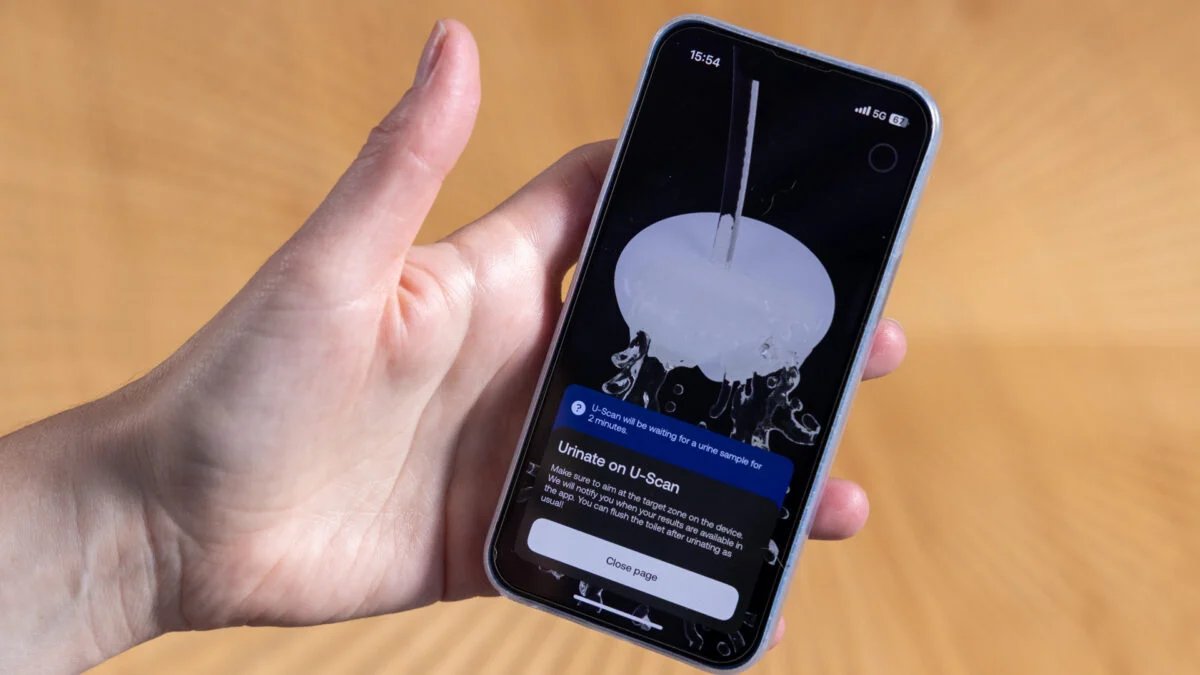
There will come a point when we’ve gone too far with health tracking. One could argue we have already arrived, but sometimes we really need to overindulge to rein ourselves in. Case in point: we can now analyze our urine anytime we want, from the comfort of our own toilets.
In November, Withings released its long-awaited U-Scan: a home monitoring system for your urine. The gadget resembles an artificial seashell that sits inside your toilet. When prompted, it collects a bit of urine that flows over it as you pee and analyzes it for various elements like pH and calcium.
Withings U-Scan
Do most healthy people need a urine tracker? Absolutely not. Was the Withings U-Scan fun and enlightening? Absolutely yes.
- Fun and addictive
- Rewarding to see your levels improve
- Relatively easy setup and very easy to use
- Unclear how useful it is for healthy people
- You have to explain it to people who use your toilet
- Expensive
I can’t think of a single person who enjoys providing a urine sample at the doctor’s office, myself included. So I was completely unenthusiastic about testing the $380 U-Scan, if I’m being honest. For whatever reason, the concept of collecting details about my urine is way less exciting than knowing how many hours of sleep I had the night before, or how many steps I took, or how high my heart rate got on my run that morning. Despite all this dread, though, I somehow surprised myself. Analyzing my urine for a few weeks turned out to be somewhat surprisingly fun. And it’s nothing like peeing in a cup inside a cold doctor’s office bathroom.
Yes, it sits inside your toilet
© Raymond Wong / Gizmodo
Withings first debuted the U-Scan back at CES in 2023, so it’s taken the company a few years to perfect.
The hockey puck-sized (or large seashell) device opens up to reveal a compartment for a removable cartridge. Right now, there are two cartridges available. The first, called the Nutrio, focuses on components of your urine that reflect your body’s overall nutrition. It checks your urine pH, its specific gravity, ketones, and your current level of vitamin C. The second, called the Calci, also tracks your urine’s pH and specific gravity, but it additionally checks your calcium levels. This test focuses on your body’s overall kidney functioning.
The U-Scan comes in four different versions. First, you can choose either the Proactive Package or the Intensive Package. Both of them include the U-Scan reader, but the Proactive Package comes with just one cartridge, while the Intensive Package comes with two cartridges. Then, you can choose whether you want the Calci or the Nutrio. The Proactive package (with either test) will cost you $380, while the Intensive package will reach $450. Each cartridge contains 22 urine tests. With the Proactive package, your renewal cartridge is delivered every two to three months for $100 each renewal cycle. With the Intensive Package, you’ll get a renewal delivery (of two cartridges) every two to three months for $180 each. For my testing purposes, I chose the Nutrio cartridge.
Installing the device on your toilet is equal parts easy and difficult. The main difficult part is literally getting the U-Scan open to install the cartridge. Because it is going to literally sit inside your toilet, where lots of liquid is spraying everywhere, the scanner must be sealed shut. Withings does this by using a sort of twisting method where you have to hold the palms of your hands on both sides of the device and twist it open and shut. Unless you are a devoted rock climber with the finger and wrist muscles to prove it or a chef who twists open difficult jars on a regular basis, it’s likely that you will have difficulty with this step. I eventually got the U-Scan open, but it took a lot of feeling silly and confused. However, once I figured out the signature twist, I could usually reliably get it open anytime I wanted (which was literally twice).
Once unsealed, the U-Scan has an empty place for where the cartridge sits, and it clips in fairly easily. Then you have to reseal the device (equally as hard as unsealing it) and clip it to your toilet. Withings provides three clip sizes; my toilet turned out to be medium-sized. All in all, the installation process was fairly routine, albeit a bit weird.
Why urine?!
© Raymond Wong / Gizmodo
The logical next step is to pee on the U-Scan, which is even simpler than it sounds. Inside the Withings app, you click on the “Launch a measurement” feature. You’ll quickly hear the device power up, and then you have about a two-minute window to pee like you normally would. As this is happening, the U-Scan has a thermal sensor that detects the presence of urine via a temperature meter (urine is much warmer than toilet water). Once it detects urine, the U-Scan has a pumping system that pulls urine inside it via a microfluidic channel, which manipulates the flow of liquid through pumps whose diameter is often smaller than a human hair. The tiny channels move the urine along to the testing area.
Once there, according to Withings, a needle injects the sample onto a colorimetric test strip, which changes colors based on various chemical reactions. A built-in LED plus a proprietary algorithm analyzes any color changes that help determine things like pH and vitamin C levels, among other things. Within a few minutes, your urine analysis will pop up within the Withings app.
© Raymond Wong / Gizmodo
Okay, but why? From a medical perspective, urine is actually full of surprises. Urine testing has one of the longest continuous histories in medicine. That’s mainly because it is easy to collect and reflects many body processes. In fact, during medieval times, ancient physicians would literally taste urine, knowing that sweet-tasting urine often meant that their patient had diabetes. Thankfully, this practice ended in the 1700s.
Today, though, there are so many things we can check with a simple urine test. The U-Scan focuses on a few main ones, including the pH of your urine, its specific gravity, the calcium level, and the presence of ketones.
© Raymond Wong / Gizmodo
When I tested the device, I did it about once a day (as recommended by Withings) and tried to do it at the same time every day as well (often first thing in the morning). For the most part, my readings were within the normal range, but randomly they’d be a bit off, particularly my pH, the level of vitamin C, or my calculated hydration status. If I got a result like that, I would just focus on eating more vegetables over the next couple of days or drinking more water. Often, though, my results would return to normal even if I didn’t do any of those things.
© Raymond Wong / Gizmodo
And that’s where the utility of the U-Scan gets a bit wonky for me. Unless you have a diagnosed condition, like diabetes or kidney disease, that you are monitoring (hopefully with the help of a doctor!), it’s unclear how well the U-Scan will improve your health. I can see an extremely healthy person overly obsessing over every single pH or vitamin C reading without those one-off readings having any actionable effect on their health.
How does it stay clean?
The U-Scan comes with a cleaning and charging station (it charges via a USB-C port). According to Withings, the battery life can last up to three months on a full charge, but could be significantly less (only about a month) if you use it frequently. Withings claims that with every toilet flush, the U-Scan should stay clean. However, it also comes with a deep cleaning detergent that you can use inside the station (you’ll need to remove the cartridge first).
Will it become a permanent feature on my toilet?
© Raymond Wong / Gizmodo
The U-Scan seems designed—or at least currently marketed—for health-obsessed yet overtly healthy people. For instance, anytime that my urine reading told me that my hydration level was low, I would make a point to drink water throughout my day, and the next day the reading would be back to normal. It made me feel awesome, yes, but do I need a $400 device that measures my urine every morning to remember that hydrating on the regular is good for my health? Probably not.
On the other hand, I can see the U-Scan having a ton of potential for people with conditions like diabetes or kidney disease, where urine readings for ketones or protein are incredibly important for monitoring their condition. And while there are other devices out there that can test your urine, most of them utilize physical test strips. There doesn’t yet seem to be another device like the U-Scan that attaches directly to the toilet and contains the testing technology inside the device itself. I don’t want to overall dismiss the concept of an at-home urine analyzer, however, even for healthy people. But I think it needs more work on what you are testing and why, and how to use the data it spits out to you.
