

I do a lot of photography and videography, and those files can take up a lot of storage. I used to just store the footage and photos on my laptop’s internal storage, moving it to the NAS only when needed. Now, I just back up the footage to my NAS first and work from there, and that workflow is so much better. Here’s how I automatically back up my SD card to my NAS, and how you can too.
My NAS has a built-in auto copy feature for one-click importing
Dedicated hardware makes backing up my SD card simple.
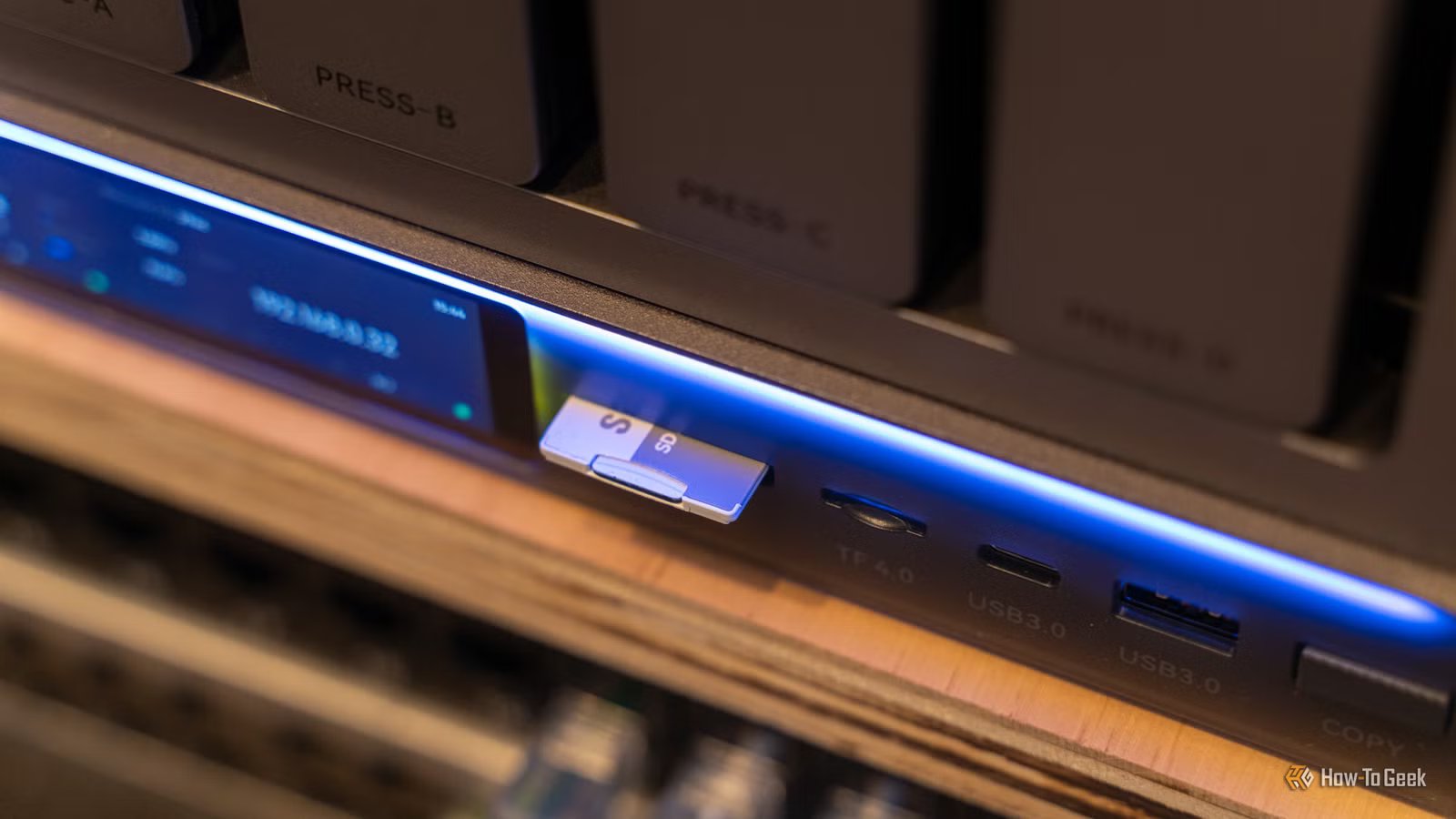
I recently deployed a new NAS in my homelab—the Zettlab D4. This AI-focused NAS has a lot of unique features (and some quirks), but one of the nicest functions is the built-in SD and microSD card slots on the front.
On my Zettlab D4, there’s a built-in app called Cocard that I have set up for the automation. I’ve got it programmed so that whenever I insert a SD or microSD card, I can just click the copy button on the front of my NAS and it will look for new files then copy those files to a specific folder on the NAS.
This type of setup makes it extremely simple to back up my SD cards. I don’t have to try and create new folders, drag and drop anything, or use any type of UI. It’s quick and painless, and then the copy is done, it ejects the SD card so I can unplug it safely.
Being able to easily copy my photos or videos to the NAS is actually really nice as it increases my productivity quite a bit. I have my NAS mounted to my MacBook Pro over 2.5Gb/s Ethernet and access my photos library from the NAS, so this helps to further automate my workflow.
However, if you don’t have the Zettlab D4 NAS like I do, as it’s fairly new, you can still easily set your SD card up to automatically back up to your NAS.
Other NAS systems offer similar functionality with a bit more setup required
While the process might be different, the result is the same.
Credit: Jordan Gloor / How-To Geek
My Zettlab D4 with a built-in SD card slot is somewhat of an outlier in the NAS realm, but other brands feature similar capabilities if you’re willing to put in a bit more effort.
For example, Synology NAS servers might not have a built-in SD slot, but you can achieve the same functionality by plugging in a USB to SD card reader into any of the USB ports. Once you have the SD adapter plugged up, install USB Copy from the Synology app store. This app allows you to configure the storage server to automatically back up your SD cards once they’re inserted—no button press required.
QNAP network attached storage servers have a similar function to Synology, with the built-in Hybrid Backup Sync (HBS 3) tool. Just make sure you have the USB to SD card reader plugged into a USB port and configure the backup job to move the files wherever you want.
Other NAS systems likely have similar plugins, so if you be sure to check your storage server’s capabilities to see if functionality like this is either baked-in or available to install.
7/10
Brand
Synology
CPU
Intel Celeron J4125
This four-bay NAS works great for home and small office use, and it comes with a three-year warranty from Synology.
You can set up just about any NAS to do the same
Just because it’s not built-in doesn’t make it difficult.
Not every NAS has built-in capabilities to automatically back up SD cards though, and yours might fall into that list. That’s totally fine, as there’s a totally different approach you can take, and it starts at your computer.
Those on Macs can check out Hazel, a piece of software from Noodlesoft. The way Hazel works is by monitoring the folders that you tell it. If your SD cards have a fixed naming schema, then that makes this method work super well.
Essentially, you tell Hazel to watch /Volumes for a folder named whatever your SD card (or cards) are called. Whenever Hazel sees that folder in /Volumes, you can set it up to automatically copy the files to a mounted network drive.
Related
This Open-Source App Is My Favorite Way to Back Up My Windows 11 PC
Don’t lose your essential data.
Those on Windows (or macOS, actually) can use FreeFileSync with the RealTimeSync plugin. This setup works similarly to Hazel but with a few more steps. To start with, use FreeFileSync to create a batch job that backs up your SD card’s root folder to your mounted network drive. Then, open up RealTimeSync and drag your SD card’s root folder into the monitored folders list. After that, set the command to run to the batch file that you build with FreeFileSync.
Now, whenever RealTimeSync sees the SD card mounted, it will automatically back up the contents to your NAS without you have to click a single button.
Backing up an SD card to a NAS is an extremely beneficial thing to do, and if you aren’t doing it, you should start. The RAID array on any NAS offers redundancy backups to help from losing files, and it’s also possible to have a NAS backed up to the cloud.
For me, storing my SD card’s files on the NAS allows me to work on video or photo projects from anywhere in my house, not just at my desk. It’s extremely nice to be able to be in my workshop with a long laser project running and just grab the footage from a video shoot from the NAS and start editing.
If you’re not automatically backing up your SD cards to your NAS, you should start, it’s not that difficult to set up.
