

Why you can trust Android Central
Our expert reviewers spend hours testing and comparing products and services so you can choose the best for you. Find out more about how we test.
The Redmi Note 15 might be the clearest example yet of how Xiaomi is trying to fix its once-iconic mid-range lineup, but doing so at a frustratingly slow pace. I’ve been using the Redmi Note 15 for more than a week now, and there are so many moments when it feels like Xiaomi is listening again. But then there are moments when it reminds you why the Redmi Note name has lost some of its shine over the past few years.
Xiaomi’s Redmi Note series was once an easy recommendation in the mid-range smartphone space, but that reputation began to slip a few generations ago, particularly around the Redmi Note 11 Pro, which our Senior Editor Harish Jonnalagadda described as a “poor showing for the category.” Since then, Xiaomi has struggled to consistently deliver the kind of value that made the series iconic in the first place.
Redmi Note 15: Price and availability
(Image credit: Sanuj Bhatia / Android Central)
Xiaomi introduced the Redmi Note 15 first in its home market of China in August 2025, then rolled it out to global markets on December 18, 2025, followed by a launch in India on January 6, 2026.
The Redmi Note 15 is available in both 4G and 5G variants, which is somewhat unusual for a smartphone in 2026 since most brands have shifted entirely to 5G. That said, the Redmi Note 15 5G comes in 128GB and 256GB storage options. While Xiaomi has introduced 6GB RAM variants in some global markets, both the 128GB and 256GB models sold in India ship with 8GB of RAM.
The Redmi Note 15 starts at INR 22,999/€279, while the 8GB/256GB variant is priced at INR 24,999/€299. All models also include a microSD card slot shared with the SIM tray, allowing storage expansion of up to 1TB.
Swipe to scroll horizontallySpecifications
Category
Xiaomi Redmi Note 15 5G
OS
HyperOS 2 (Android 15)
Display
6.77-inch, AMOLED, 3200 nits peak brightness (800 nits in high brightness mode), 120Hz, 2392 × 1080 pixels, 3840Hz PWM dimming
Chipset
Qualcomm Snapdragon 6 Gen 3, Adreno 710, 4nm
RAM
8GB
Storage
128GB / 256GB
Expandable up to 1TB via microSD card
Rear cameras
108MP, f/1.7 (primary) + 8MP, f/2.2 (ultra-wide)
Front camera
20MP, f/2.2
Ingress protection
IP65 + IP66 dust and water resistance
Connectivity
5G, Wi-Fi, Bluetooth 5.1, NFC, IR blaster
Security
Under-display fingerprint sensor, Face unlock, PIN, Pattern, Password
Battery
5,520 mAh
Charging
45W USB-C fast wired charging
Dimensions
164 X 75.42 X 7.35 mm
Weight: 178g
Colors
Black, Glacier Blue, Mist Purple
Redmi Note 15: What I like
(Image credit: Sanuj Bhatia / Android Central)
While brands like Samsung appear to have stepped away from slim smartphones with the rumored cancellation of the Galaxy S26 Edge, other Android brands are still willing to experiment with the form factor. And that becomes immediately obvious the moment you take the Redmi Note 15 out of the box.
At 7.35mm, the Redmi Note 15 isn’t as thin as other “slim” smartphones, but it is noticeably slimmer than traditional flagships like the Pixel 10 Pro or the OnePlus 15, both of which measure over 8mm.
(Image credit: Sanuj Bhatia / Android Central)
The Redmi Note 15 manages this while staying light at just 178g and still packing a sizeable battery. Much of this is made possible by Xiaomi adopting silicon-carbon battery technology, while some other brands are still taking their time to implement it.
That low weight largely comes from the phone’s plastic build, which can feel a bit cheap at times. That said, given the pricing, I find it’s a reasonable compromise.
(Image credit: Sanuj Bhatia / Android Central)
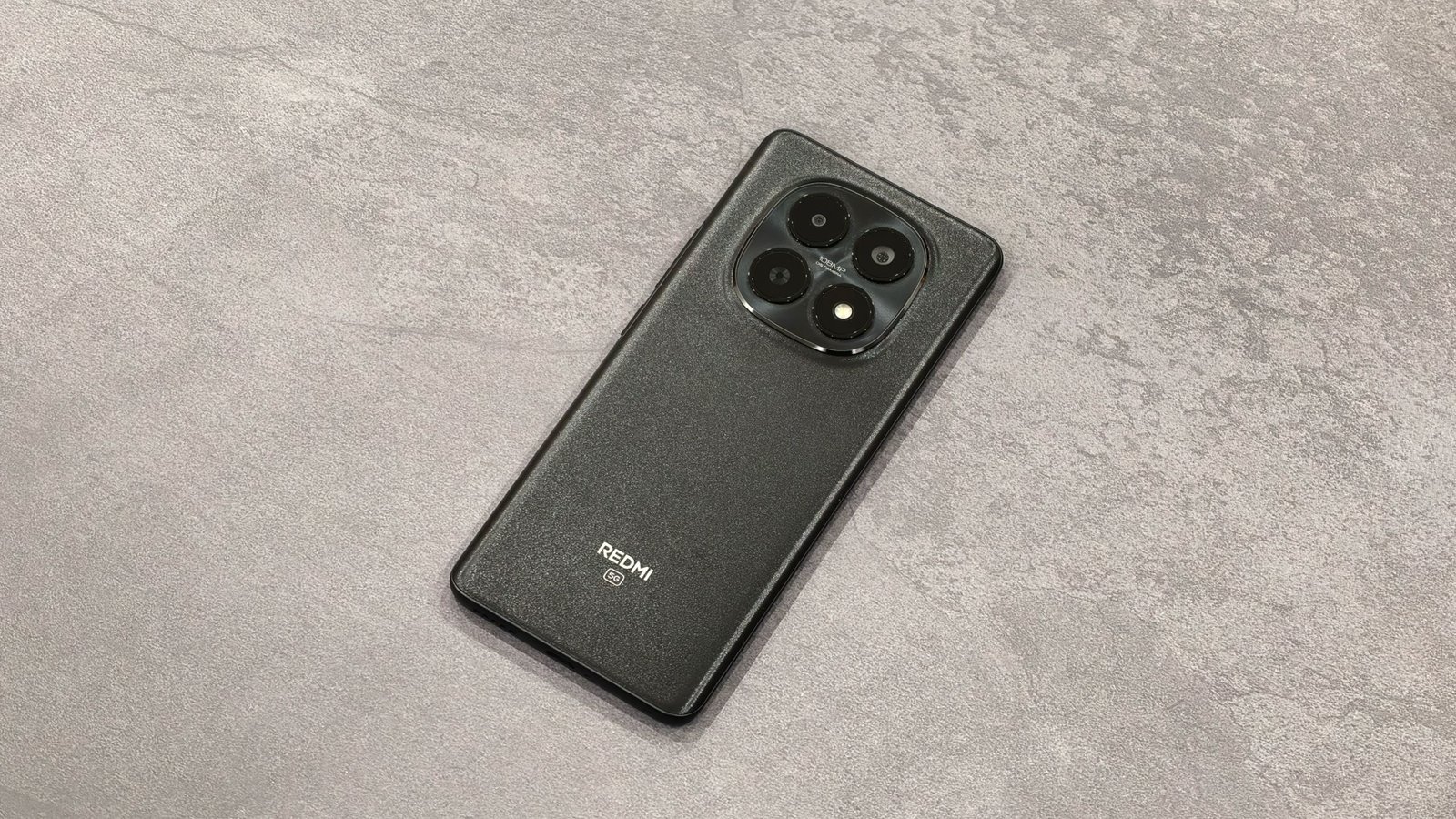
Design-wise, the Redmi Note 15 looks like a fairly standard budget Xiaomi device, with rounded edges and curved glass, something that is becoming less common on smartphones today. The rear features a squarish camera module that misleadingly appears to house three sensors, but actually includes just two cameras.
What doesn’t feel cheap, however, is the display up front. The Redmi Note 15 ships with a large 6.67-inch AMOLED panel that is easily one of the best I have seen in this segment. It supports a 120Hz refresh rate and reaches up to 3,200 nits of peak brightness.
(Image credit: Sanuj Bhatia / Android Central)
While many smartphones in this price range still have thick bezels, Xiaomi has done a solid job keeping them to a minimum. The AMOLED panel delivers vibrant colors, good viewing angles, and a consistently pleasant experience in daily use. The under-display fingerprint sensor is also reliable and works well.
There were plenty of things that impressed me about the Redmi Note 15, but the most Note-worthy is its battery. For a phone this thin and light, it packs a sizeable 5,520 mAh battery and supports up to 45W fast charging. While it cannot match devices like the OnePlus 15R or Oppo Find X9 Pro, which come with much larger batteries, I had no trouble getting through a full day on a single charge, even on 5G.
There is also support for 18W wireless charging, which is rare in this segment, and Xiaomi still includes a charger in the box, something other brands could learn from.
(Image credit: Sanuj Bhatia / Android Central)
The primary camera is quite impressive. It is the first smartphone to use Samsung’s ISOCELL HM9 sensor, which was developed in collaboration with Xiaomi. The result is strong performance in good lighting, with the camera delivering consistently solid shots in broad daylight.
Photos look sharp and detailed, with colors that lean slightly bright without feeling unnatural. The 108MP sensor also enables up to 3x lossless zoom via sensor cropping, helping compensate for the lack of a dedicated telephoto camera. Low-light performance does take a hit, with the processor pushing noise reduction a bit too far to recover lost detail, but that is fairly typical behavior for large sensors in this segment.
Image 1 of 6
(Image credit: Sanuj Bhatia / Android Central)(Image credit: Sanuj Bhatia / Android Central)(Image credit: Sanuj Bhatia / Android Central)(Image credit: Sanuj Bhatia / Android Central)(Image credit: Sanuj Bhatia / Android Central)(Image credit: Sanuj Bhatia / Android Central)
One last positive worth mentioning about the Redmi Note 15 is expandable storage. At a time when most phones have dropped microSD support, and brands usually push users toward purchasing cloud storage, the Redmi Note 15 still includes a dedicated SD card slot. It is shared with the secondary SIM slot, but it allows storage expansion of up to 1TB.
Redmi Note 15: What I don’t like
(Image credit: Sanuj Bhatia / Android Central)
After using the Redmi Note 15 for the past week, the biggest issue for me, and arguably the most important part of a smartphone, is the processor. The phone is powered by the Snapdragon 6 Gen 3, which is neither the latest nor the most capable chipset, and that clearly shows in day-to-day performance.
This is by no means a gaming smartphone, and some sluggishness is expected at this price point. However, the Snapdragon 6 Gen 3 struggles even with basic daily tasks. There are frequent hiccups when switching between apps or even returning to the home screen after applying a wallpaper, which makes the experience feel unnecessarily slow.
Part of this sluggishness also stems from the software. We are in 2026, yet the Redmi Note 15 ships with Android 15 out of the box, running Xiaomi’s HyperOS 2 skin. Xiaomi says Android 16-based HyperOS 3 is coming soon, but launching a new phone with software that is already over a year old feels unacceptable.
(Image credit: Sanuj Bhatia / Android Central)
And even though Xiaomi is promising four years of OS updates for the Redmi Note 15, starting a year behind effectively means users will realistically get only three meaningful Android updates.
The software itself is heavily customized across almost every interface element. This adds extra strain to an already-average processor and further contributes to performance issues. On top of that, there is still a noticeable amount of pre-installed bloatware out of the box, giving the chipset even more to deal with from day one.
It would help significantly if Xiaomi toned down some of its software features on lower-end devices, but the company continues to miss the mark. Running Geekbench 6 on the Redmi Note 15 only reinforced this, with the phone turning out to be one of the slowest devices in its price range. Spending as little as INR 3,000 (about $30) more can get you noticeably better-performing alternatives.
Swipe to scroll horizontallyGeekbench 6 benchmark results
Smartphone
Price
Single-core
Multi-core
Redmi Note 15
INR 22,999 / $255
1,014
2,894
Nothing Phone 3a
INR 24,999 / $275
1,208
3,325
OnePlus Nord CE5
INR 24,999 / $275
1,309
3,884
There are also a few smaller issues worth mentioning, such as the ultrawide camera, which is underwhelming and feels more like a checkbox feature than something genuinely useful. There is also a downgrade in glass protection compared to last year’s Note 14, moving from Gorilla Glass 5 to Xiaomi’s in-house solution, though I did not encounter any immediate durability issues.
Redmi Note 15: Competition
(Image credit: Brady Snyder / Android Central)
Nothing Phone 3a remains one of the best budget smartphones available. It offers a more distinctive design than the Redmi Note 15, along with a noticeably more powerful processor and a newer version of Android that stays closer to stock. It also includes a telephoto zoom camera, which can be genuinely useful at times.
OnePlus’ Nord CE5 is another strong option, delivering solid performance while retaining the convenience of a microSD card slot. If you prefer Xiaomi phones and MIUI, the year-old Poco X7 Pro is still worth considering, offering a larger battery, better ingress protection, and a more powerful processor overall.
Redmi Note 15: Should you buy it?
(Image credit: Sanuj Bhatia / Android Central)
You should buy this if…
- You want a budget smartphone with a great display.
- You want a slim, lightweight phone with a big battery and fast charging.
- You are fine running an older version of Android.
You shouldn’t buy this if…
- You care about consistently lag-free day-to-day performance.
- You can spend more for a noticeably better smartphone.
- You want a phone that will comfortably last several years.
The Redmi Note 15 shows glimpses of what Xiaomi still gets right. The display, build quality, and battery life are genuinely impressive for the price, and the cameras are fairly decent as well. Unfortunately, inconsistent day-to-day performance and outdated software hold it back from being a true standout in the budget segment.
You can find better-looking, more performant alternatives at this price point, but if you value a sleek design and low weight, the Redmi Note 15 remains a great option. It would be an even better choice if Xiaomi addressed the software experience.
Solid specs for the price
The Redmi Note 15 5G feels like a proper comeback for Xiaomi in the lower-end mid-range category. It nails the basics, delivering a great display and strong battery life, while remaining slim and lightweight. While the software is not the newest, the overall feature set makes up for it.
