

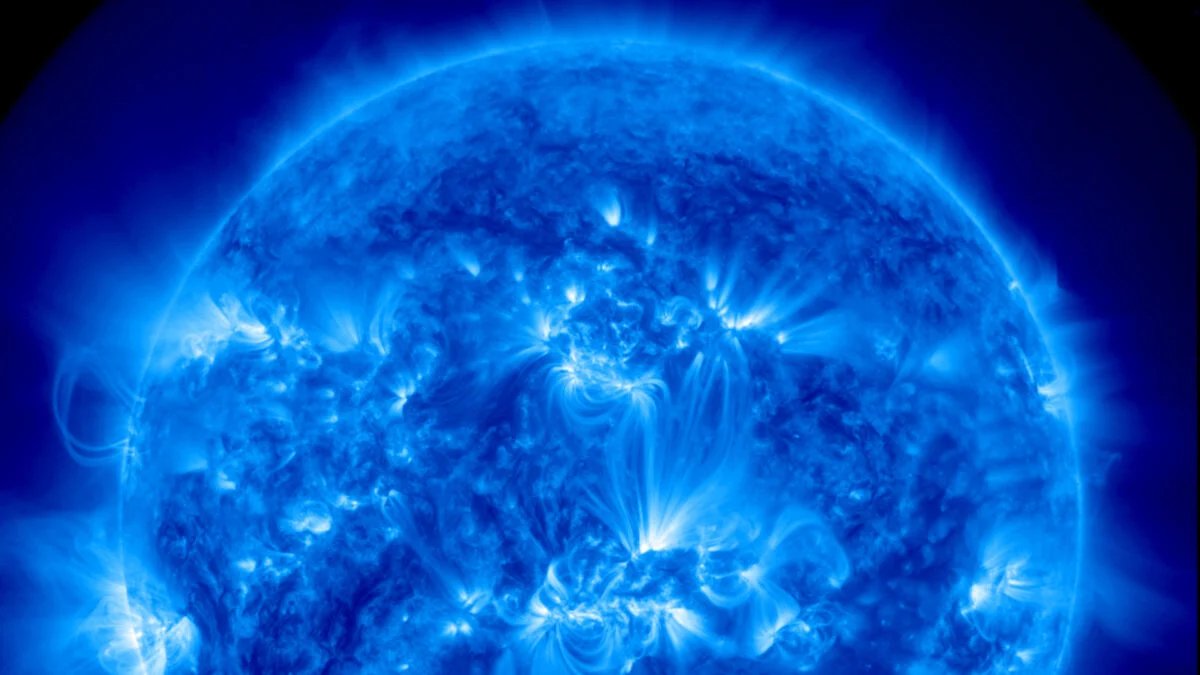
The Sun released a slew of fast-moving, intense charged particles in Earth’s direction, resulting in the largest solar radiation storm to hit our planet since 2003.
The National Oceanic and Atmospheric Administration’s Space Weather Prediction Center (SWPC) is actively monitoring the severe solar radiation storm. Charged particles, released by the Sun, reached Earth on Monday, resulting in a solar storm ranked 4 out of 5 on a severity scale.
“An S4 severe solar radiation storm is now in progress—this is the largest solar radiation storm in over 20 years,” SWPC declared on X. The storm is still ongoing, with a potential impact on space launches, satellite operations, and aviation.
Storm watch
A solar radiation storm occurs when the Sun releases a barrage of charged particles aimed at Earth. These particles are accelerated by processes at or near the Sun and travel at exceptional speeds. If enough of them reach Earth at once, a solar radiation storm results.
Once those particles reach Earth, they increase radiation exposure risks for astronauts in orbit and for passengers on commercial flights traveling polar routes. S4-magnitude storms can last for days, though they typically weaken over time.
© NOAA
Solar radiation storms of this strength are rare, according to SWPC. The last time an S4 solar storm struck Earth was in October 2003, resulting in power outages in Sweden and damage to power transformers in South Africa.
SWPC will continue to monitor the storm to keep NASA, the Federal Aviation Administration, and other agencies informed of potential risks. During periods of increased radiation risk, astronauts aboard the International Space Station are instructed to stay in better-shielded areas of the spacecraft.
Wild star
The Sun is having quite the week. On Monday, a severe geomagnetic storm also reached Earth, resulting in stunning displays of aurorae across the skies from Germany to the southwestern United States.
Unlike a solar radiation storm, a geomagnetic storm is triggered by the arrival of a coronal mass ejection (CME)—a violent eruption of plasma from the Sun. The most recent storm was triggered by a CME that struck Earth’s magnetic field at 2:38 p.m. ET on January 19. Storm conditions reached a level of G4 in severity.
Our host star goes through an 11-year cycle, varying in the intensity of its activity. The Sun is currently experiencing solar maximum, a period marked by an increased number of CMEs, solar flares, and charged particles erupting from the star.
On May 10, 2024, a G5, or extreme geomagnetic storm, struck Earth as a result of large expulsions of plasma from the Sun’s corona. The G5 storm affected Earth’s power grid while stirring up some spectacular auroras seen across much of the globe. The storm also increased atmospheric density in low Earth orbit by up to an order of magnitude, which in turn caused atmospheric drag that affected satellites.
