

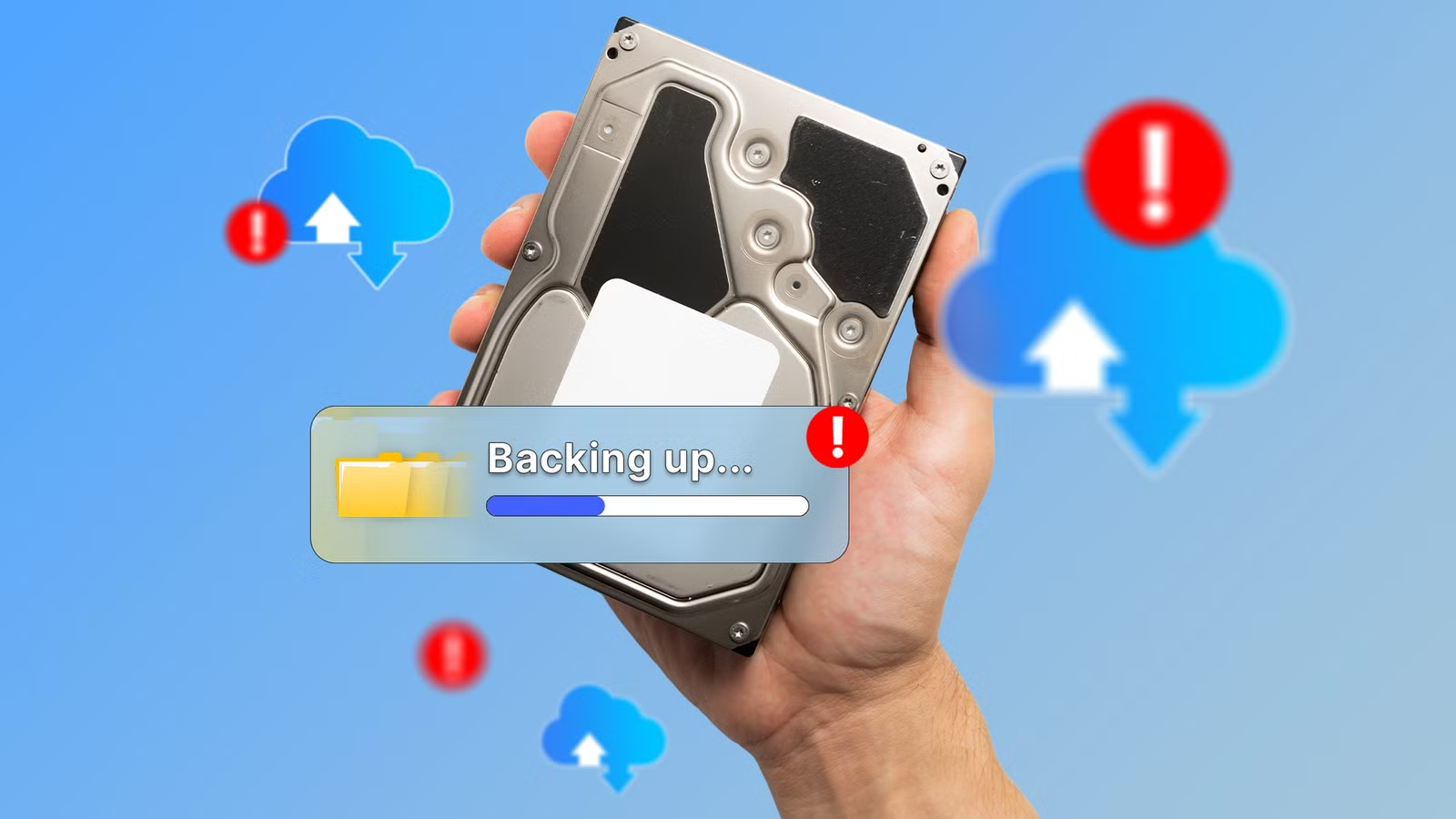
Cloud storage can get costly, so an alternative for many people is to just grab any important memories and store them in a hard drive to revisit in the future.
Sadly, though, this is a bad idea—and if you’re doing this, you’ll probably want to get that drive spinning as soon as possible. Enter the concept of bit rot: the silent killer for your precious photos and videos and, frankly, any file you might have on that old drive filled with dust.
What’s bit rot?
Credit: Patrick Campanale / How-To Geek
At its most fundamental level, bit rot—formally known as data degradation or data decay—is how we call the gradual decay of storage media and the subsequent corruption of the information residing on it. Remember that, even as technology has progressed, data ultimately still exists and is stored as binary code, consisting of zeros and ones. The way a hard drive works is that these bits are recorded by magnetizing tiny, microscopic sectors on a spinning platter. A north pole might represent a one, while a south pole represents a zero.
Over time, these magnetic domains can lose their orientation due to the natural tendency of magnetic polarity to disperse, a process often accelerated by environmental factors. When a bit flips—changing from a zero to a one or vice versa—without the operating system explicitly commanding that change, bit rot has occurred. And a teeny tiny bit flip can have catastrophic consequences.
This is pretty dangerous because it’s a silent process. Unlike a catastrophic drive failure where the mechanical arm breaks or the motor burns out, bit rot happens at the molecular level. It’s physics. The file system may still show the file as existing, occupying the correct amount of space, and retaining its original creation date. However, the internal structure of the file has fundamentally changed, all because of that one changed bit. If the rot affects a non-critical part of a text file, you might just see a random character appear in a sentence. However, if that flipped bit resides in the header of a photo file or the keyframe of a video, the entire file can become unreadable. The computer attempts to open the image, encounters code that no longer makes sense, and simply displays an error message or a corrupted, pixelated mess. It is the digital equivalent of ink fading on a page until the words are no longer legible, occurring entirely without your knowledge until you attempt to access the memory years later.
How common is it?
Credit: Patrick Campanale / How-To Geek
The prevalence of bit rot is widely misunderstood because it is often confused with total hardware failure, yet it is a nearly inevitable occurrence given a long enough timeline. It is not a question of if a storage medium will degrade, but rather when.
In the context of magnetic hard drives, which are the most common medium for long-term storage of old photos, the magnetic signature required to hold data is not permanent. While modern error-correcting code (ECC) built into hard drives is designed to catch and fix these minor errors as they happen, this defense mechanism requires the drive to be powered on and reading the data. When a drive sits in a drawer disconnected from power for years, the error correction systems are dormant, allowing the gradual magnetic decay to accumulate unchecked. This is why this happens to old, unplugged drives after years without use, and not drives that are constantly running.
The frequency of this decay relies heavily on the quality of the drive and the environment in which it is stored. High heat and humidity are the primary accelerators of bit rot. In a hot attic or a damp basement, the chemical breakdown of the drive’s protective layers and the thermal agitation of the magnetic particles speed up the loss of data significantly.
This is not exclusive to spinning hard drives. SSDs, which store data using electrical charges in floating-gate transistors, might actually be even more prone to data loss when left unpowered. The electrical charge leaks out over time, leading to data corruption much faster than magnetic decay in traditional drives.
While cosmic rays and background radiation can statistically cause bit flips, the most common culprit is simply the entropy of the physical materials. Every hard drive sitting in a closet right now is slowly undergoing this process.
Should I worry about it?
Credit: Corbin Davenport / How-To Geek
If your goal is to preserve a digital family album for decades, bit rot is absolutely a cause for concern, specifically because of the passive way most people treat archival storage. The “set it and forget it” mentality is the single greatest risk factor for digital photos. Many users treat hard drives like time capsules, burying them in a box with the expectation of digging them up twenty years later to find everything pristine. Please don’t do this. Digital storage media is not archival in the same way that acid-free paper or stone tablets are. It requires active maintenance.
If you rely on a single external hard drive that hasn’t been plugged in since 2015, there is a statistically significant chance that some of those files have already suffered corruption.
A “perfect” hard drive that’s not subject to bit rot doesn’t exist, so what are your solutions for archival? It’s wise to maintain multiple copies on different media types and to periodically check them. This is often referred to as data scrubbing, where files are read and verified against checksums to ensure integrity.
If you don’t want to do that, or you can’t, then simply powering on their archive drives once or twice a year and ensuring the files open correctly can allow the drive’s firmware to refresh the data. Just don’t keep it unplugged for years on end and expect it to be completely fine.
