

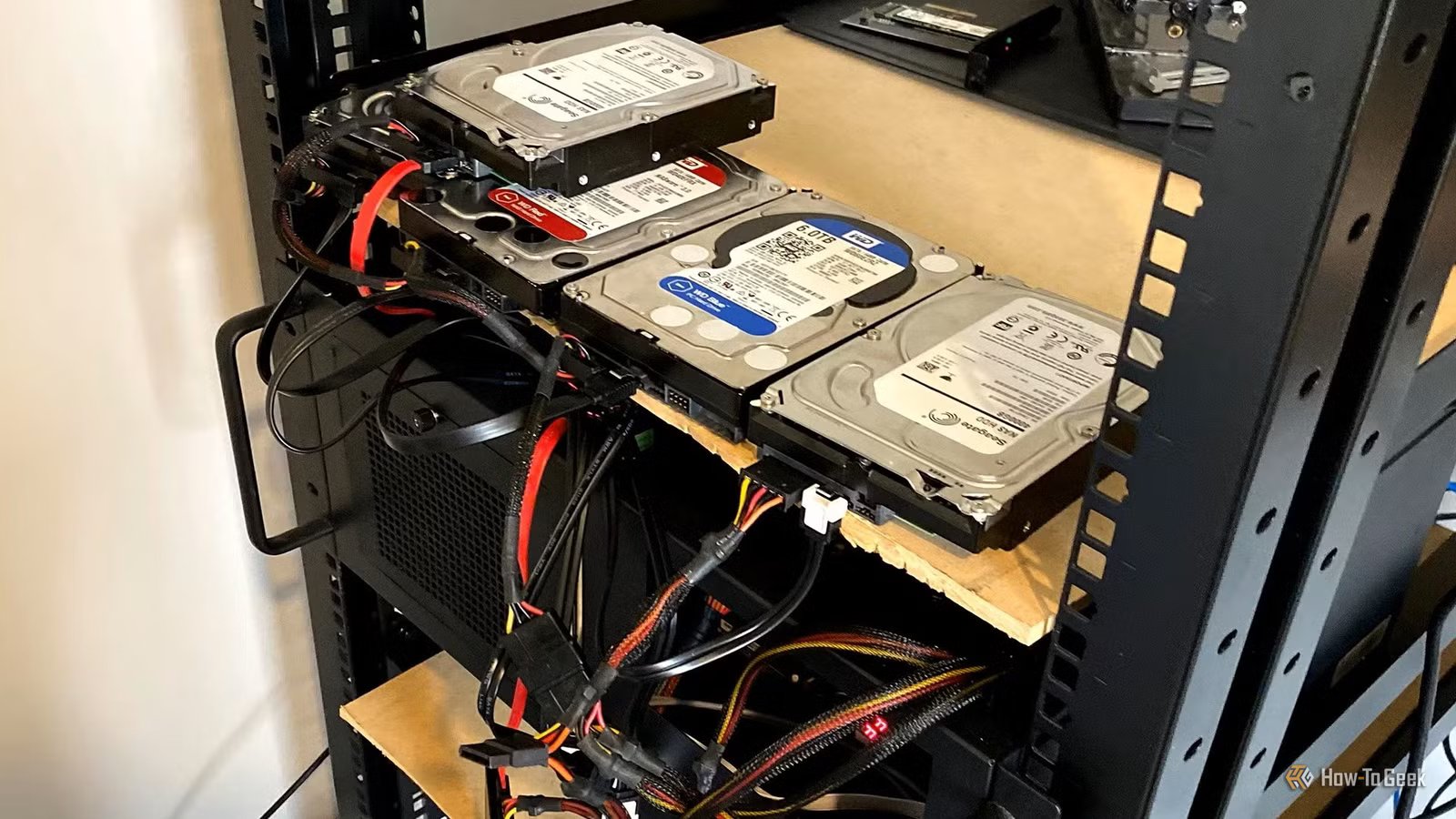
With the price of SSDs rising rapidly and no relief likely for at least a few years, it is time to revisit old-fashioned mechanical hard drives. Despite their slower speeds, they’re still great for a huge range of applications, and they’re an excellent value option—especially if you buy them used.
Not everything needs a solid-state drive
For the last several years (except very recently), the price of solid-state drives have fallen steadily, and they’ve becoming blazing fast, as they’ve moved from the relatively slow SATA interface to PCIe 5.0, which supports transfer rates up to 16 gigabytes per second.
Credit: Corbin Davenport / How-To Geek
However, most applications can’t really make use of those speeds. Even things you might expect to thrive with the extra speed often don’t, like the loading screen on video games.
Unfortunately, the only thing that you can be pretty sure will scale well with increasing transfer speeds are jobs that involve moving large files.
However, not everything calls for transfer speeds in the dozens of gigabytes per second—often times, you can get by with less. If you’re just using a drive for cold storage, there isn’t really a minimum speed you need. Even if you’re using a drive in something like a Jellyfin server streaming 4K video content, you can easily get by with as little as 100 megabytes per second.
That means you don’t need to pay the extra premium associated with NVMe SSDS—especially PCIe 5.0—for every application. You can often get by with a regular mechanical hard drive instead. They’re slower, but the price difference is enormous. For the cost of a 4TB PCIe 5.0 NVMe SSD (about$550), you can get a 24 or 26TB mechanical hard drive.
If you’re willing to shop refurbished or recertified, mechanical hard drives are an even better deal. I was able to find a refurbished 24TB hard drive for only $280, and it had only been used for 50 hours. In the line of computer components, that is practically new.
What should you look for when buying a used drive?
In general, I’d recommend against buying used drives from places like Facebook Marketplace, where the only guarantee you have is someone’s word. The only exception is if the drive is included in the cost of an entire used PC you’re buying—then there is really no harm.
However, if you’re shopping on the internet, there are three big things I look for:
- Plenty of good reviews for a seller
- Manufacturer recertified or refurbished drives
- Recertification from a seller with good reviews
Unfortunately, sites like Ebay and Amazon are filled to the brim with fake reviews that are designed to prop up a seller’s reputation. Always be on the lookout for signs of fake reviews before you buy anything expensive.
Related
You Still Can’t Trust Amazon Reviews and Here’s Why
Amazon reviews and ratings are a tricky business. Here’s why you still can’t trust them.
Then you have the drives themselves. There are three main things to consider:
- Form Factor — Mechanical hard drives are usually 2.5-inch or 3.5-inch. 3.5-inch is the size you use in desktops, while 2.5-inch is for laptops and other small devices.
- Interface — Consumer drives use a SATA interface, while commercial drives often use SAS
- Drive speed — You’ll find drives that spin at 5,400, 7,200, or 10,000 RPM. In general, the faster the drive spin, the faster the read and write speeds.
Most of the time, I just buy desktop SATA drives that spin at 7,200 RPM, since they’re very common, affordable, and they don’t require special hardware. If you want to use a SAS drive in a regular desktop, or an old desktop you’ve converted to a server, you’ll need to get an interface card, which adds cost and complexity.
On the other hand, SAS drives will tolerate harder, longer workloads, and they may be the better option for you if your home server (or NAS) sees a lot of use.
Where should you buy used hard drives?
There are two main places I shop for used drives: ServerPartDeals and Amazon.
ServerPartDeals is typically where I stop first, since I’ve always had very good luck with their sales and I don’t have to worry about vetting a third-party vendor on Amazon. I’ve lost track of how many drives I’ve purchased from them now, but all but one still work. The one that doesn’t work only broke when I dropped it.
Credit: Nick Lewis / How-To Geek
I’ve also purchased used drives off of Amazon before, but I’m always much more cautious there, especially if a deal looks excellent. There are an alarming number of scammers out there, and Amazon has done very little to curtail the problem.
Related
Why the Heck Is Amazon Selling These Fake 16 Terabyte Portable SSD Drives?
Maybe some company figured out how to sell a 16TB portable SSD, normally thousands of dollars, for $100. And maybe frogs can fly. Who knows?
Whether you’re buying a drive for cold-storage, or looking to expand the space on your NAS or homelab, a used hard drive from a reputable reseller can save you literally hundreds of dollars per drive. With the cost of subscriptions skyrocketing, self-hosting can be a great way to save some money—if you buy bulk storage for the right price.
