

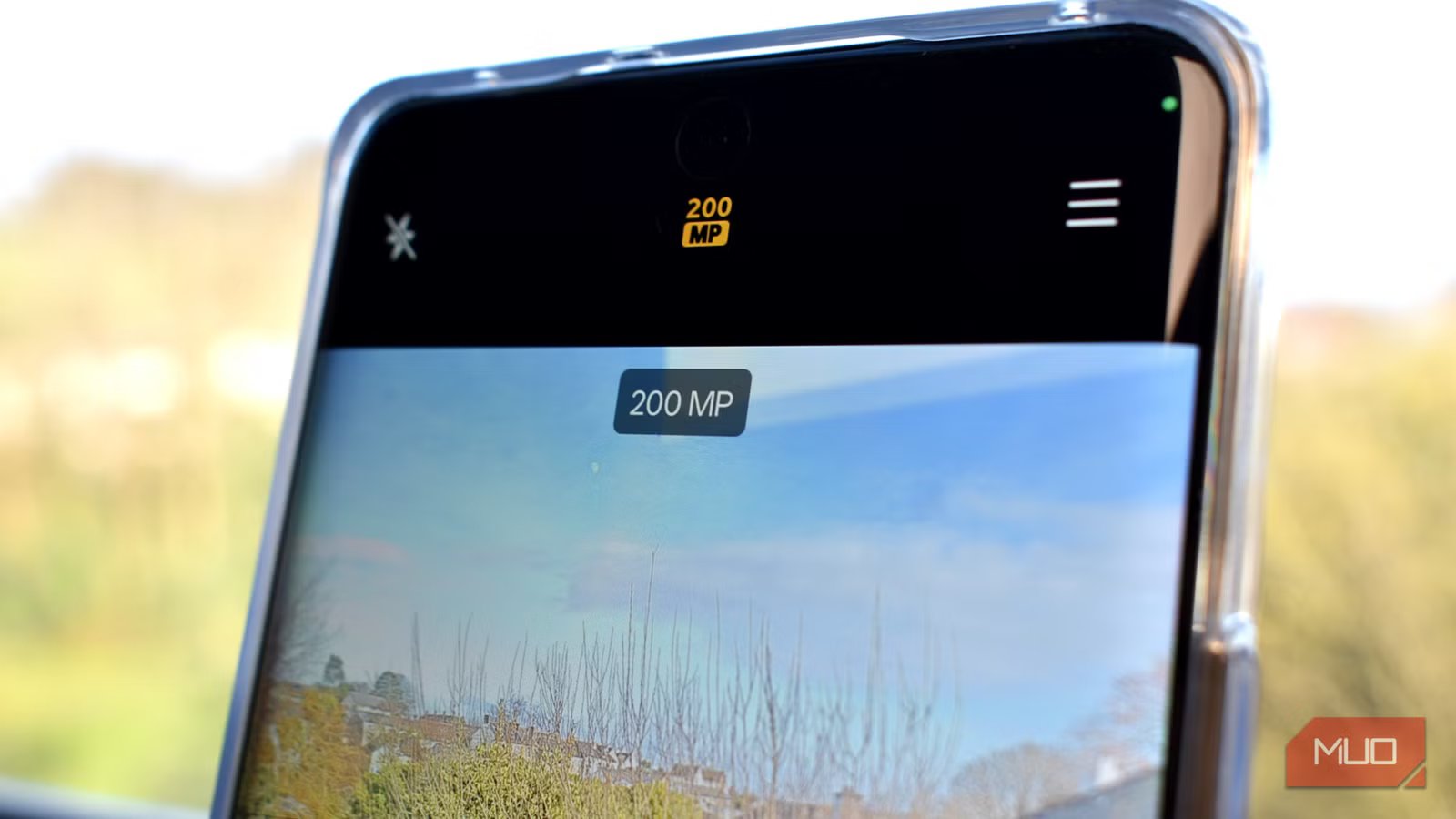
My current phone has a 200-megapixel camera. Just a few years ago, that number would have sounded utterly ridiculous, but in 2026, 200MP is where most smartphone cameras are heading.
But does it always mean you’re guaranteed much better photos? Not quite. There are many more factors at play when it comes to smartphone photography, and while the big flashy “200MP” number is grabbing your attention, it’s letting other, more important specs hide in the background.
It’s not because a smartphone with a 200MP is bad or worse than one with 50MP. It’s that megapixels are the most overused, misunderstood, and misleading spec in smartphone photography.
Megapixels don’t mean what you think
That big number is doing some serious lifting
Megapixels measure resolution. Nothing more, nothing less; it basically tells you how many pixels you’ll find in the final image. Importantly, it doesn’t tell you anything about the quality of the pixels, how good the image capture process is, or basically anything else that’s important regarding smartphone photography.
A 200MP photo simply means the image is extremely large. It does not mean it has better low-light performance, more detail in shadows, better colour, or more natural depth. In many cases, it means the opposite.
Most high-megapixel smartphone sensors rely on pixel binning. A smartphone with a 200MP camera typically won’t shoot a 200MP image by default. Instead, the camera software groups pixels together in specific ratios to improve brightness, reduce noise, and deliver consistent output across different lighting situations. It means that you’re often not actually shooting at “true” 200MP
In many cases, the 200MP camera is actually not the main camera or is limited to specific modes. For example, the Honor Magic 8 Pro has a 50MP main camera and a 200MP telephoto lens, while the Realme 16 Pro Plus has a 200MP main camera but defaults to a much smaller megapixel output; you have to specifically select the 200MP mode to capture huge images.
This is the spec that really matters, but you’ve never seen advertised
It’s not as alluring for advertisers
The spec you should be paying attention to is the sensor size. A larger sensor physically captures more light, which has a cascading effect on almost every aspect of image quality, including low-light performance, noise levels, dynamic range, and the natural separation between subject and background.
This is why a smartphone camera with a large sensor can outperform a camera with a larger megapixel count and a smaller sensor. It’s simply not all about the eye-catching MP number, especially when you consider how important light capture is to photography. Bigger sensors capture more light and deliver better quality photos.
The problem is that sensor measurement values aren’t as easy to sell. Slapping “comes with a 1/1.3-inch sensor” isn’t nearly as enticing as “200MP AI camera,” even though it tells you more about how the camera will perform. Manufacturers often bury the sensor size deep in the official specs, hidden away, as they believe most folks don’t care about it, despite it being one of the clearest indicators of real-world image quality. Two phones can both advertise 50MP cameras while using very different sensor sizes, and the larger sensor will almost always deliver better, more consistent results.
Lens quality and aperture are also important
Though again, it’s a mouthful to fit on a billboard
Another smartphone photography feature that’s just as important as all those megapixels is the lens quality and aperture. You can have all the megapixels and a lovely large sensor, but if the smartphone has a terrible lens and limited aperture, you’re going to shoot rubbish all day long.
Smartphone lenses are incredibly small and require significant optical compromises, but there are still meaningful differences between a well-designed lens and a mediocre one. Lens quality affects sharpness across the frame, control of flare and ghosting, edge distortion, and overall contrast, all of which shape how “good” an image feels before any processing is applied. Resolution means very little if the lens itself cannot resolve fine detail cleanly.
Aperture basically determines how much light reaches the smartphone sensor. Remember how important getting light to the sensor is? It tracks that a wider aperture allows more dynamic control over lighting conditions, and can boost smartphone photography in numerous ways. You may have seen aperture ratings on cameras, such as f/1.6, f/1.8, or f/2.2, and what you’re looking for is a good range between the two values.
You can’t talk smartphone cameras without talking AI
I wish it weren’t so, but that’s where we’re at
It’s impossible to talk about how megapixels are misleading in smartphone specs without considering the impact of the software that’s really running the show. Smartphone camera software has a huge bearing on the quality of your photos, whether you like it or not.
We’re not talking about swapping in and out AI filters. It’s the post-processing applied to every image before you even get to the filter stage, with smartphone camera manufacturers adding features like HDR stacking, multi-frame noise reduction, tone mapping, and semantic scene detection without even checking if you want them applied.
The image processing pipeline is exceptionally well-tuned on all smartphone cameras, and it has a dramatic effect on what you see versus what you actually shoot and the camera specs on paper. At the end of 2024, I took a trip to a smartphone camera manufacturing factory, and a good proportion of the trip was taken up explaining the cutting-edge developments in the smartphone camera processing pipeline.
At the time of writing, we’re 13 months on from that trip, and nearly everything spoken about on that trip has been surpassed already.
In fairness to smartphone manufacturers, AI integration and computational photography are features that appear on smartphone spec lists. It gives the manufacturer a chance to flex its latest AI photography development, but the real impact of this isn’t made clear when you’re buying a phone.
Related
These Free Apps Will Instantly Improve Your Smartphone Photos
Edit like a pro, shoot like a pro—all for zero dollars.
So, how much difference does 200MP make?
I found this whole process revealing
As said, I’ve been using a 200MP Realme 16 Pro+ for a little while, and the photos it shoots are admittedly great. I’m impressed with the quality; they’re sharp, colorful, and full of detail. But I’m not entirely convinced they’re multiple steps better than what I’ve shot with the Realme 16 Pro+ 50MP main camera.
I’ve taken a range of snaps using the Realme 16 Pro+, along with the Nothing Phone 3 (2025) and the Honor 200 Pro (2024).
Specification
Realme 16 Pro+ 5G (2026)
Nothing Phone 3 (2025)
Honor 200 Pro (2024)
Rear Camera System
Triple: 200 MP main (wide), 50 MP telephoto (periscope), 8 MP ultrawide
Triple: 50 MP main (wide), 50 MP telephoto (periscope), 50 MP ultrawide
Triple: 50 MP main (wide), 50 MP telephoto, 12 MP ultrawide & macro
Main Sensor (Rear)
Samsung ISOCELL HP5 200 MP – 1/1.56″ – ~0.5 µm pixels – OIS
OmniVision OV50H 50 MP – 1/1.3″ – ~1.0 µm pixels – OIS
OmniVision H9000 50 MP – 1/1.3″ – ~1.2 µm pixels – OIS
Telephoto Sensor (Rear)
50 MP periscope – ~1/2.75″ – ~0.64 µm pixels – OIS (Samsung/ISOCELL JN5)
50 MP periscope – ~1/2.75″ – OIS
50 MP telephoto – ~1/2.51″ – OIS – ~2.5× optical zoom (Sony IMX856-based)
Ultrawide Sensor (Rear)
8 MP – 1/4.0″ – ~1.12 µm pixels
50 MP – 1/2.76″ – wide angle
12 MP – sensor size not officially specified (wide/macro combo)
First up, 200MP images are huge in terms of data and dimensions. The image below measures 7500 x 10000 and is over 40MB in size, but that’s not actually the original image size (our CMS wasn’t happy!). The original measured 12288 x 16384 and was over 65MB and that’s just for a JPEG (so you’re losing a bit of quality and data in the compression process), as the Realme 16 Pro+ 5G doesn’t have a default RAW setting.
The same photo using the Realme, Nothing, and Honor’s regular camera doesn’t show a huge amount of difference (images in that order – Realme, Nothing, Honor), though the Honor’s camera adds a level of blue to the processing I’m not keen on. However, one noticable difference is the level of AI processing taking place in the larger image. If you zoom on the 200MP image, the wall and the people sitting by it have all the hallmarks of AI meddling, with strange blurred details, warped features, and so on.
It’s a similar story when looking out to sea and snapping the harbor wall and cliffs behind.
The overall image quality from the Realme’s 200MP Hi-Res mode is great, but given the time taken to capture and the comparison with the standard mode, I think you’ll do just fine with its regular 50MP mode. In this round, the Nothing Phone 3 looks a little washed out and the Honor 200 Pro is on the blue-side again, but the Realme has decent light balance.
Side-by-side comparisons also reveal strengths and weakesses of the 200MP mode. For example, you can zoom into a higher level of detail on the bigger image with far more pixels, but at a glance, the two images aren’t too dissimilar (the 200MP image is first) .
Related
10 Smartphone Photography Mistakes That Held Me Back for Years
These mistakes kept me stuck—don’t let them stop you.
Megapixels aren’t going anywhere
Megapixels are the perfect marketing tool because they are easy to understand, easy to compare, and easy to scale year after year. They give the illusion of clear progress, even when the real-world improvements are marginal or dependent on very specific conditions.
From a branding perspective, it’s far easier to sell “200MP” than it is to explain improvements in sensor architecture, processing pipelines, or tone mapping algorithms. Those things are harder to communicate and harder to turn into bold, eye-catching claims.
But if photography matters to you, or you’re tired of being sold on that same number increasing annually, at the very least, you know what you should really be checking out to find the best smartphone camera among the marketing hype.
