

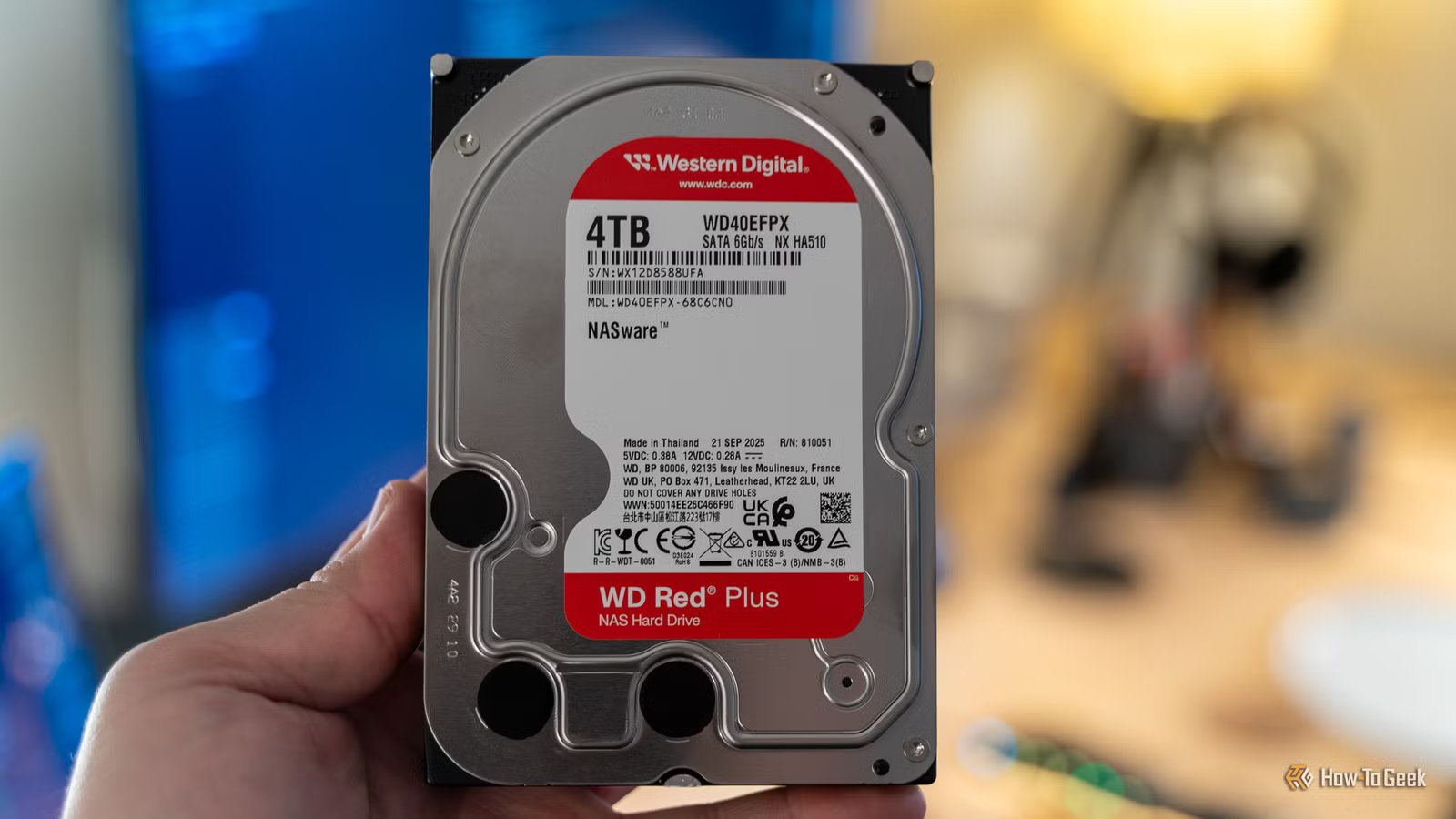
Wiping a drive before selling it is very important. Not just because whoever’s going to use it next needs the space, but also because you don’t want them snooping through your files after you sold it.
So here’s how to properly go about it.
Why quick formatting is not enough
Credit: Patrick Campanale / How-To Geek
Many people, especially less tech-savvy folks, just hit “Quick format” to wipe the drive before putting it inside a shipping box. Don’t ever do this. The drive will appear empty and work like an empty drive, sure, but it is functionally equivalent to tearing the table of contents out of a book while leaving all the pages intact.
In a file system, data is managed through a master directory that points to where specific files are physically located on the disk. When you delete a file or perform a quick format, the computer does not actually scrub the magnetic or electronic data from the storage sectors. Instead, it simply removes the reference to that file in the directory and marks the space it occupies as “available” for future use. It works like an empty drive because it will just write over it when the time comes, but that doesn’t mean that it’s empty.
Because the actual binary information remains on the platters or memory chips until it is specifically overwritten by new data, the “deleted” files are trivially easy to recover. Sophisticated data recovery software does not rely on the file allocation table; rather, it scans the physical drive sector by sector, looking for known file headers and data patterns. This means that a drive you formatted seconds ago can be scanned by free, readily available tools to resurrect photos, tax documents, and passwords within minutes. The data persists in a sort of digital purgatory, invisible to the operating system but fully accessible to anyone with the right utility. And it’s not even that complicated to access. No need to take it to specialized data retrieval experts, but you just need free software and a few minutes of your day.
To be fair, mechanical hard drives and solid-state drives handle data retention differently, but a quick format fails to secure either. On older mechanical drives, magnetic remnants can remain even after simple deletion. On modern systems, relying on the operating system to simply declare the space “free” creates a false sense of security. If the drive has not been forced to physically change the state of every single storage bit—switching them all to zeros or random patterns—the information is still sitting there, waiting to be read.
How to (really) go in depth
Credit: Nick Lewis / How-To Geek
To genuinely sanitize a drive, you must move beyond file system management and utilize data destruction methods that render the previous information irretrievable. The gold standard for this process is known as “wiping” or “secure erasing,” which involves overwriting every addressable sector on the drive with non-sensitive data. For traditional mechanical hard disk drives (HDDs), this usually entails running software that writes a pass of all zeros, or a series of random characters, over the entire disk surface.
Historically, standards like the Department of Defense (DoD) 5220.22-M required multiple passes to overcome magnetic remanence, but for modern high-density drives, a single rigorous overwrite pass is generally considered statistically sufficient to prevent data recovery. However, the approach must be fundamentally different for SSDs. Because SSDs use wear-leveling algorithms to distribute data evenly across flash memory cells, traditional overwriting tools cannot guarantee that every specific physical sector is wiped; the drive controller might direct the new data to a fresh block while leaving the old data in a retired block. Therefore, attempting to wipe an SSD with HDD tools not only fails to sanitize it completely but also unnecessarily degrades the lifespan of the drive.
For these modern drives, the correct method is to invoke the firmware-level “Secure Erase” command. This instruction tells the SSD controller to release a voltage spike to all memory cells simultaneously, effectively resetting them to their factory state.
Most major drive manufacturers provide proprietary toolbox software that can execute this Secure Erase command safely. Alternatively, many modern computer BIOS/UEFI interfaces have built-in data sanitation tools that can wipe a drive before the operating system even boots.
For those who prefer third-party solutions, there’s a number of bootable software environments like DBAN (for HDDs) or Parted Magic (which supports SSD Secure Erase) that allow the user to wipe a drive completely independent of the host operating system.
Why you need to do this before selling a drive
Credit: Lucas Gouveia / How-To Geek | Hendrik Sejati / Shutterstock
In the digital age, our storage drives act as repositories for the most intimate details of our lives. They house cached web browser history, autofill data containing names and addresses, saved credit card numbers, tax returns, and scans of passports or driver’s licenses. Even if you believe you have deleted these specific files, the residual data discussed earlier can be pieced together to build a comprehensive profile of your identity. Selling a drive without wiping it is akin to selling your old wallet with your driver’s license and credit cards still tucked inside a hidden compartment. You really, really, don’t want that out there.
There is a well-documented secondary market phenomenon where individuals purchase used hard drives specifically to harvest data. Security researchers and cybercriminals alike have purchased batches of used drives from online auction sites and thrift stores only to find a treasure trove of corporate secrets, medical records, and private family photos. If the drive was ever used for remote work or business purposes, failing to wipe it could also constitute a breach of contract or a violation of data protection regulations like GDPR or HIPAA, leading to potential legal liability. The chain of custody for that data ends with you; once the hardware leaves your possession, you lose all control over who accesses that information.
Ultimately, the small amount of time required to run a secure erase utility is a negligible cost compared to the potential fallout of a data breach. The peace of mind gained from knowing your digital footprint has been obliterated is invaluable.
