

You’re probably aware that mirrorless and digital SLR cameras with interchangeable lenses can deliver greatly improved image quality and optical performance compared to smartphones. What might be slightly more surprising are the pint-sized point-and-shoots that can do the same.
Here are five examples of pocket-sized cameras that are bound to put a smile on your face.
Sony RX100 VII
Sony’s travel-friendly all-rounder
Credit: Sony
Sony is killing it in the consumer photography market, mostly with its full-frame A7 lineup. There are many things the Japanese giant’s latest breed of cameras gets right, from size and lens selection right through to autofocus performance and video quality. There’s a Sony out there for everyone, and the RX100 VII ($1,700) is one such example.
This tiny all-rounder has a 1-inch sensor that shoots 20.1 megapixel stills. The sensor size is a little smaller than what you’d find in an APS-C camera, like the a6700, but it allows Sony to pack a lot of camera into a tiny package. Image quality is excellent, with the 24-200mm (35mm equivalent) Zeiss Vario-Sonnar T* f/2.4-4.5 zoom lens playing a pivotal role.
It’s a great travel camera thanks to its size and versatile lens, though some reviewers complain that it’s a little small in the hand and it’s got a classic Sony interface (which can be needlessly complex). There are plenty of things to like, including a pop-up electronic viewfinder, no shutter blackout when shooting bursts, a port for an external microphone, and 4K HDR video at 30 frames per second with minimal rolling shutter.
Ricoh GR IV
Understated street photography royalty
Credit: Ricoh
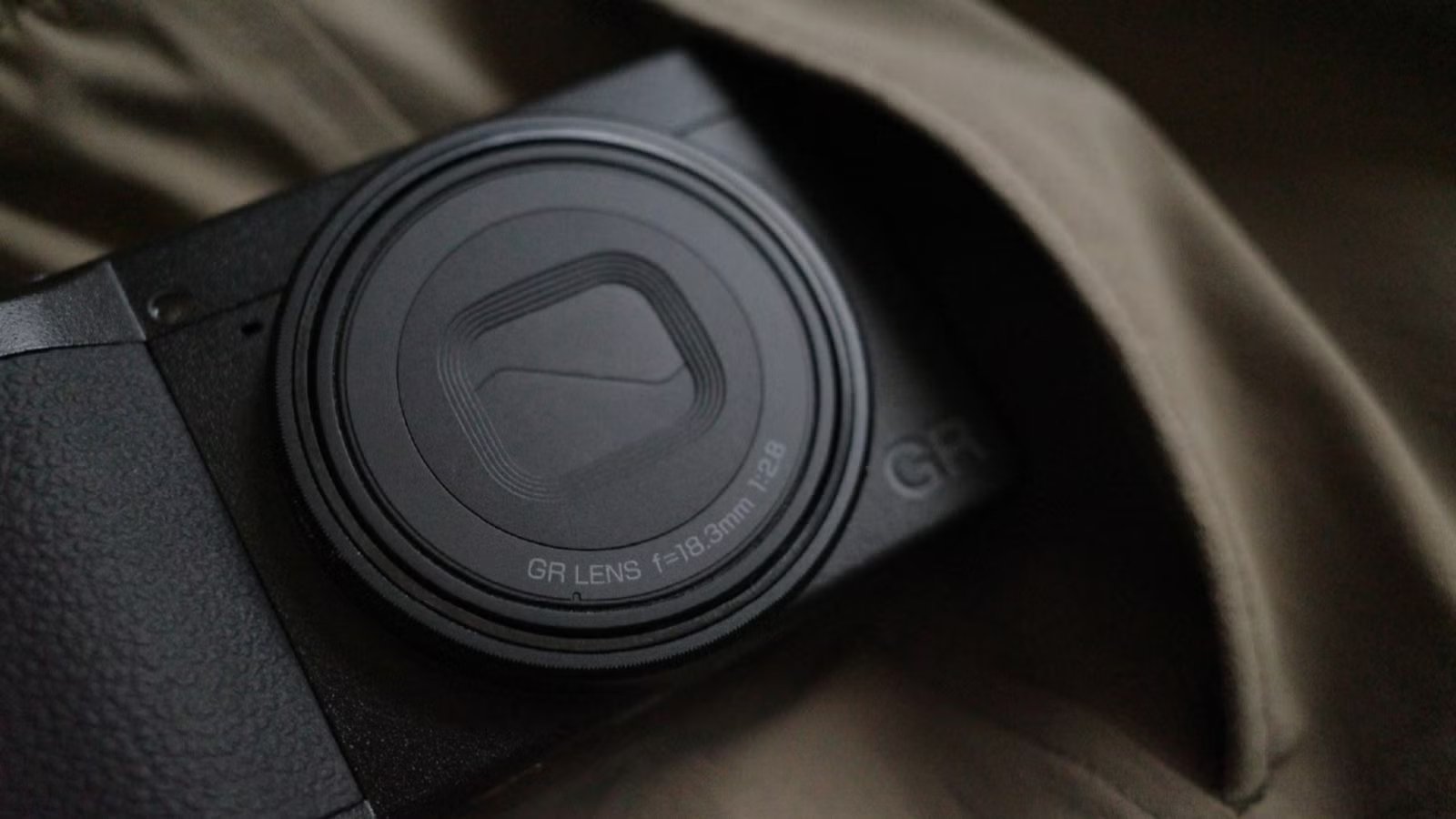
Ricoh is a camera brand that has managed to fly under the radar for many. Though the company hasn’t seen success on the level of Canon or Sony when it comes to SLRs and mirrorless offerings, its compact GR range is legendary among street photographers and anyone looking for high-performance point-and-shoots.
The GR IV ($1,500) is the latest iteration of a classic, a low-profile fixed focal-length shooter that could be mistaken for an off-brand film camera on first glance. With its APS-C sensor (23.3 x 15.5 mm) and 28mm (equivalent) f/2.8-16 lens, the GR IV is perfect for anyone who thrives when less is more.
The camera is incredibly thin and compact, and the overall design is sparse and simple. The camera is responsive, captures 25.7 megapixel images, and offers remarkable low light performance even at high ISO values. Ricoh markets it as the “quintessential snapshot camera,” which is true to the range’s street photography roots: it’s a camera that you whip out, snap, and put away again.
The GR IV has two siblings you should probably know about. The GR IV Monochrome ($2,200) is designed specifically for black and white photography thanks to its specially-designed sensor, while the GR IV HDF ($1,600) incorporates a highlight diffusion filter for soft and stylized handling of the brighter elements in a scene.
Fujifilm X100VI
A digital compact for film camera nerds
Credit: Fujifilm
Fujifilm has long been an enthusiast brand, carving out a niche among those who are drawn to smaller interchangeable lens cameras, shiny metal bodies, and chunky knobs. The X100VI ($1,800) is another example of beautiful design that’s as functional as it is pleasing on the eye.
This point-and-shoot features a 40.2 megapixel APS-C sensor, the most pixel-dense of all the cameras here. It’s also arguably the most technologically advanced, with an integrated neutral density filter that enables you to stop down your lens (achieving a shallower depth of field) without letting in too much light. The camera uses a fixed-length 35mm (equivalent) f/2-16 lens, with digital (crop) zoom of 1.4x and 2x.
That’ll be useful with impressive video specs like 6.2K video at 30 frames per second (and 4K at 60), plus the company’s best autofocus performance to date. Perhaps one of the most alluring features is film simulation, with the X100VI offering 20 film simulation modes in body. Sure, you could do this in post, but doing it in-camera feels better suited to the point-and-shoot ethos.
Sensor Size
40.2MP
Video Resolution
Up to 6.2K
X100VI has 20 built-in Film Simulation modes and enjoy a new creative opportunity with REALA ACE. Featuring Fujifilm’s latest X-Trans CMOS 5 HR sensor and X-Processor 5, you can create 40.2MP images or video up to 6.2K/30P, sharing them in the moment or cherishing them for the future.
Panasonic Lumix ZS99
It’s all about the zoom
Credit: Panasonic
The Panasonic Lumix ZS99 is the cheapest camera on this list, with a list price of $700. Truth be told, its 20.3 megapixel 1/2.3″ sensor will struggle to stand out when put against the latest smartphones, and its video performance of just 4K at 30 frames per second is nothing to write home about. Even the menu system isn’t great.
Beyond its price, there’s only one clear reason to pick the ZS99. The camera comes with a 24-720mm (equivalent) Leica DC lens, offering an optical zoom factor of 30x in a tiny package. Whether this is worth the image quality trade-off largely depends on what you’re using your camera for.
It’s going to struggle in low light, and there’s no dedicated electronic viewfinder, but its position as a pint-sized superzoom means that it can do something that no smartphone on the market can.
Leica D-Lux 8
Leica quality in a compact package, if you can afford it (and find one)
Credit: Leica
Leica makes cameras and lenses that many of us dream of owning. The company exudes an aura that has photography nerds frothing at the mouth, and a price tag to match. That said, the D-Lux 8 is on the more affordable end of the spectrum at $1,915.
The camera features a 4/3” sensor that captures 17 megapixel images via the Leica DC Vario-Summilux 24-75 mm (equivalent) f/1.7-2.8 lens. The body is cast from magnesium, and the user interface and button layout have been improved for this revision, taking inspiration from Leica’s much pricier Q series.
There’s a dedicated OLED electronic viewfinder, RAW capture, UHS-II SD card support, and that unmistakable Leica look and feel. They aren’t always the best cameras on paper, but there’s more to photography than tech specs. Unfortunately, the D-Lux 8 can be a little hard to get hold of, with even Leica’s own store reporting the camera is on backorder.
Most of these cameras cost as much as, if not more than, a flagship smartphone. But unlike a smartphone, they’ll probably last longer. You won’t feel quite as compelled to upgrade them, since not even the manufacturers are committed to yearly update cycles.
So it’s worth thinking about the cost-to-value proposition a little differently, speaking as someone who has had the same mirrorless body for a full decade and who feels no compulsion to upgrade.
