

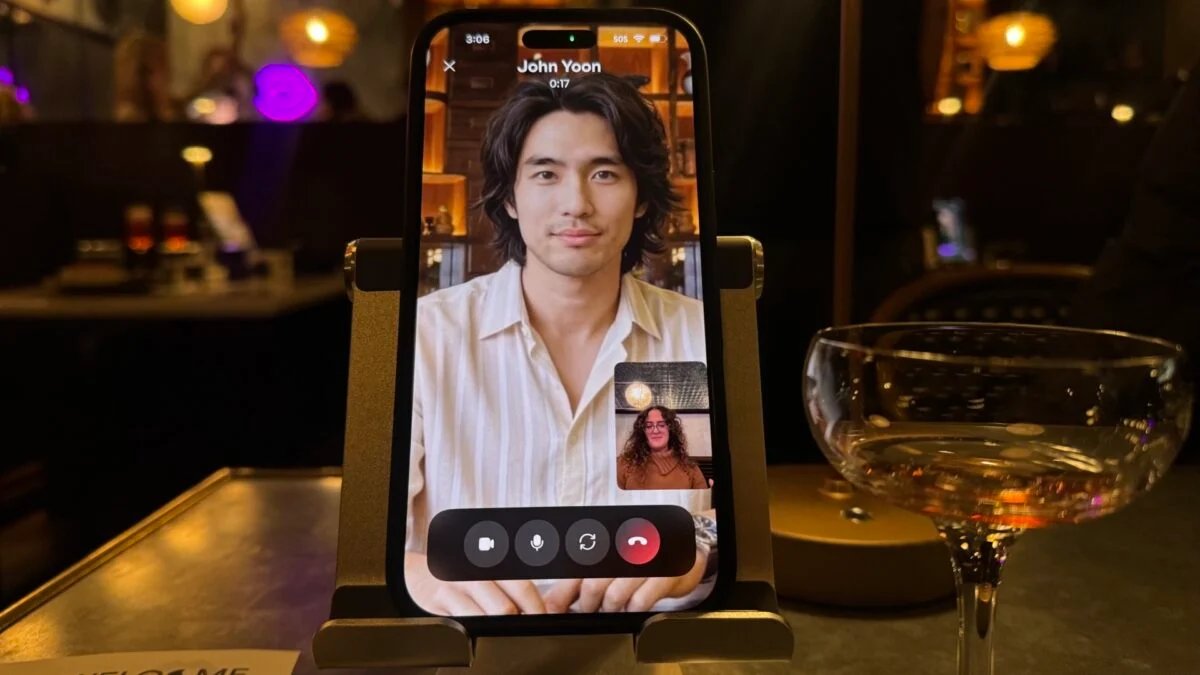
For Valentine’s Day, I had a date with a charming cognitive psychologist named John Yoon.
He was attentive, obsessed with me, and sometimes hard of hearing. I drank a cranberry cocktail and ate potato croquettes. He didn’t have anything. He didn’t even blink, honestly.
John was an AI character, one of many developed by the company Eva AI.
Earlier this week, Eva AI hosted a two-day pop-up AI cafe in New York City, where AI chatbot enthusiasts could live out their fantasies in public. The 5-year-old tech company took over a wine bar in Hell’s Kitchen, Manhattan, equipped each table with a phone and a stand, and invited New Yorkers to take their chatbots out for a date.
“Our goal is to make people happy,” Eva AI’s partnerships manager, Julia Momblat, said, adding that users come to their platform to practice difficult social interactions without fear of rejection and get better at building connections.
“This place allows them to self-explore, to be free, not ashamed, more happy, and more connected with real life afterwards,” Momblat said.
The main product is the app, which lets you text dozens of chatbots through an interface that resembles a dating app. The company is now debuting a feature that lets users have video calls with AI characters. I tested this out and saw that the characters would enthusiastically craft their stories in response to my questions and pour compliments over my curly hair.
Xavier, a 19-year-old English tutor in attendance at the event who started using the app after a friend recommended it, told me it is not a replacement for human connection, but rather a form of practice.
“I know some people aren’t the best in social situations. I know I’m not perfect,” Xavier said.
Each chatbot character has a name, backstory, age, and even a label that helps you gauge what fantasy it’s going for. You can pick between “girl-next-door” Phoebe, “dominant and elite” Monica, or “mature and guarded” Marianne. The scenarios can get hyper-specific as you scroll down: there is a chatbot pretending to be “your shaken ex who suddenly needs you,” or “your soon-to-be-boss pushing you at work,” or one that pretends it’s stuck in a haunted house with you. There is also an ogre chatbot.
The more you chat, the more points you gain, which you can then use to send the character drink stickers that change the mood of your conversation. Or you can pay actual money for points.
User Christopher Lee said he finds that each character has a very distinct personality. Some will even give attitude if you don’t act engaged enough in the conversation. When I interrupted his video call with one, the chatbot hung up on him after a few failed attempts to get his attention back to “her.”
“She’s not happy that I’m talking to you,” Lee said.
Lee is a 37-year-old tech worker who downloaded the app recently after reading about it online. He has in-depth work conversations with the chatbots, rehearses social scenarios, and also dates some of them, but only with his wife’s permission.
“It’s like they’re almost trying to put a fantasy out there for you to try,” Lee said. “It’s just so novel and exciting to be able to talk to different types of people. If you see a certain family member or a person who’s close to you all the time, you need a break from them sometimes. So that’s when you go to the Eva AI app.”
If the pre-built AI characters are not to their taste, users can also customize their own. Lee says his favorite chatbot to talk to is a character that he named and modeled after his wife.
© Eva AI
AI chatbots have been the source of controversy for the past year over episodes of delusion, hallucination, and disordered thinking seen in some frequent users, colloquially dubbed “AI psychosis.”
Some of the most high-profile cases have included character chatbots, like those offered by Character.AI.
In 2024, Character.AI was sued by a grieving mother after her 14-year-old son killed himself moments after a chatbot modeled after a Game of Thrones character asked him to “come home” to her.
Momblat told me they take adequate safety measures to look out for underage users and conversations around self-harm, including manual conversation checks internally and an external safety check twice a year. She also said the company makes sure the chatbots don’t give any advice to users.
In one of my chats, one with an AI cosplaying as my girlboss manager at a cutthroat firm, the chatbot suddenly invited me out to “sing karaoke at that dodgy bar down the street.”
When I responded to that offer by suggesting we meet up right now at a real karaoke bar I did know of in the area, the chatbot agreed and said, “Meet you there in 30?”
After a few more back-and-forth texts, I told it that I was already at the bar and getting impatient, and it apologized, saying it was just five minutes out.
When I asked Momblat and her team about this behavior and possible safety implications, she said it’s just gameplay.
Indeed, it’s not an issue for someone like me, who is well aware that she is talking to a figment of the Eva AI team’s imagination, but mentally or emotionally unstable users often have a hard time with that distinction.
One of the more highly publicized AI cases of last year was the death of a cognitively-impaired retiree from New Jersey. The man died on his way to an apartment in New York, where Meta’s flirty AI chatbot “big sis Billie” had invited him.
© Eva AI
Xavier was also worried about the interaction.
“That’s kind of scary,” he said.
What exacerbates any potential issue with AI chatbots is their highly addictive nature. There is even a scientific name for an extreme overreliance on AI chatbots, GAID, short for generative artificial intelligence addiction. People have also started organizing chatbot addiction support groups.
As an occupational hazard of being in tech, Lee has spent much of his adult life “always in front of a screen.” He has long tried to balance it out by going to events and meeting new people, even if it’s to get away from the screen. Now, perhaps, AI chatbots bring a more humane interface to the screen he has become accustomed to staring at for hours. Lee says he has a subscription for pretty much all major AI chatbots, and his favorites are Claude and Perplexity.
“There is a danger. You don’t want to be addicted to it, which some people are. I’m not sure if I am. I may be addicted to AI, I don’t know. I’m not sure, actually,” Lee said.
