

The “little pieces of Sunderland” produced by the city’s glassmaking factory for more than a century can be traced back to an even older story that began in the seventh century, when English glassmaking began at a monastery beside the River Wear, run by abbott and later saint Benedict Biscop.
In 2007, the Pyrex factory that opened more than 100 years earlier and made glass that found its way into millions of homes closed down, with production moved to France.
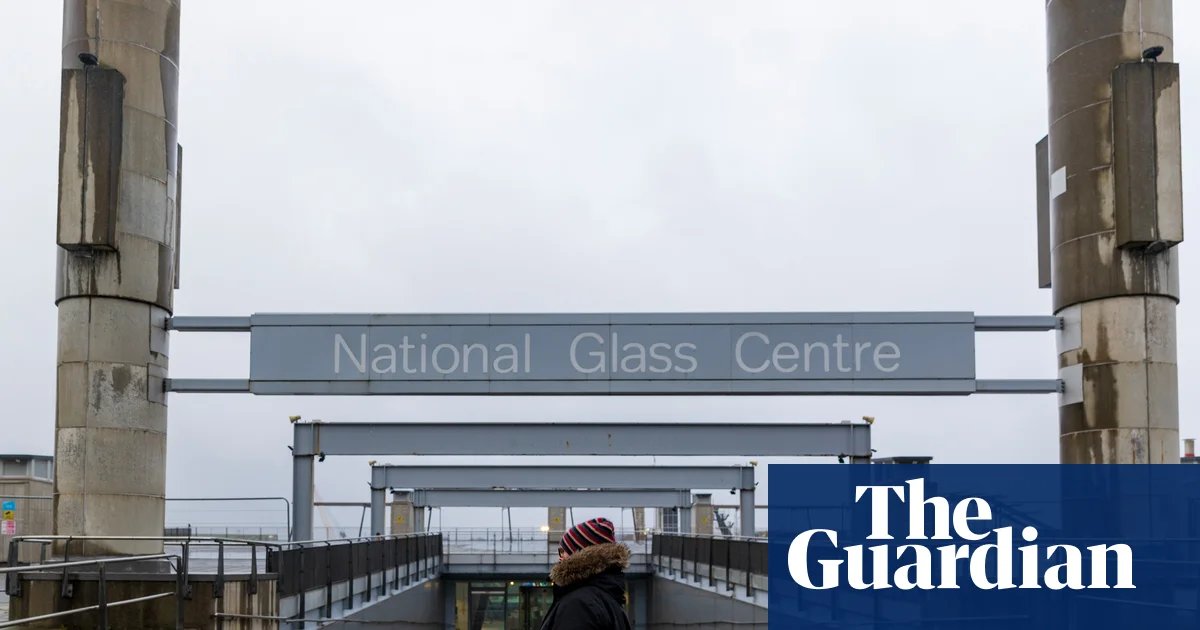
That long heritage was honoured by a shiny cultural landmark that opened in 1996: the National Glass Centre. The impressive building, made from concrete and – of course – glass, has stood beside the water, drawing in visitors from all over the country ever since.
But now the centre’s future is under threat. The University of Sunderland, which has custodianship of the building, says it faces a repair bill of up to £45m, and the only option is to pull the whole thing down. The centre is expected to close to the public in July.
Campaigners from the Save the National Glass Centre say the closure is a symbol of surrender to decline. Photograph: Gary Calton/The Guardian
Others say the university is not telling the whole story and that the closure of the National Glass Centre is deeply unpopular and viewed by many in the city as a symbol of surrender to decline. The strength of feeling means the battle for its survival has become a political flashpoint, with the cause adopted by the Liberal Democrats and the far right.
“They’re going on marches with placards saying ‘Deport the immigrants’, but also ‘Save the glass centre’,” one person connected to the university said.
On a rainy weekday morning, the National Glass Centre is bustling – with barely a free table in the cafe, a queue in the shop and a visitor group packed into tiered seating, watching a glass-blowing demonstration.
Carolyn Basing, a glass artist who has a studio in the building, studied at the university and graduated in 2016, said she had become really aware of how the centre had “just gradually declined and declined and declined”.
“Yes, we had a pandemic,” she said. “That was a difficult period, everybody had to recover from that. But certainly from 2018 onwards, that decline was very marked.
Brian Jones moved into a studio within the glass centre in 1998. Photograph: Gary Calton/The Guardian
I would say there has been a deliberate policy by the university since 2018 to run the place down.”
In his workshop, Brian Jones, 70, is creating glass figurines of the Angel of the North. He started out as a 15-year-old apprentice scientific glass blower at the Pyrex factory. At the time, “I didn’t even know what it was, to be honest”, he said.
Jones moved to the National Glass Centre when it opened in 1998, and now he is commissioned by artists and his work is displayed in galleries. “The different things we’ve made here, it’s been unbelievable,” he said, “I wouldn’t have dreamed of it before we came here.”
There are plans to move operations across the river, but the proposed site, close to hundreds of residential properties, has been called “utterly impractical”.
‘It’s built by public money,’ say campaigners, who claim the university wants to sell the land for development. Photograph: Gary Calton/The Guardian
Campaigners who are fighting to save the building have accused the university of failing to maintain the structure, and then inflating the repair bill, claiming it wants to sell the land for development.
Roger Clubley, a chartered town planner who was part of the now defunct Tyne and Wear Development Corporation, which helped to establish the glass centre, dismissed the estimated repair bill as “total bullshit”.
“It’s built by public money,” he said. “We only got the money if we could demonstrate that the building would make a surplus each year, in order to pay for itself. The building should be earning some money.”
The original plans were that space within the building would be let out to glass companies, who would pay rent, but, Clubley said: “The university seems to have been almost the sole occupier for a long time.”
Nigel Taylor, a member of the Institution of Civil Engineers, who worked on projects including the Bullring in Birmingham and the ExCeL centre in London during his 40-year career, has also cast aspersions on the estimates. “Look at it, it’s being used,” he said. “It just didn’t make any sense to me. So, I went through all the reports.”
Campaigners dispute the figures put forward by the university and have prepared different renovation options. Photograph: blickwinkel/Alamy
He studied the various proposals for different renovation options prepared by architects, structural engineers and building services engineers, and disputed the figures put forward by the university. “I’ve stripped out some of the things that I think are over the top,” he said, adding that removing VAT would further reduce the final bill. “You end up with a cost of about £8.3m.
“And I think there’s still fat within that that could be stripped out,” he added. “And all that work does not have to be done now, it can be done over a period of time. Why does it all have to be done now?”
Plans to close the building are seen by many as depriving the city of one of its few cultural assets. Tens of thousands of people have signed a petition objecting to the closure.
Anne Loadman, a former teacher, has got involved with the campaign. “I used to teach in what’s called the coalfield schools … old mining communities. Access to culture is extremely limited, and those children don’t have very wide experiences, so we were trying to get them out whenever possible.”
They would bring the children on trips where they would see “the whole process from this burning globule of glass to become a vase, a plate, and it’s amazing. There are children who remember that, and that is very powerful, much more so than looking in a book, and it’s part of their history,” she said.
Sculptures by Brian Jones of the Covid virus and the AstraZeneca vaccine, which are on display at the musuem. Photograph: Gary Calton/The Guardian
Political tensions have inevitably followed. Denny Wilson, a Labour councillor, temporarily lost the whip last year after he broke ranks to back the campaign to save the venue from closure. “Many of the 41,000 people who signed the petition believe that the demolition of the National Glass Centre in Sunderland is the scam of the century, involving millions of pounds, happening in plain sight, right in front of everybody’s faces,” he said.
“Many believe the people of Sunderland are being taken for fools and being deceived into losing a state-of-the-art, multimillion pound, iconic building that can never be replaced.”
Earlier this week Labour finally came out against the demolition. It appears likely they have one eye on the May local elections, when Reform is expected to make significant gains from Labour – and has ambitions to take control of the council.
The university says no one has proposed a way of covering the £800,000 annual subsidy it provides. Photograph: Richard Saker/The Guardian
In a statement after a meeting on Monday, the council’s Labour group said: “We call on the University of Sunderland to immediately halt the planned closure and demolition of the National Glass Centre.
“We ask the University of Sunderland to work with Sunderland city council and its partners to, firstly, review the decision-making process and how the council and the public were potentially led to believe that this was the only option due to the condition of the building; and, secondly, to review the decision with a view to exploring alternative viable options.”
A spokesperson for the University of Sunderland said that nobody had come up with a feasible plan to cover the cost of the capital works required on the building, which it insisted range from £14m to £45m.
“Nor has anyone proposed a way of covering the £800,000 annual subsidy provided by the university to cover the NGC’s running costs,” the spokesperson added. “Given that nearly 90% of its income comes from student tuition fees, the university must spend the money on its core purposes of teaching, research and knowledge exchange. It cannot afford the ongoing liability of maintaining and operating a building that does not have a sustainable future.
Many Sunderland residents, however, remain unconvinced. Tom Mulholland, a campaigner who has worked in heritage projects and museums across the UK, said “the successful ones have got a great story to tell, they’ve got a unique selling point”.
The National Glass Centre is one of those, he said, because it “celebrates the heritage of Sunderland, the starting point for glassmaking in the UK. Glass was being brought in by the Romans a long, long time ago, but this is where we started to make it.”
