

With storage prices climbing, now’s the perfect time to stock up on USB flash drives. They’re small, portable, convenient, and come in various capacity sizes that can easily store all types of data you can throw at them: text documents, slideshow presentations, music, movies, video games, apps—you name it.
However, most people make a simple mistake when picking a flash drive that can cost them convenience down the line. Before you grab a new one, make sure it has this crucial feature.
Dual-connector flash drives are a must-have in this day and age
Having dual USB-C and USB-A (what you typically associate with “USB”) connectors in a flash drive is one of the most important features you should look for. The dual-interface design is crucial if you want to use your flash drive the way it was originally intended—to move or access files between all kinds of devices.
Having both connectors eliminates the reliance on adapters. Whether you’re plugging the flash drive into your phone, computer, laptop, tablet, car stereo, NAS, monitor, or another device, it’s all made easy with a dual-port flash drive.
9/10
Capacity
256GB, 512GB, 1TB, 2TB
Speed
1000MB/s read, 800MB/s write
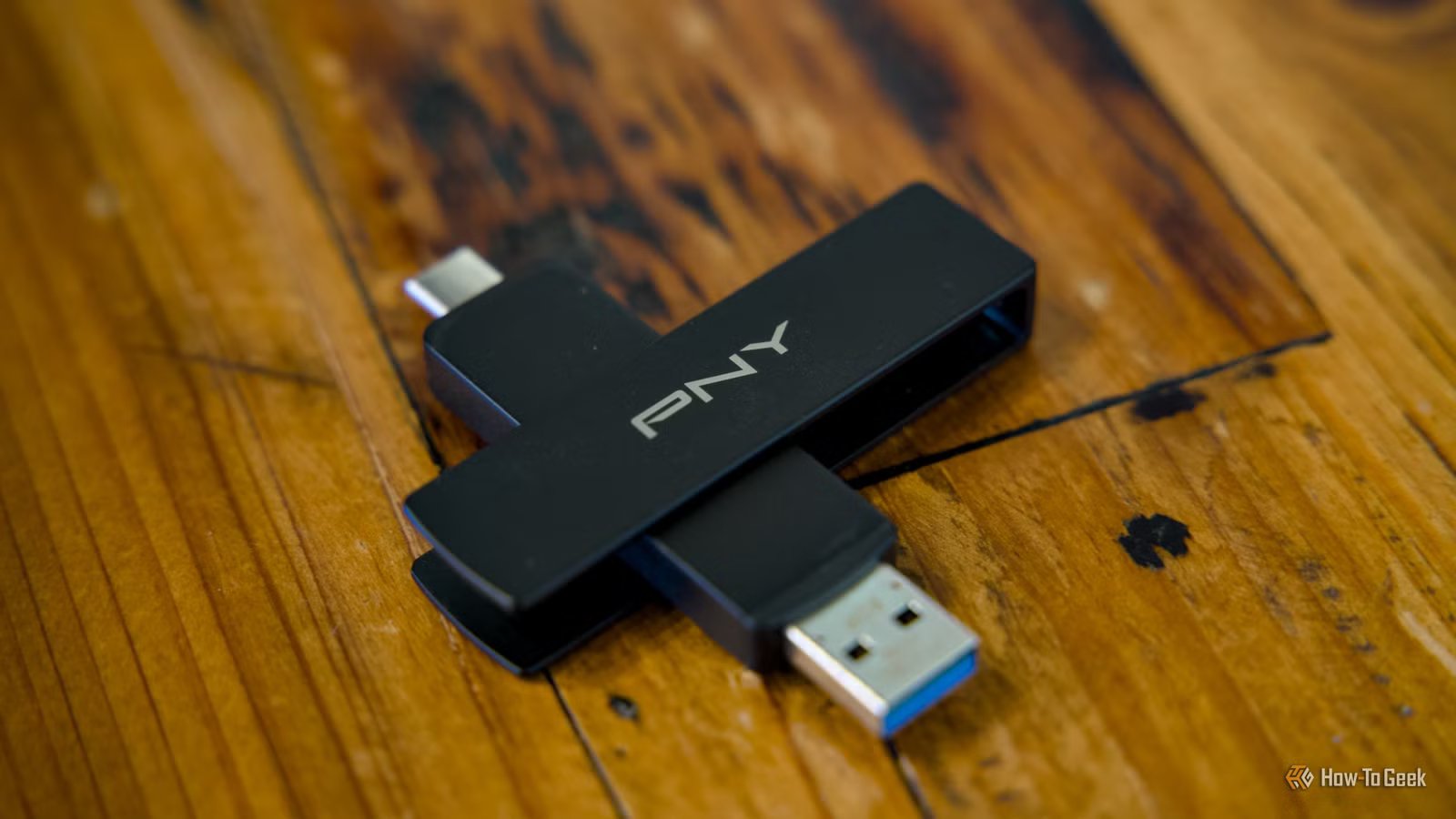
The PNY Duo Link V3 flash drive offers both USB-C and USB-A plugs. With USB 3.2 Gen 2 speeds, you can expect up to 1,000MB/s read and 800MB/s write speeds from this flash drive. Coming in 256GB, 512GB, 1TB, and 2TB storage sizes, this all-metal flash drive makes it easy to bring large amounts of fast storage with you anywhere.
Even if you don’t have many devices to plug it into, you at least have a phone. Thanks to the dual connectors, you can transfer files to and from your phone and another device without carrying a separate cable. A USB is often the perfect, most straightforward solution if you need to transfer lots of large files between your PC and phone quickly, and you don’t have a NAS.
Credit: Patrick Campanale / How-To Geek
The convenience is only the beginning.
Many USB-C/USB-A flash drives are also built with faster USB standards, such as USB 3.2 Gen 1 (up to 5Gbps) or Gen 2 (up to 10Gbps), which allow for faster transfers than the older USB 2.0 standard found on many older or cheaper drives. Having these speeds available on both USB-A and USB-C makes moving files between devices much easier.
Related
SSD prices are skyrocketing: Why you should stock up on USB drives
This $75 USB drive is faster than a SATA SSD (And fits in your pocket)
Adapters are fine until you actually need them
You might say that using a USB-A to USB-C (or vice versa) adapter in conjunction with your single-port USB flash drive gives you flexibility without the cost premium that dual-port flash drives often have—and that’s a valid point.
If you have a USB 3.2 flash drive with USB-A and also grab a compatible USB-C to USB-A adapter to throw in your pocket, you can get the same transfer speeds and most of the convenience.
However, adapters have the inherent disadvantage of not being built into the flash drive itself. They can bend, break, and—let’s be honest—magically get lost right when you need them.
Credit: Jason Montoya / How-To Geek
The worst part is that adding an adapter makes the connection longer, significantly increasing the chances of an accidental disconnect while you’re transferring files, which can corrupt your files.
It’s also worth noting that not all adapters are fully compatible and universal in the way you imagine. An older or poorly made adapter may not support the full bandwidth of your flash drive.
The bottom line is this: an adapter can be a fine solution in a pinch, but if you use a flash drive daily, it creates unnecessary steps and adds friction to your workflow that you can eliminate with a dual USB-C/USB-A flash drive.
USB-C is the future, but USB-A is still everywhere
Credit: Ismar Hrnjicevic / How-To Geek
As we’re all still patiently waiting for USB-C to become the universal, tiny, and reversible connector it’s promised to be, we simply have to face the fact that USB-A isn’t going anywhere—at least not for the next decade or so.
New laptops, computer cases, motherboards, game consoles, monitors, routers, TVs, car infotainment systems, chargers, and a host of other devices are still coming out with USB-A as standard in 2026, with only some higher-end variants of said devices including USB-C ports (albeit rarely or in limited numbers).
Quite frankly, if a modern Windows laptop came out that only used USB-C with no USB-A in sight, I doubt I would personally get it. I know that modern MacBooks and some ultrabooks include only USB-C or Thunderbolt, but the flexibility you lose by going USB-C only is hard to live with—especially when you’re on the go and forget to throw an adapter or hub into your backpack.
Related
It’s time for USB-A to die: Why my next PC will be USB-C only
Step aside grandpa, it’s time for the younger generation to take center stage.
However, as newer devices slowly phase out USB-A, it’s smart to have a flash drive that can connect to literally any device.
Your phone, new PC case, or laptop might only have USB-C, but you want to transfer files to an older computer with USB-A? Your dual USB-C/A flash drive has you covered—no adapters required!
Having both USB-C and USB-A in a single flash drive eliminates the potential compatibility and reliability issues that can come with using an adapter. It’s the only way to make a USB flash drive truly universal, so make sure your next one has both.
