

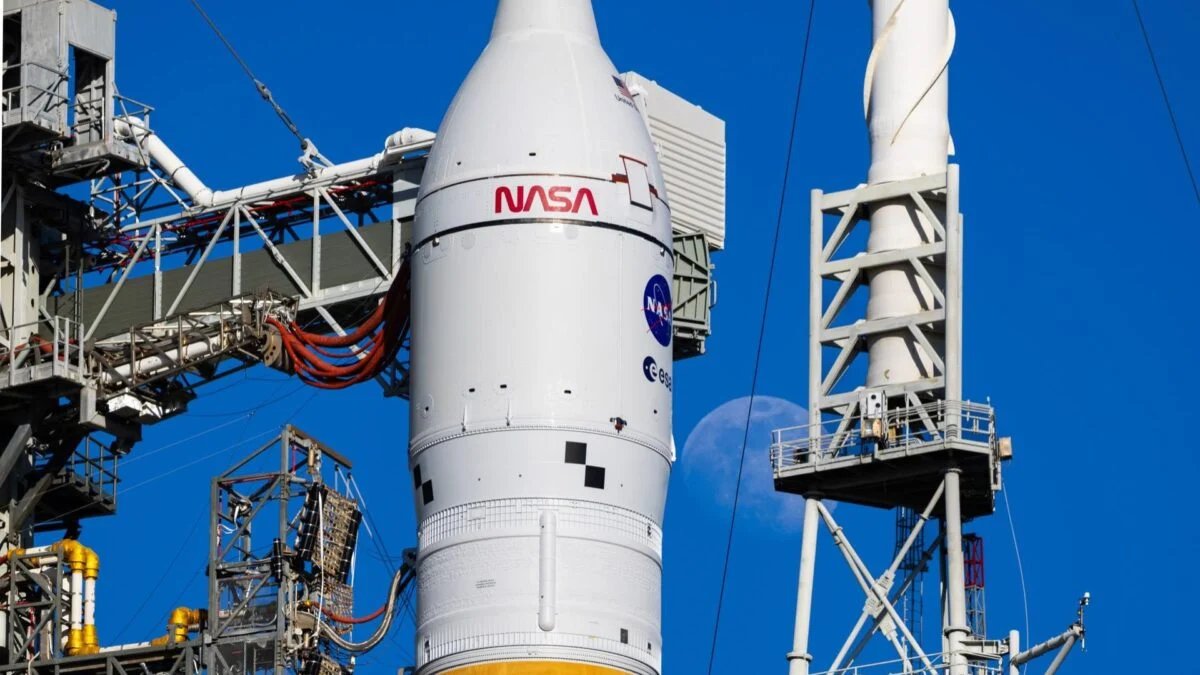
NASA’s pre-launch preparations for the Artemis 2 mission are off to a rocky start, conjuring memories of the technical issues that delayed Artemis 1 by several months. A redo fueling test this week will likely determine whether this mission will face similar setbacks.
In a Monday statement, the agency said it is targeting Thursday as the tanking day for the second Artemis 2 wet dress rehearsal. The first rehearsal ended prematurely on February 3 due to a hydrogen leak in one of the tail service mast umbilicals on the mobile launcher. Since then, engineers have replaced two seals inside the tail service masts and conducted a confidence test of the repairs on February 12, but that didn’t exactly go as planned either.
During the test, engineers encountered an issue with ground support equipment that prevented them from completely filling the Space Launch System (SLS) rocket’s core stage with liquid hydrogen. In a statement posted on X, NASA Administrator Jared Isaacman said the agency still managed to gather “a great deal of data” and observed lower hydrogen leak rates compared to observations during the first wet dress rehearsal.
“Considering the issues observed during the lead-up to Artemis I, and the long duration between missions, we should not be surprised there are challenges entering the Artemis II campaign,” Isaacman said, adding, “There is still a great deal of work ahead to prepare for this historic mission.”
NASA is currently targeting the March launch window, which opens March 6 and closes March 11, for Artemis 2’s liftoff.
All too familiar
To Isaacman’s point, hydrogen leaks have plagued the SLS since the beginning. That’s partly because liquid hydrogen is a notoriously tricky fuel to work with, as these tiny molecules can slip through miniscule gaps in seals and joints. It’s also extremely cold (-423 degrees Fahrenheit, or -253 degrees Celsius), which can cause hardware to become brittle and crack.
A wet dress rehearsal allows engineers to practice fueling and countdown procedures and identify technical issues ahead of a launch. During the test, teams load the SLS core and upper stages with cryogenic propellants (liquid hydrogen and liquid oxygen) and run the countdown to T-29 seconds, stopping short of igniting the rocket’s boosters.
The hydrogen leak during the Artemis 2 wet dress rehearsal appeared in the same location as the leaks that derailed the Artemis 1 rehearsal three years ago. Those leaks forced teams to roll the SLS back to NASA’s Vehicle Assembly Building three times over the course of six months, contributing to extended launch delays.
“We really did learn a lot from the Artemis 1 mission, and we implemented a lot of the lessons learned yesterday through wet dress,” Lori Glaze, NASA’s Exploration Systems Development Mission Directorate acting associate administrator, said during a post-wet dress rehearsal press conference on February 3. Still, it’s clear the agency is still struggling to get the SLS’s fueling issues under control.
Second time’s the charm?
To address the hydrogen leak that halted the Artemis 2 rehearsal, technicians replaced two seals inside the tail service masts. These 35-foot-tall (11-meter-tall) structures provide cryogenic propellant lines and electrical cable connections to the SLS core stage.
During testing on February 12, engineers achieved “several key objectives” but encountered an issue with ground support equipment that reduced the flow of liquid hydrogen into the rocket, according to a NASA statement. Over the weekend, teams replaced a filter they believe caused the problem.
While this partial fueling test wasn’t flawless, engineers gathered enough data to proceed with another wet dress rehearsal this week. But as Isaacman said, much work remains before Artemis 2 is ready for launch. It took four attempts to complete a wet dress rehearsal for Artemis 1, and while lessons learned from that mission could help speed things up, seeing technical issues repeated during Artemis 2 launch preparations isn’t encouraging.
It’s difficult to overstate the importance of this mission. It’s not only the first crewed launch of the SLS and Orion spacecraft but also the first to return astronauts to the vicinity of the Moon since the Apollo era. The success of Artemis 2 is crucial, as it will serve as a critical stepping stone toward Artemis 3, NASA’s planned Moon landing.
The agency definitely does not want to rush Artemis 2—human lives are on the line. At the same time, NASA is under pressure to launch as soon as possible as it races against China to return to the lunar surface. After Thursday’s wet dress rehearsal, we should have a much clearer idea of when this mission will get off the ground.
