

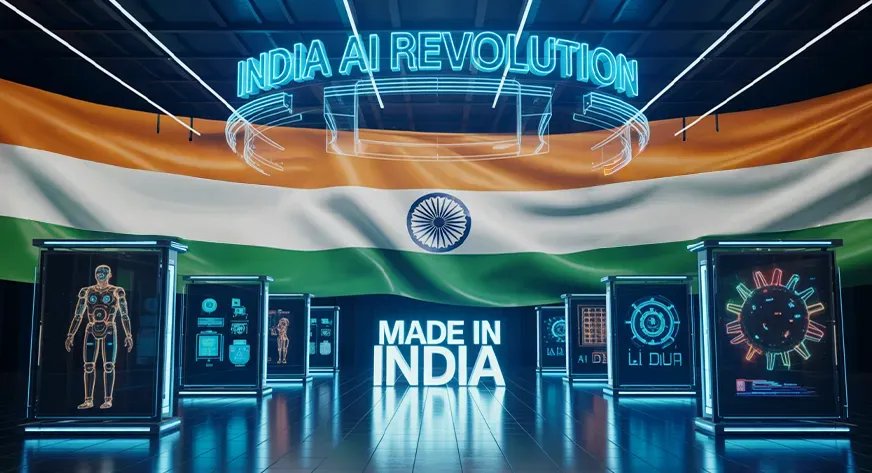
When it comes to new-age technology, India has historically been at the forefront of several eras seen by human civilisation. Following suit, the nation is now stepping up in the age of Artificial Intelligence. A big proof is the ongoing AI Impact Expo 2026 in Delhi. The event has delegates and companies from over 27 countries showcasing their prowess in the field of AI. Graced by top executives and delegates, it has already seen a flood of AI solutions built to better life as we know it. Best part – most of these AI products and services are made in India.
Here, we explore some of the top AI products made in India that are currently on display at the AI Impact Expo 2026. But before we begin with the list, here is a brief about the ongoing summit and expo, and what it aims to achieve.
AI Impact Expo 2026: First-of-its-kind AI Initiative
The AI Impact Expo 2026 stands as India’s first global event dedicated to showcasing the use of AI and its impact across sectors. The five-day event is taking place in the capital, at Bharat Mandapam, from February 16 to 20. As mentioned on its official website, it hosts over 30 countries and 300 plus exhibitors across 10 plus pavilions for a grand expo on AI.
Guided by the principles of ‘People, Planet, and Progress,’ the event is to bring together the top players in the field of AI, as well as policymakers, at a unified platform. This should further enable easier connections and discussions on the future of AI, its use, and its impact on human lives. In totality, the AI Impact Expo 2026 envisions “a future where AI advances humanity, fosters inclusive growth, and safeguards our shared planet.”
With that vision in mind, here are the top made-in-India AI products that graced the halls of the expo.
1. Two New Large-Language-Models (LLMs) by Sarvam AI
We can talk about AI all we want. But for its practical use-case, most of the world relies either on the US or on China. This is simply because the most capable large-language-models to date belong to these countries. Enter a Bengaluru-based AI startup that wants to change the game. Sarvam AI, as it is called, has debuted 2 new LLMs at the ongoing AI Impact Expo 2026.
These are 30B and 105B parameter large-language models. As the company puts it on its website, these models are built not just for performance, but for sovereign deployment. In simple terms, organisations can run powerful AI within their own infrastructure, without shipping sensitive data across borders. For banks, government systems, defence networks, and healthcare institutions, that is a big “must-have.”
But security is just one play here. These models are tuned for multilingual Indian contexts and enterprise workflows. This makes them practical for real-world use. Imagine all the tasks performed on ChatGPT or Qwen today – drafting policy documents, automating citizen services, analysing compliance data etc. All being powered by a homegrown Indian AI.
Also read: Top LLMs made in India
2. Voice Cloning by Gnani.ai’s Vachana TTS
If AI is meant to serve a billion people, it needs to speak their language. Gnani.ai’s Vachana TTS aims to do exactly that. Introduced at the AI Impact Expo 2026, Vachana TTS is a text-to-speech system that can clone a human voice using less than 10 seconds of reference audio. Yes, ten seconds!
The model preserves tone, pitch, and speaking style perfectly, all while producing speech that sounds all natural. More importantly, it works across 12 Indian languages, making it practical for India, where linguistic diversity often becomes an access barrier.
Built for low-bandwidth environments, Vachana is designed for real-world deployment. This means it can be used for government helplines and citizen services, customer support systems, and enterprise automation. Imagine official announcements delivered in familiar local voices, or support calls handled in a tone that feels human, not scripted.
3. AI-Powered Kids’ Robots by Miko
Now this is one of those made-in-India AI products that are already quite popular across the country. You may have seen it in any established toy store near you. Showcased at the AI Impact Summit, Miko is an AI-powered robot that is meant to accelerate your child’s learning through fun games, as well as interactive idea-sharing sessions on the go. Think of a ChatGPT on wheels, built especially for kids.
During the expo, Miko founder Sneh Vaswani told Prime Minister Narendra Modi that the product and its underlying intelligence were developed entirely in India and are now being exported globally. He also mentioned that Miko currently serves over 5 lakh households across the world, helping children stay safe, have fun, and learn constantly, all with the power of AI.
4. Elixis-W: The Made-in-India Humanoid by Addverb
We have all seen smart and capable humanoids performing several seemingly impossible actions in several videos. Most such robots that you see are being built by companies either in the West or in China. At the AI Impact Expo 2026, it is evident that Indian firms are also catching up with the trend.
Proof – Elixis-W, a completely made-in-India humanoid robot, presented at the summit. Noida-based AI and robotics firm Addverb built Elixis-W to operate primarily in manufacturing plants, warehouses, and industrial environments. The robot uses AI to mimic human mobility and dexterity. This means it can navigate complex shop floors, handle materials, assist in repetitive tasks, and support human workers in physically demanding operations.
An important distinction here – unlike most other humanoids, Elixis-W is wheeled at the bottom instead of regular legs. This has enabled faster deployment for the robot, as the company notes that most warehouses and manufacturing facilities have flat, structured floors. In the long term, Addverb has plans for a legged humanoid, but for now, it has introduced Addverb for faster, wheeled mobility.
Addverb’s goal is to transform traditional supply chains for complete automation. On its website, the company claims to have served over 350 clients, automating over 500 warehouses by deploying over 2000 robots to date. These robots help with sortation, cargo movement, picking, and storage.
Because Addverb manufactures every component in India, the company can produce up to 1 lakh robots each year.
5. Early TB Detection AI System by Wadhwani AI
If we are talking about AI’s impact, it is in no way limited to industrial optimisation. Wadhwani AI, an initiative risen from the grounds of Mumbai, proves it. The company is all about AI for social impact, with several of its solutions collectively reaching over 190 million beneficiaries across India and other countries.
One of its solutions, for instance, that found its way to the AI Impact Expo 2026, is an AI-powered software that is able to detect Tuberculosis from a phone or a tablet. The way it works is it listens to your cough for its sound, then maps it with a set of questions that you need to answer. Based on a collective report, it detects whether you suffer from TB or not.
Other than this, the organisation has come up with AI solutions across healthcare, education, and agriculture. It has partnered with government agencies, NGOs, academic institutions, and private sector leaders to deploy AI solutions for the bottom 95% across India.
6. The Back-End Logistics Robot by Alphadroid
Yet another AI-powered robot showcased at the AI Impact Summit tackled the problem of everyday logistics. Be it a hospital, a hotel, or a retail store, the movement of supplies is quintessential for smooth operations. Noida-based Alphadroid aims to ensure exactly that, with its CarryMate robot.
At its core, CarryMate is a smart utility robot that autonomously transports supplies, equipment, and inventory across large facilities. Built in India from the ground up, it is purpose-designed for hospitality, healthcare, retail, airports, and QSR environments. Its task – quietly handle the behind-the-scenes movement that keeps operations running smoothly.
Using SLAM-based navigation, LiDAR, depth cameras, and real-time sensors, the robot maps environments, avoids obstacles, and delivers items. Its modular tray system can carry loads up to 60 kg per tray. There is also integrated tracking that ensures items reach the right destination without routing errors.
In simple terms, while staff focus on people and service, CarryMate’s job is to keep the entire facility moving. And for this useful purpose, it finds its place on our list.
7. Spam and Fraud Detection Solution by Airtel
Airtel users across the country know of this. The telecom provider had come up with a unique AI-powered solution to tackle one of the biggest problems faced in our nation – that of spam and fraud over voice calls. Its network-based AI-powered spam and fraud detection solution comes as the first in India to combat the growing menace of unwanted calls and messages.
Built into Airtel’s AI-powered network, the system automatically scans all incoming calls and SMS in real time and flags suspicious ones as “Suspected Spam.” This helps users avoid fraud and nuisance communications. The dual-layer solution (at both network and IT systems levels). For this, AI processes nearly 1 trillion records in real time, identifying about 100 million spam calls and 3 million spam SMSes daily.
More importantly, Airtel powers the solution with proprietary algorithms developed in-house and offers it free to users with automatic activation. It clearly demonstrates how AI can strengthen protection against scams, phishing links, and fraudulent activity.
8. AI Traffic Camera Recon by Stellarview
Can you use AI to turn the everyday traffic chaos into useful data? Recon by Stellarview has been built for that purpose.
Showcased as the world’s first edge GenAI-powered ITS camera, Recon is meant to gather road intelligence. For this, it monitors highways, smart cities, and urban corridors for real-time response. Instead of merely capturing footage, the system processes data on the edge. It then enables real-time decisions without relying on distant servers.
At its core is AI-driven video analytics that reads number plates, classifies vehicles, detects violations, and flags incidents instantly. Think overspeeding and wrong-lane driving to helmet violations and banned vehicle movement. Recon automates enforcement with evidence capture and real-time alerts.
Its Automatic Traffic Counting & Classification engine identifies 18 vehicle categories tailored to Indian road conditions. It is also equipped with a Video Incident Detection System. The system flags stalled vehicles, accidents, wrong-way driving, and even animal crossings. Integrated speed detection and enforcement tools ensure violations are logged and linked to specific vehicles.
Because the intelligence runs on-device, Recon works day and night reliably, even in bandwidth-limited environments.
9 The AI That Eats Your Waste: Chewie by Mankomb
Let’s be honest. Dealing with kitchen waste is the least glamorous part of adult life. Chewie wants to make it disappear, almost magically if I may add.
Positioned at the AI Impact Expo 2026 as the first AI-native home wet waste management appliance, Chewie quietly converts everyday food scraps into nutrient-rich soil. All of this, right inside your kitchen. Which basically means no smell, no mess, and no backyard compost drama.
Using computer vision and control AI, Chewie identifies what you drop in, then automatically optimises temperature, airflow, moisture, and mixing to accelerate microbial breakdown. The result? Organic waste becomes usable “Regen Soil” in as little as 8 to 40 hours.
And yes, it works with the chaos of Indian kitchens: curries, leftovers, oily food, even small bones. If something doesn’t belong, the AI flags it.
Designed for urban homes, Chewie runs silently (<40 dB), consumes minimal power, and processes up to 120 kg of wet waste per month. A carbon filtration system ensures that while all this is happening, your kitchen smells like a kitchen, not a landfill.
Think of it as sustainability on autopilot.
10. India’s First AI-powered Glasses: Sarvam Kaze
Sarvam AI definitely deserves a double mention in this list, simply because of its slew of launches that position India as an AI creator, and not just a consumer anymore. Case in point, India’s first AI-powered smart glasses – the Sarvam Kaze. And just like the Meta Ray-Ban glasses, these are packed with several AI features, with Sarvam’s own nifty little tweaks.
Think of Kaze as a wearable AI companion, designed to cover your eyes, but interact with the real world. The glasses can capture photos and videos hands-free, listen to conversations, understand context, and respond in real time, all without you pulling out your phone.
But the real ambition goes beyond recording moments. Sarvam describes Kaze as a platform where developers can build custom AI experiences, turning the wearable into everything from a productivity assistant to an accessibility tool.
Built to run AI directly in everyday environments, the device represents a shift away from screens and toward ambient intelligence, where technology quietly works in the background while you stay present in the real world.
With Sarvam’s AI models now stepping into hardware, Kaze signals something bigger: India is already building on AI for the real-life impact, and not just on theory. While the tech majors took decades to transition to AI hardware, Sarvam has shown how its practical approach will bring AI to the people of India in a way shorter time.
Conclusion
The innovations showcased at AI Impact Expo 2026 make one thing unmistakably clear. India is no longer just adopting artificial intelligence. It is (or at least aiming to) actively building it. From breaking language barriers and enterprise operations to better healthcare, public safety, and infrastructure. These made-in-India AI products and solutions reflect AI designed for real-world impact.
And you don’t have to look closely to see what stands out – the diversity of application. The same technology powering warehouse robots and fraud detection is also helping children learn. It is further enabling early disease detection and even restoring hearing.
Know this – India is already the top user base of the biggest AI solutions like ChatGPT and Gemini. As the country invests in digital infrastructure and homegrown innovation, it is now positioning itself not just as a consumer of AI, but as a creator of globally relevant solutions. The message from the expo is clear: India’s AI moment is here, and it is built for impact.
Technical content strategist and communicator with a decade of experience in content creation and distribution across national media, Government of India, and private platforms
Login to continue reading and enjoy expert-curated content.
Keep Reading for Free
