

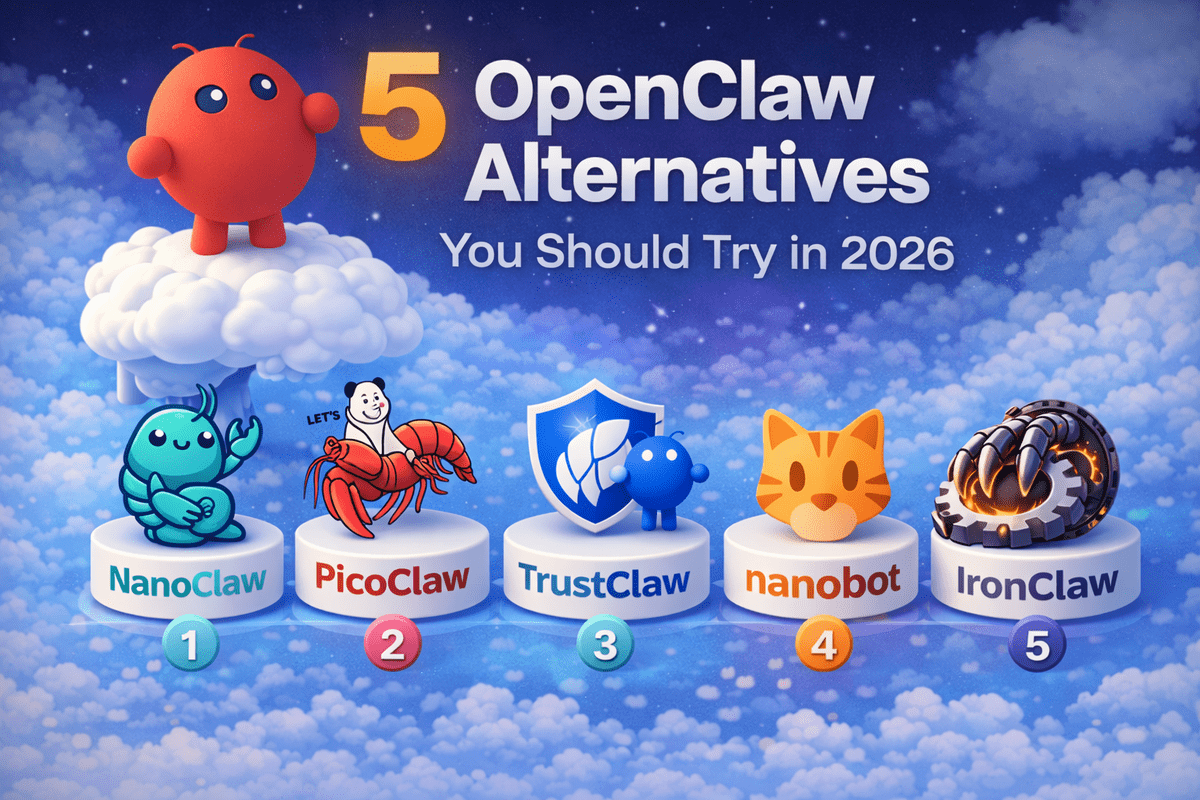
Image by Author
# Introduction
OpenClaw has quickly become one of the most talked about open source autonomous AI agent projects, especially among developers building agents that connect to messaging apps, automate workflows, and take real actions through tools and plugins. However, OpenClaw is not the only option in 2026.
A new wave of lightweight, security focused, and modular agent frameworks is emerging. Many of these alternatives are designed to be easier to deploy, safer to run locally, and more optimized for specific agent use cases.
In this article, we review five of the best open source and commercial alternatives to OpenClaw that are faster, smaller, and built with local first performance and security in mind.
# 1. NanoClaw
NanoClaw is a lightweight alternative designed with security in mind. Instead of running directly with broad system access, NanoClaw is built to operate inside containers, which helps isolate the agent environment and reduce exposure.
It supports messaging integrations such as WhatsApp, includes memory features, and can run scheduled background jobs. NanoClaw also integrates directly with Anthropic’s Agents SDK, making it appealing for developers building on Claude based workflows.
🔒 Best for teams who want agent automation with stronger containment and safer execution.
# 2. PicoClaw
PicoClaw focuses on speed, simplicity, and portability. It is designed to be extremely small and easy to deploy across environments, including local setups, containers, or lightweight edge systems.
Rather than offering a massive ecosystem, PicoClaw emphasizes doing the basics well: automating repetitive tasks, enabling agent workflows, and staying minimal.
⚡ Best for developers who want a fast agent runtime without heavy infrastructure.
# 3. TrustClaw
TrustClaw is a more platform oriented alternative, offering an agent experience that prioritizes usability and trust. Unlike purely local open source frameworks, TrustClaw positions itself as a managed environment for running AI agents safely.
This is useful for users who want agent capabilities without maintaining the full operational complexity of a self hosted system.
☁️ Best for users who prefer a hosted and structured agent platform over DIY setups.
# 4. NanoBot
NanoBot is one of the most lightweight OpenClaw style alternatives available. It is written in Python and designed to be compact, understandable, and easy to extend.
NanoBot provides core agent building blocks such as tool use, memory, and messaging automation, but with a much smaller codebase compared to large scale agent ecosystems.
Its simplicity makes it easier to audit and customize, especially for researchers or developers experimenting with agent design.
💾 Best for builders who want a clean and minimal agent framework in Python.
# 5. IronClaw
IronClaw takes a modular approach to agent development. It is designed for developers who want structured autonomy, flexible tool execution, and reusable components for building more advanced systems.
While it may not be as tiny as NanoBot or PicoClaw, IronClaw provides a stronger foundation for teams building production grade workflows and multi tool automation pipelines.
🧩 Best for developers who want a scalable and modular agent framework beyond simple prototypes.
# Final Thoughts
Here is a quick takeaway of which agents are best for which scenarios:
Agent
Ideal Use Case
NanoClaw
🔒
Best for teams who want agent automation with stronger containment and safer execution.
PicoClaw
⚡
Best for developers who want a fast agent runtime without heavy infrastructure.
TrustClaw
☁️
Best for users who prefer a hosted and structured agent platform over DIY setups.
NanoBot
💾
Best for builders who want a clean and minimal agent framework in Python.
IronClaw
🧩
Best for developers who want a scalable and modular agent framework beyond simple prototypes.
OpenClaw helped popularize the idea of local first autonomous AI agents, but the ecosystem is expanding rapidly in 2026.
These alternatives show the direction agent tooling is heading:
- More secure execution through containers
- Smaller and more auditable frameworks
- Easier deployment and portability
- Modular systems for serious automation use cases
If you are building agents this year, exploring these projects is a great first step.
Abid Ali Awan (@1abidaliawan) is a certified data scientist professional who loves building machine learning models. Currently, he is focusing on content creation and writing technical blogs on machine learning and data science technologies. Abid holds a Master’s degree in technology management and a bachelor’s degree in telecommunication engineering. His vision is to build an AI product using a graph neural network for students struggling with mental illness.
