

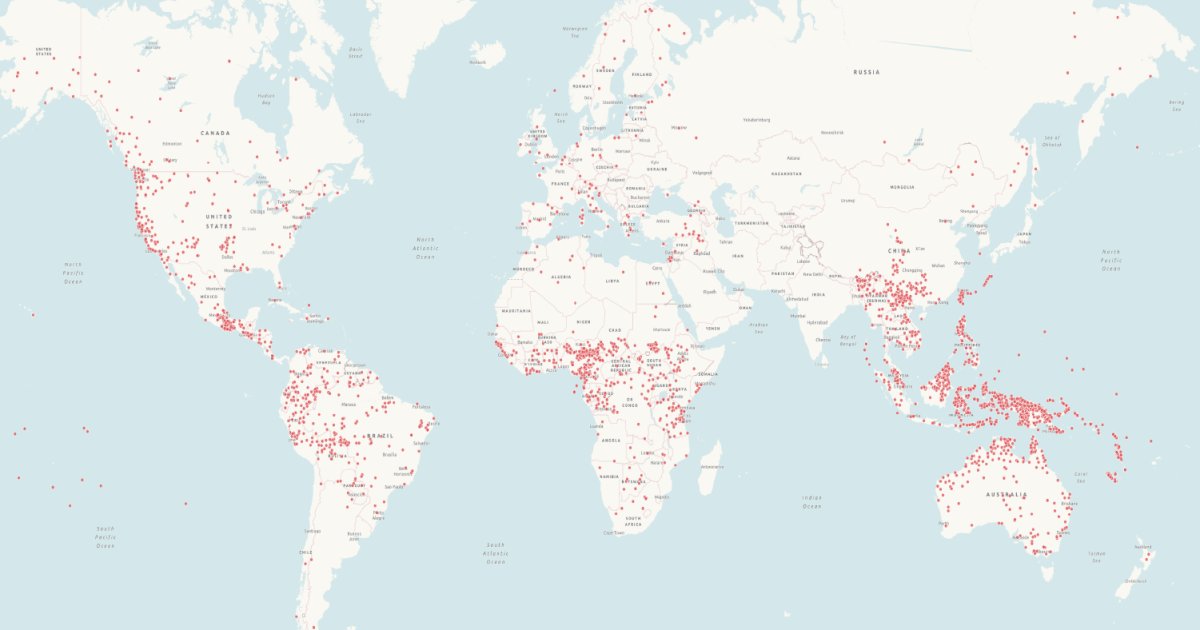
More than 7,000 languages are spoken around the world today and at least 3,000 of them, or 40 percent, are endangered.
English is the most widely spoken language, with approximately 1.5 billion speakers in 186 countries. Two out of every 10 English speakers are native, while the remaining 80 percent speak English as their second, third or higher language, according to Ethnologue, a database which catalogues the world’s languages.
Mandarin Chinese is the second most spoken language with almost 1.2 billion speakers. However, when accounting for native speakers, it is the largest language in the world, owing to China’s large population.
Hindi comes in third at 609 million speakers, followed by Spanish (559 million), and Standard Arabic (335 million).
Scripts in the world’s most popular languages
There are 293 known scripts – sets of graphic characters used to write a language – according to The World’s Writing Systems, a reference book about global scripts.
More than 156 scripts are still in use today, while more than 137 historical scripts, including Egyptian Hieroglyphs and Aztec pictograms, are no longer in use.
The Latin script, which is used to write English, French, Spanish, German and more, is used in at least 305 of the world’s 7,139 known living human languages. More than 70 percent of the world’s population use it.
Which are the most endangered languages?
Of the 7,159 languages spoken worldwide, 3,193 (44 percent) are endangered, 3,479 (49 percent) are stable, and 487 (7 percent) are institutional, meaning they are used by governments, schools and the media.
A language becomes endangered when its users begin to pass on a more dominant language to the children in the community. Many are used as second languages.
According to Ethnologue, some 337 languages are said to be dormant while 454 are extinct.
Dormant languages are those that no longer have proficient speakers, but the language still has social uses and the language is part of the identity of an ethnic community. Extinct languages are those that have no speakers and no social uses or groups that claim it as part of their heritage or identity.
According to Ethnologue, 88.1 million people speak an endangered language as their mother tongue. There are:
- 1,431 languages with fewer than 1,000 first-language speakers
- 463 with fewer than 100 speakers
- 110 with fewer than 10 speakers
Just 25 countries are home to some 80 percent of the world’s endangered languages. Oceania has the most endangered languages, followed by Asia, Africa and the Americas.
Some endangered languages include:
Oceania
In Australia, Yugambeh, an endangered Aboriginal language, is spoken by the Yugambeh people, primarily across the Gold Coast, Scenic Rim and Logan in eastern Australia.
In recent years, a strong community-led revitalisation programme and the use of learning apps have made the language more accessible to younger generations.
Asia
Japan’s Ainu (Ainu Itak) is a critically endangered language. According to UNESCO, it can’t be linked with certainty to any family of languages. The exact number of Ainu speakers is unknown, however a 2006 survey showed that out of 23,782 Ainu, 304 know the language.
Africa
In Ethiopia, Ongota is a critically endangered language.
It was spoken by a community on the west bank of the Weito River in southwest Ethiopia. There are only about 400 members of the community left, with a handful of elders speaking the language.
Americas
In North and Central America, almost all Indigenous languages are endangered. Louisiana Creole, a French-based creole with African and Indigenous influences, is a seriously endangered language in the United States, with it mostly spoken by elders.
Leco is an endangered Indigenous language spoken in Bolivia and is considered an isolated language – one that has no genetic relationship to other languages. The language is only now spoken by elders with a Leco ethnic population of only about 13,500.
Europe
Cornish (Kernewek), spoken in southwest England, was marked as an extinct language by UNESCO, until it was revived and in 2010 changed to an endangered language. It is spoken as a first language by 563 people according to the 2021 England and Wales census.
