

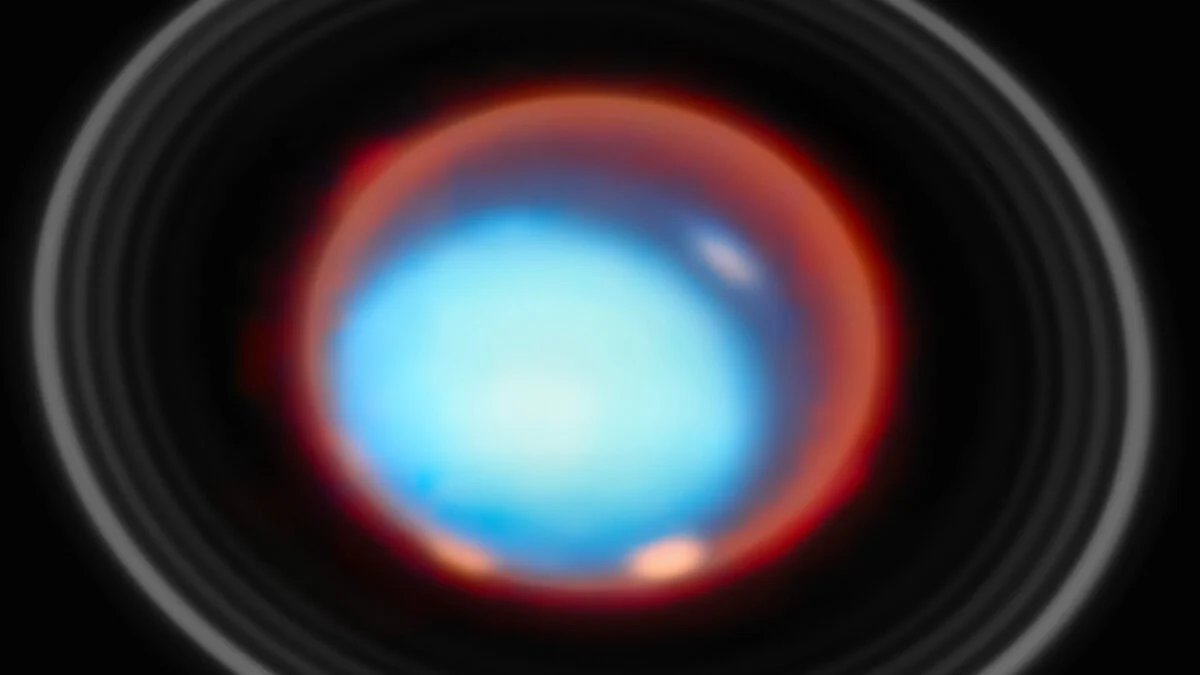
On January 19, the Webb space telescope stared deep into the chaotic world of Uranus for 17 hours, observing as the faint glow from molecules above the planet’s clouds meets its unusual magnetic field. The resulting data helped scientists map Uranus’s upper atmosphere in unprecedented detail, revealing new insight into how its tantalizing auroras are formed.
An international team of researchers used Webb’s Near-Infrared Spectrograph (NIRSpec) instrument to map the temperature and density of ions found around 3,000 miles (5,000 kilometers) above Uranus’s cloud tops. The findings, published in Geophysical Research Letters, reveal how the planet’s eccentric magnetic field influences its auroras and offer new insight into how energy behaves in the upper layers of ice giants.
“This is the first time we’ve been able to see Uranus’s upper atmosphere in three dimensions,” Paola Tiranti, a PhD student at Northumbria University in the U.K., and lead author of the study, said in a statement. “With Webb’s sensitivity, we can trace how energy moves upward through the planet’s atmosphere and even see the influence of its lopsided magnetic field.”
Giant weirdo
Uranus has a rather unusual magnetic field. The planet’s rotation axis is tilted over 90 degrees, causing the planet to rotate on its side. The magnetic axis also has a large tilt, nearly 60 degrees away from its rotation axis. Its sideways magnetic field gives Uranus a more variable magnetosphere, meaning its auroras sweep across the surface in more complex ways, according to NASA.
The recent Webb observations detected two bright auroral bands near Uranus’s magnetic poles, as well as a significant depletion of ion density and emissions in the region between the bands. This is likely due to how magnetic field lines guide charged particles through Uranus’s atmosphere.
It was the Hubble Space Telescope that spotted auroras on Uranus for the first time in 2012. Since then, scientists have sought to understand how the planet’s whacky magnetosphere influences its auroral displays.
“Uranus’s magnetosphere is one of the strangest in the Solar System,” Tiranti said. “Webb has now shown us how deeply those effects reach into the atmosphere.”
A collage of Webb’s recent observations of Uranus. Credit: ESA/Webb, NASA, CSA, STScI, P. Tiranti, H. Melin, M. Zamani (ESA/Webb)
Cold world
NASA’s Voyager 2 spacecraft carried out the first close flyby of Uranus on January 24, 1986. The mission revealed a pale blue world that’s very cold compared to its neighboring planets. At the time, temperatures in Uranus’s upper atmosphere plunged below -353 Fahrenheit (-214 Celsius).
Webb’s recent data also confirmed that Uranus’s upper atmosphere is still cooling. Based on data collected by the Voyager 2 flyby, Uranus’s upper atmosphere was found to be undergoing a long-term cooling trend, with temperatures dropping over time. The team measured temperatures around 302 Fahrenheit (150 Celsius) lower than ones recorded during previous attempts.
“By revealing Uranus’s vertical structure in such detail, Webb is helping us understand the energy balance of the ice giants,” Tiranti said. “This is a crucial step towards characterizing giant planets beyond our solar system.”
