

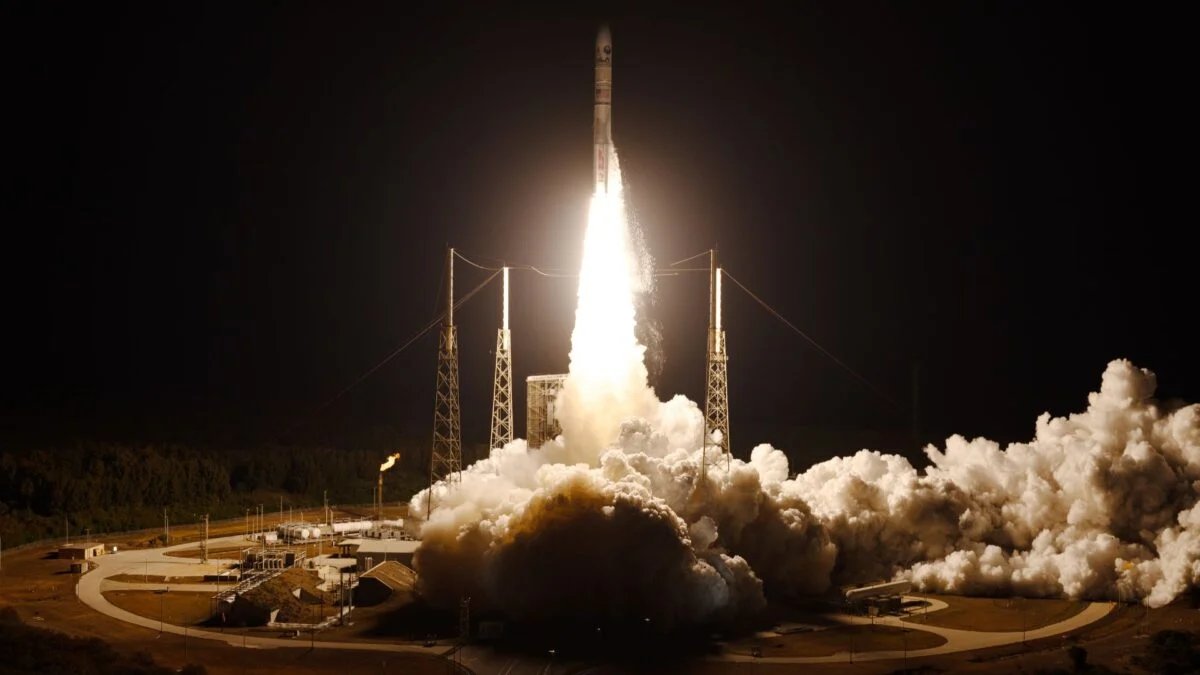
A United Launch Alliance (ULA) Vulcan Centaur rocket successfully delivered two national security satellites to orbit earlier this month but suffered an anomaly that caused one of the boosters to emit an unusual plume of debris. Now, the U.S. Space Force has paused all military launches aboard the rocket until the issue is resolved.
The investigation could take months, Colonel Eric Zarybnisky, acting portfolio acquisition executive for space access, told reporters at the Air and Space Forces Association’s Air Warfare Symposium on Wednesday, according to Aviation Week. This has thrown the timing of more than a dozen Space Force missions planned for this year into question.
“Until this anomaly is solved, we will not be launching National Security Space Launch missions on the Vulcan,” Zarybnisky reportedly said, adding that mission success is the “number one priority.”
What went wrong?
Vulcan Centaur launched from Cape Canaveral Space Force Station in Florida in the pre-dawn hours of February 12, carrying a pair of space surveillance satellites for the Space Force’s Geosynchronous Space Situational Awareness Program.
Early on in the flight, officials observed an anomalous plume of debris emanating from one of the rocket’s solid boosters. Vulcan still managed to deliver its payloads to their designated orbits, but the issue still warranted investigation.
Uhhh….that’s not great. Looks like Vulcan may have lost one of its SRB nozzles again… A burnthrough happens at T+0:29, and then looks like the full nozzle falls off at T+1:06. Vulcan also had this issue on the Certification-2 mission.
📸 https://t.co/QwC08n4J6Q & ULA pic.twitter.com/NTFxkqKvn0
— Lukas C. H. (@GewoonLukas_) February 12, 2026
This was the rocket’s fourth flight, and it wasn’t the first time it has experienced this kind of anomaly. During its second launch in October 2024, a malfunctioning insulator failed to protect one of the booster nozzles from the exhaust, causing it to fail and produce a cloud of debris.
It took months for the Space Force to resume launching missions aboard Vulcan after that mishap. It’s possible that the same malfunction is behind this most recent anomaly, but that remains under investigation.
ULA back in the doghouse
Vulcan’s next Space Force mission is slated for March. The flight is supposed to carry the tenth and final GPS 3 satellite to medium-Earth orbit, but the odds of Vulcan getting cleared to fly military payloads by then are looking slim.
In May, the rocket is scheduled to launch the first of three Next Generation Overhead Persistent Infrared geostationary satellites for the Space Force. These orbiters are designed to enhance U.S. and allied missile warning capabilities. Depending on how long it takes to resolve Vulcan’s booster anomaly, this mission—and subsequent Space Force flights—could get bumped too.
To avoid cascading delays, the Space Force could transfer Vulcan’s upcoming missions to SpaceX’s Falcon 9 rocket—it wouldn’t be the first time. Officials have done so for the past three GPS 3 satellite launches to minimize the impact of Vulcan delays.
Zarybnisky said Wednesday that he had not switched launch providers for the March GPS 3 mission yet but added that he is considering a number of options to get the satellite to orbit as soon as possible, according to Aviation Week.
ULA plans to ramp up Vulcan launches in 2026, aiming for 18 to 22 flights. More than half of those missions are supposed to come from the Space Force, but if the company can’t get a handle on its rocket’s technical issues, it could lose those opportunities. Repeated mishaps are already straining ULA’s relationship with the Space Force and helping SpaceX secure its position as the military’s most reliable launch provider.
The pressure is on for ULA to get to the bottom of Vulcan’s latest anomaly or risk falling short of its ambitious 2026 launch goal.
