

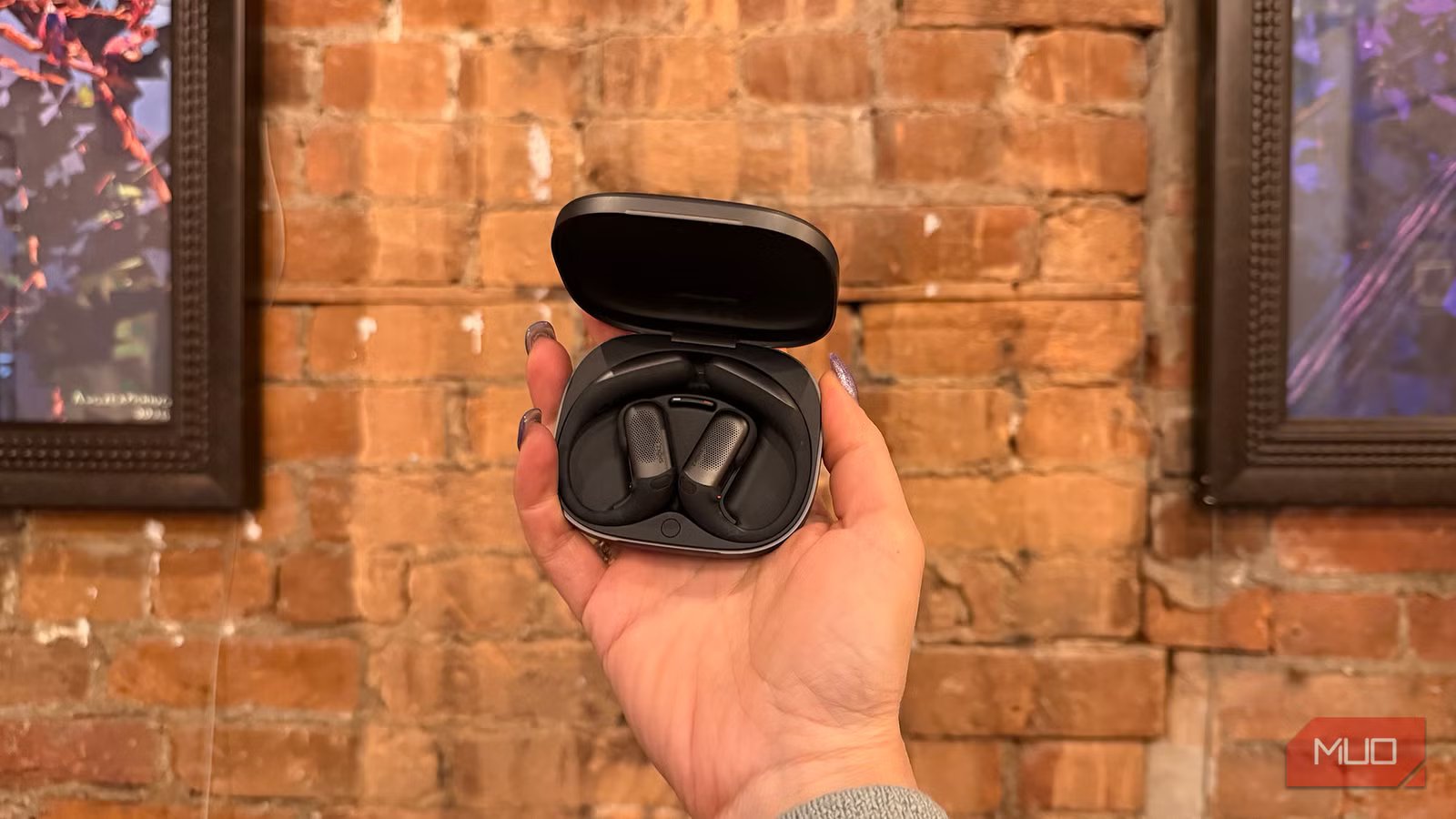
Open-ear earbuds and noise cancellation don’t typically go together. By definition, open-ear buds sit atop your ears versus going inside them, which logically means sound leaks in since your ear canals aren’t sealed. But somehow, Shokz, one of the top brands in this space, has managed to develop a pair that offers noise reduction through its own technology. The Shokz OpenFit Pro earbuds, which were introduced at CES 2026 earlier this year, have been making waves for this reason.
I had the chance to test them in a variety of scenarios, including at home while working, listening to music, and making calls, at a local (and busy) coffee shop, while going for daily outdoor walks, and doing workouts at home, from cardio to strength training. While I tested every aspect of these buds, what really blew me away is that the noise cancelling actually works.
Related
MakeUseOf’s CES 2026 Best in Show: Headphones, rollable laptops, and multi-screen smartphones
It’s a bumper year for shiny new tech at this year’s edition of CES.
How Shokz achieves noise cancelling
It uses a clever set-up
The OpenFit Pros, as with any other open-ear buds, sit atop your ear, securing through hooks positioned around the back of the lobe. Noise reduction is provided through Shokz’s own technology called OpenEar Noise Reduction. As the first pair to include this technology, it’s achieved through a combination of methods. There are three mics in each bud. The first mic monitors external noise, the second enhances noise reduction, and the feedback mid predicts in-ear noise. These work in tandem with an algorithm that adapts to your ear, analyzing sound in real-time, and reducing low-frequency ambient noise.
The Shokz SuperBoost dual diaphragm driver, meanwhile, is designed to enhance overall sound, providing finer details. But the byproduct of this enhancement is that higher frequency response means the earbuds can better detect lower frequency noise, like the hum of an engine, rustling of the wind, or chatter in a café. Once identified, the buds suppress them. The result? Noise cancellation in an open-ear design. Of course, these aren’t going to rival the top ANC headphones. But as a feature you don’t typically find in open-ear buds, it’s a massive plus. And they even outperform some entry- and mid-level in-ears I’ve tested that offer varying degrees of noise cancellation.
How well the noise cancelling works
It blew me away
As mentioned, I tried the noise reduction feature in a variety of scenarios, and the fact that it works at all is an impressive feat in and of itself. It performs best, as expected, in scenarios with consistent, low frequency sounds, like the hum of my furnace at home, chatter and background music in a busy coffee shop, even quiet outdoor sounds. It didn’t work as well while walking along a busy road: I still had to crank the volume to hear with rows of cars going by or to compensate for high winds. But it was better than buds with no noise cancellation at all.
Using a slider in the companion app, you can adjust the level of noise cancellation, too. So, you might only want mild noise reduction while running a local trail but maximum noise reduction at the gym so you can get into your workout zone, or even while commuting. Note that it only works when you have both buds in your ears. It’s also worth keeping in mind that when you turn on noise reduction mode, battery life drops by half from up to 12 hours per charge to 6 (24 hours using the charging case versus 50). That’s still pretty decent, especially if you’ll only be using noise reduction in certain scenarios.
Who should get these buds?
Preference, fit, sensitive ears
Open-ear buds like these ones are growing in popularity for a variety of reasons. Some active individuals prefer them. Runners, especially, gravitate to neckband bone conduction models that sit at your temples since they sit nicely while you do a 10K while you can still be aware of your surroundings. There are people who have sensitive ears as well, or who simply don’t like buds that plug their ears. Some people have trouble finding in-ear buds that fit securely, whether it’s because they have extra-small ear canals/ears or can just never get positioning right. For some, wearing buds for hours while taking calls, for example, is uncomfortable, while these are easy to forget you even have them on.
The addition of noise cancelling in this pair, something you might not think is possible with open-ear buds, makes them jump to the top of the list of ones to get. I compared them to the original Shokz OpenFit earbuds, which were introduced in 2023, and those still sound fantastic, too. But the noise cancellation along with additional features like head tracking and enhanced bass, along with longer battery life (without noise reduction) make these worth considering. They don’t perform as well as in-ear noise cancelling buds like my favorites, the Panasonic Technics EAH-AZ100s. But as a compromise model, they don’t disappoint.
