

I have been an inveterate Mac user for 25 years, and I have always loved the Cupertino company’s design philosophy, deep integration of hardware and software, and pure aesthetics. However, when it comes to mobile, I am an Android fan through and through, and I have always relied on its native Google Maps for navigation.
So it came as a surprise to learn that Apple, the company known for maintaining a tightly controlled ecosystem, has made its Apple Maps service accessible on Android devices. Could this be the answer to cross-platform compatibility that many Mac users have been waiting for? As I found out, Apple Maps is certainly available, but not in the way most Android users might expect.
OS
iOS
Developer
Apple Inc.
Price model
Free
Initial release
September 19, 2012
Apple Maps is Apple Inc.’s native mapping and navigation app that provides directions, real-time traffic updates, and turn-by-turn navigation.
What’s actually rolled out on Android
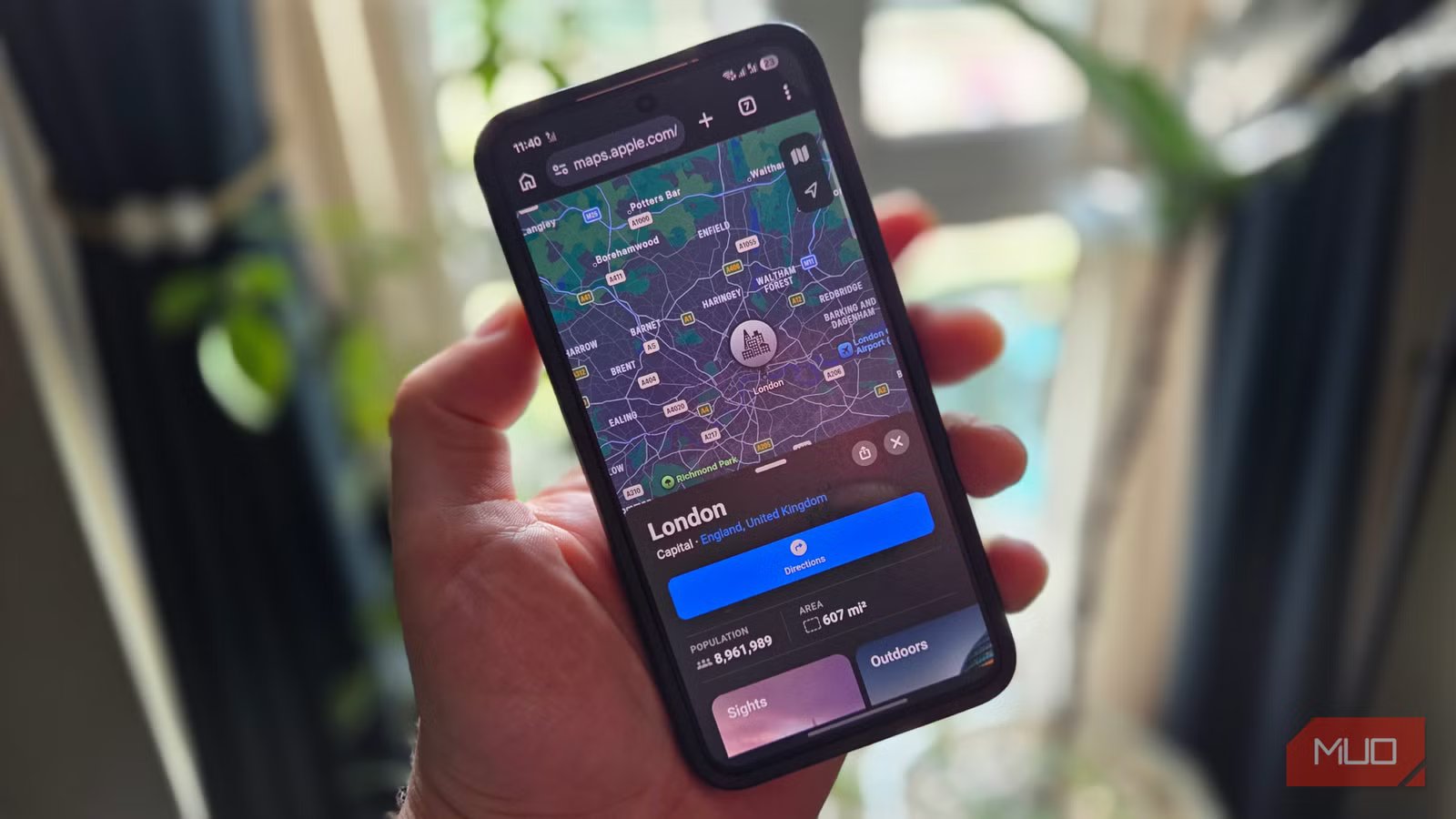
Apple Maps is technically available, just not via the Play Store
Credit: Jack Mitchell/MakeUseOf
Instead of launching a native app on Google Play, Apple chose to expand Apple Maps to Android and other platforms with only web browser support. This means users can visit maps.apple.com in a mobile browser and use it on phones and tablets outside the Apple ecosystem, but it is not a native Android app, unlike Google Maps, which is available via the App Store.
While somewhat limited, this web-based rollout marks a significant departure from Apple’s typical practice of keeping its core apps exclusive to iOS and macOS. Until lately, Apple Maps was only available on Apple devices, unless you were prepared to tinker with platform bridges via developer tools.
As a keen user of both Apple and Google’s platforms, this sounded like a breath of fresh air: could this be a sign of more integrations to come? With Apple recently adding a Transfer to Android tool to its settings menu as part of the iOS 26.3 update, things are certainly looking positive.
Related
I tried the Waze alternative no one talks about — and it’s great, up to a point
Can this lesser-known alternative dethrone the reigning champions of navigation?
Core features and what’s missing
Apple Maps on Android falls short in several key areas
While Apple Maps on Android is now technically available, the experience is far more limited than users of the native Google Maps or Apple Maps apps on iPhone enjoy.
I found that there is very basic routing and searching. I could search for places and get driving directions through the browser interface, but there was also no sign-in or personalization facilities. Without logging in to an Apple ID, many user features, such as saved places, personalized recommendations, and travel history, aren’t available, so anyone hoping for cross-device synchronization will be disappointed.
Some key attributes are missing, and these are what make the iOS version the well-rounded, feature-rich app that many users prefer. For example, the Detailed City Experience (3D depictions of landmarks and road markings, etc.) was not fully available when I tested it, and, more crucially, it has limited navigational capabilities. The web experience currently lacks many advanced tools, such as real-time traffic overlays, live rerouting, offline maps, and turn-by-turn guidance with voice prompts.
All of these come standard in iOS versions and should be expected as fundamental features of modern navigation apps. Yet, this is not the case here, making the whole experience feel more like a preview than the polished version I know so well.
Why Apple is adopting this approach
Is Apple simply testing the water in a highly competitive market?
All of this begs the question: why is such an esteemed company like Apple bothering with such a half-baked version of its tried-and-tested native navigation software? My guess is that it’s just part of a larger strategy, an early step on Apple’s cross-platform journey that allows for testing and market research without rolling out the full, all-singing-all-dancing version on the Play Store.
However, such a tentative outing from the software giant suggests that it’s not ready to compete with the myriad solutions available on Android just yet. Having extensively tested many of Apple Maps’ chief competitors, I can attest to the quality and usability of many of these, not least the formidable market-leading Google Maps and Waze.
If Apple were to roll out the full version of its navigation software tomorrow, complete with all its considerable features, it would still have its work cut out in a highly competitive Android market.
What’s next for Apple Maps on Android?
As it stands, for most Android users today, there is no way that a browser-based Apple Maps can replace Android’s navigation options. With no basic features like turn-by-turn navigation and a host of successful third-party competitors, including the community-driven Waze and the privacy-focused Magic Earth, snapping at its heels, it couldn’t stand a chance, but that is likely the point.
At this stage, Apple’s motive appears to be purely experimental: a way to expose Apple Maps to a wider audience without releasing a full Android application. The company may use the insights gained from this rollout to justify developing a true Android app in the future, but it has made no official announcement of any such plans yet.
Until then, Apple Maps on Android is little more than a curiosity. It may appear familiar and accessible, but its frustratingly limited navigation would only lead me to use it for basic searches and simple route planning. And, of course, in this instance, I have far better alternatives at my fingertips.
