

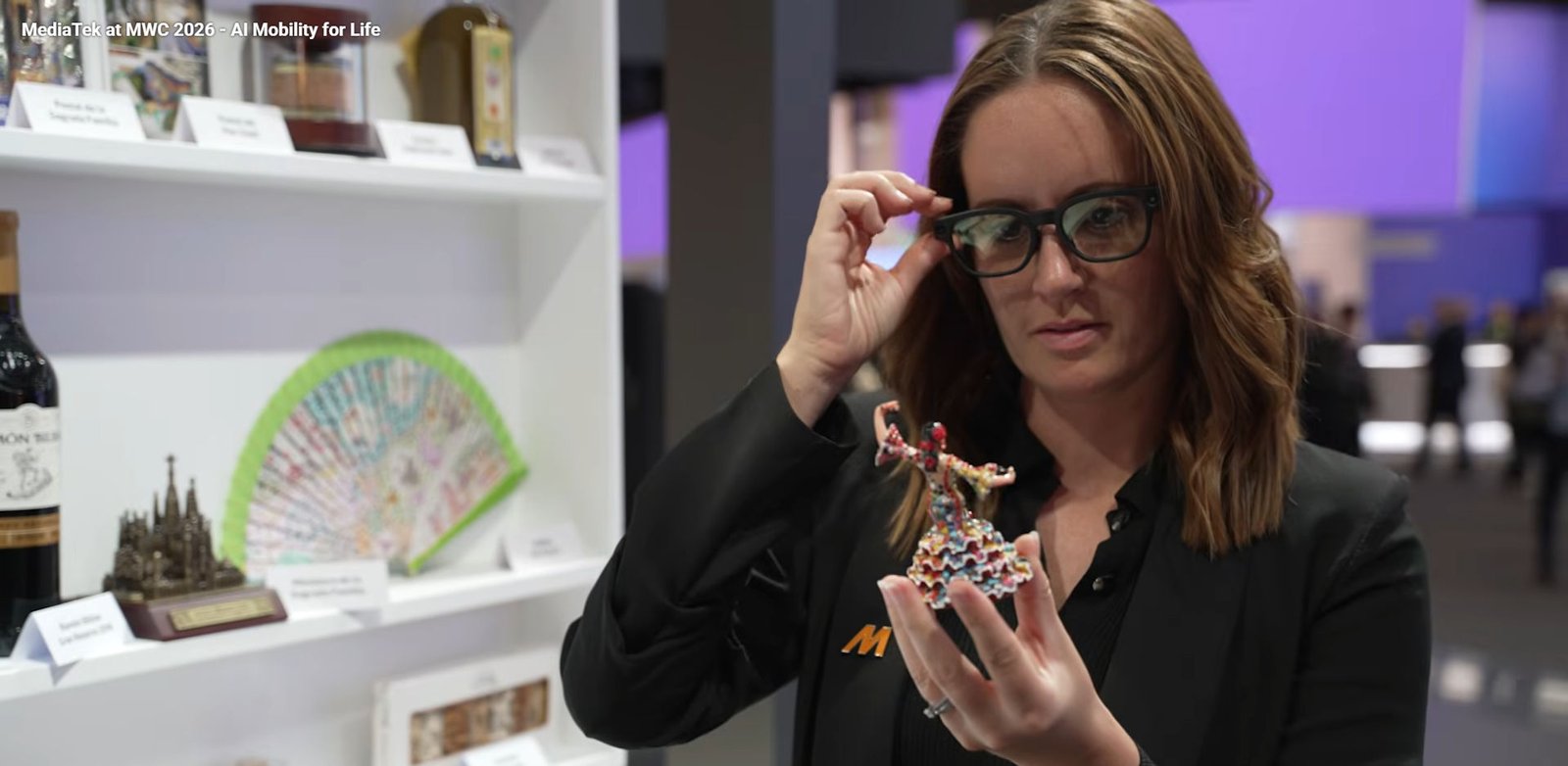
Wearables like smart glasses aren’t new. Google tried their hand at it, only to fail. However, we think Google was just a bit too ahead of its time. Now, with Meta’s Ray-Ban smart glasses gaining in popularity, more companies are looking to hop on the bandwagon. One of those companies is MediaTek, which recently showed off a pair of AI glasses at MWC 2026.
At the event, MediaTek unveiled its first-ever pair of AI smart glasses. These glasses are powered by MediaTek’s Dimensity 9500 chipset, which made its debut last year. For those unfamiliar, the Dimensity 9500 is the company’s flagship chipset designed for smartphones. However, it looks like MediaTek envisions it being used for devices like wearables as well.
According to the company, it claims that these glasses are “privacy-first.” It also boasts features like situational awareness, and by using the Dimensity 9500, it allows some features to work even without an internet connection. The design of the glasses themselves doesn’t look particularly fancy.
However, that’s a good thing. One of the selling points of Meta’s Ray-Ban smart glasses is that they look relatively discreet. This makes it easier for users to wear them out in public or for functions without them looking like some sci-fi get-up. But we should note that this is most likely a prototype or proof-of-concept. The final design might look completely different, which brings us to our next point.
At this point, we don’t know. MediaTek did not mention if it has plans to commercialize the device, and honestly, we wouldn’t hold our breaths. For starters, MediaTek is a chipset company. The company primarily develops chips for mobile devices, and it is more B2B than B2C.
Getting into B2C would require a significant shift in strategy and resources, and we’re not sure if the company is willing to commit to that. Secondly, we think these glasses are most likely a platform to demonstrate the capabilities of the Dimensity 9500. It could also act as a blueprint of sorts in case other companies want to make their own smart glasses and want a chip that can handle it.
MediaTek’s competitor, Qualcomm, is doing something similar. The company recently unveiled the Snapdragon Wear Elite chipset, a chipset designed for wearables. So, presumably, MediaTek wants a slice of that pie.
