

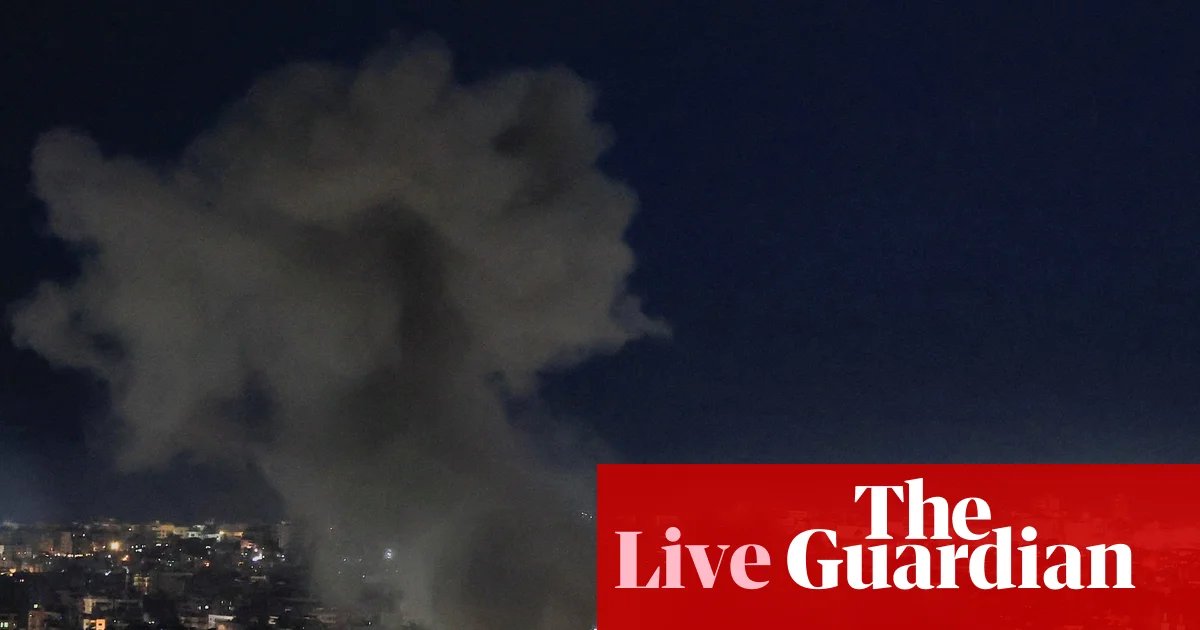
Israeli army begins strikes on Beirut’s southern suburbs
The IDF has said it is striking what it describes as Hezbollah infrastructure in the Dahiya neighbourhood, a densely populated commercial and residential area in the southern suburbs of Beirut.
Smoke billows after Israeli strikes on Beirut’s southern suburbs. Photograph: Mohamed Azakir/Reuters
The IDF had earlier issued forced evacuation orders for the whole population of Beirut’s southern suburbs – home to 500,000 people – sparking widespread panic and leading to huge queues of traffic as people tried to flee.
Per my colleague William Christou’s report, “traffic was at a standstill throughout the city and thousands of people resorted to walking, with women pushing strollers holding infants through bumper-to-bumper traffic. Families made appeals for rescue services to help extract elderly people who could not leave their homes on their own.”
Residents are also still scouring through the wreckage of residential buildings damaged by previous Israeli strikes on the Lebanese capital.
Indeed, Israel has been striking parts of Dahiya since Monday, but Israel’s far-right finance minister, Bezalel Smotrich, threatened widespread destruction in a video released on Thursday on social media.
Referring to a city in southern Gaza that Israel almost entirely destroyed during its military assault on the Palestinian territory, Smotrich said:
double quotation markThe Dahiya will look like Khan Younis. You wanted to give us hell, but you’ve brought hell upon yourself.
The evacuation order was issued just a day after the IDF ordered all residents to flee the area south of the Litani River, which compromises about 10% of Lebanon, raising concerns that it may be about to launch a ground invasion.
Per my last post, world leaders including Macron and Spanish PM Pedro Sánchez have been urging Israel to de-escalate and stop the US and Israel’s war from expanding into a new front in Lebanon.
Israel claims it is retaliating after Hezbollah fired several rockets towards northern Israel on Monday. According to the Lebanese health ministry, Israeli strikes have killed at least 123 people and injured 683 in Lebanon since then.
Share
Updated at 22.08 GMT
Key events
Show key events only
Please turn on JavaScript to use this feature
Trump claims Iran’s navy and air force are ‘gone’
Donald Trump is currently speaking at the White House, and has just thanked “wonderful Israeli partners” who “continue to demolish the enemy totally ahead of schedule and at levels people have never seen before”.
double quotation markWe’re destroying more of Iran’s missile and drone capability every single hour – knocking them out.
The US president claimed, without evidence:
double quotation markSo [Iran] have no air force, they have no air defence. All of their airplanes are gone, their communications are gone. Other than that, they’re doing quite well.
“Their navy is gone, [they lost] 24 ships in three days, that’s a lot of ships,” he said, along with 60% of Iran’s missiles and 64% of its missile launchers.
Echoing comments he made earlier this week, Trump added that the US military and Israel are “totally demolish[ing]” Iranian targets “far ahead of schedule”.
Donald Trump speaks at an event to honor the 2025 Major League Soccer champions Inter Miami CF in the East Room of the White House. Photograph: Alex Brandon/APShare
Updated at 22.03 GMT
US House rejects war powers resolution to end Trump’s hostilities with Iran
Chris Stein
The US House of Representatives has voted down a Democratic-backed measure to halt hostilities with Iran, as Republicans cleared the way for Donald Trump to continue the conflict that has drawn in countries across the Middle East, but criticized as having unclear goals.
By a vote of 212-219, the House voted to reject a war powers resolution that would have forced the US to withdraw from the conflict until Congress authorized military action.
The vote was largely along party lines, with two Republicans breaking with their party to support the resolution, and four Democrats voting against it.
Republicans control both chambers of Congress and their leaders have made clear that they believe Trump was authorized to initiate the air and naval campaign that began over the weekend, prompting Tehran to launch drones and missiles across the Middle East. Six US troops have been killed, as well as 1,230 people in Iran.
Share
Updated at 22.07 GMT
Israeli army begins strikes on Beirut’s southern suburbs
The IDF has said it is striking what it describes as Hezbollah infrastructure in the Dahiya neighbourhood, a densely populated commercial and residential area in the southern suburbs of Beirut.
Smoke billows after Israeli strikes on Beirut’s southern suburbs. Photograph: Mohamed Azakir/Reuters
The IDF had earlier issued forced evacuation orders for the whole population of Beirut’s southern suburbs – home to 500,000 people – sparking widespread panic and leading to huge queues of traffic as people tried to flee.
Per my colleague William Christou’s report, “traffic was at a standstill throughout the city and thousands of people resorted to walking, with women pushing strollers holding infants through bumper-to-bumper traffic. Families made appeals for rescue services to help extract elderly people who could not leave their homes on their own.”
Residents are also still scouring through the wreckage of residential buildings damaged by previous Israeli strikes on the Lebanese capital.
Indeed, Israel has been striking parts of Dahiya since Monday, but Israel’s far-right finance minister, Bezalel Smotrich, threatened widespread destruction in a video released on Thursday on social media.
Referring to a city in southern Gaza that Israel almost entirely destroyed during its military assault on the Palestinian territory, Smotrich said:
double quotation markThe Dahiya will look like Khan Younis. You wanted to give us hell, but you’ve brought hell upon yourself.
The evacuation order was issued just a day after the IDF ordered all residents to flee the area south of the Litani River, which compromises about 10% of Lebanon, raising concerns that it may be about to launch a ground invasion.
Per my last post, world leaders including Macron and Spanish PM Pedro Sánchez have been urging Israel to de-escalate and stop the US and Israel’s war from expanding into a new front in Lebanon.
Israel claims it is retaliating after Hezbollah fired several rockets towards northern Israel on Monday. According to the Lebanese health ministry, Israeli strikes have killed at least 123 people and injured 683 in Lebanon since then.
Share
Updated at 22.08 GMT
Macron urges Netanyahu ‘not to expand the war into Lebanon’
French president Emmanuel Macron has called on Israeli prime minister Benjamin Netanyahu “not to expand the war to Lebanon”.
“Hezbollah must immediately cease its fire toward Israel. Israel must refrain from any ground operations or large-scale actions in Lebanese territory,” Macron said on X.
“At this time of great danger, I call on the Prime Minister of Israel not to expand the war into Lebanon.”
He went on:
double quotation markThe Lebanese authorities have given me their commitment to take control of the positions held by Hezbollah and to fully assume responsibility for security across the entire national territory.
I give them my full support. France will strengthen its co-operation with the Lebanese armed forces and will provide them with armoured transport vehicles, as well as operational and logistical support.
“Everything must be done,” Macron said, to prevent Lebanon “once again being drawn into war”.
Share
Updated at 21.02 GMT
Donald Trump has brushed off concerns over any backlash sparked by the US-Israeli military operation against Iran, saying the public is “loving” it.
In an interview with Politico, the US president said: “People are loving what’s happening.”
He added: “We’re taking out a threat to the United States of America, major threat… and doing it like nobody’s ever seen before.”
Asked how much influence he expects to have over Iran’s future leadership, Trump replied:
double quotation markI’m going to have a big impact, or they’re not going to have any settlement, because we’re not going to have to go do this again.
He suggested that Iran’s future leadership would be able to “nicely build Iran but without nuclear weapons”.
Share
The IDF’s chief of staff has said it is “now moving to the next phase of the operation” against Iran.
Eyal Zamir explained that the new phase will involve “intensify strikes against the regime’s foundations and military capabilities”.
He continued: “We have additional surprise moves at our disposal that I do not intend to reveal.”
Share
Nato has bolstered its “ballistic missile defence posture”, a spokesperson for the alliance has said.
The update comes after a ballistic missile reportedly launched from Iran and heading towards Turkish airspace was shot down by Nato air defence systems yesterday.
In a statement released on social media, Col Martin O’Donnell, a spokesperson for the Supreme Headquarters Allied Powers Europe, said:
double quotation markWhile I cannot go into details about this posture change for operational security reasons, the adjustment gives the Supreme Allied Commander Europe exactly what he needs to defend the Alliance based upon the current threat and defend it he will!
He added that Nato’s ballistic missile defence posture will remain at a “heightened level until the threat from Iran’s continued indiscriminate attacks across the region subsides”.
Commenting on yesterday’s interception, O’Donnell said that in “less than 10 minutes”, Nato identified the threat of an incoming missile, confirmed its trajectory, alerted land- and sea-based missile defence systems, and launched an interceptor.
He added: “That is real strength!”
Share
Updated at 20.20 GMT
Operations at the American embassy in Kuwait City have been suspended, the US state department has announced.
In its latest update, the department said there have been no reported injuries to US personnel, but the “safety of Americans abroad remains the highest priority”.
It added:
double quotation markUS citizens in Kuwait should depart the country, if they can do so safely, using commercial or other available transportation options. US citizens unable to depart should shelter in place.
Share
Israel’s air force carried out a “wave of strikes on over 200 targets” across Iran today, according to the IDF.
A statement posted on the IDF’s Telegram channel said:
double quotation markThese strikes join previous strikes that have taken place since the start of the operation, which are focused on dismantling the Iranian regime’s ballistic missile array.
Since the beginning of the operation, hundreds of launch sites across Iran have been struck – especially in western Iran – in order to reduce missile launches toward the State of Israel.
Share
US asked Ukraine for help against Iranian drones, Zelenskyy says
In a dramatic turn of the proverbial tables, Ukrainian president Volodymyr Zelenskyy has said he received a request from the United States “for specific support” in dealing with Iran’s Shahed attack drones, as the US and its allies in the Middle East seek Ukraine’s expertise in countering such attacks.
It follows reporting from my colleague Hugo Powell yesterday that top US military officials told lawmakers in a closed-door briefing on Tuesday that they may not be able to shoot down every Iranian drone being launched against US military installations and assets in retaliatory attacks.
Ukraine, meanwhile, has been countering Russian attacks using Shahed drones – one of Iran’s best known weapons – for the last four years. Last year alone, Russia launched over 50,000 of them into Ukraine, the majority of which were intercepted.
Related: Iran’s Shahed drones have brought terror to Ukrainian skies – now they are being deployed in the Middle East
“I gave instructions to provide the necessary means and ensure the presence of Ukrainian specialists who can guarantee the required security,” Zelenskyy wrote on X. “Ukraine helps partners who help ensure our security and protect the lives of our people.”
Yesterday, Zelenskyy said he said he has spoken in recent days with the leaders of the United Arab Emirates, Qatar, Bahrain, Jordan and Kuwait about possible cooperation.
He has said that Ukrainian assistance in countering Iranian drones will be provided only if it does not weaken Ukraine’s own defenses, and if it adds leverage to Kyiv’s diplomatic efforts to stop the Russian invasion.
The irony of the Trump administration, which has for the last year held leverage over – and been highly erratic towards – Ukraine regarding military assistance and supplies of weapons, now needing help from the country whose leader it has publicly berated, is not lost on us – and will certainly not be lost on Zelenskyy.
Share
Updated at 19.45 GMT
Was Trump ever in control of the Iran war? – podcast
This week on Politics Weekly America, my colleague Rachel Leingang speaks with foreign policy expert Ali Vaez about what it was like to take part in war game exercises for the Pentagon, and how they compare with what he has seen play out this week.
Then the Guardian’s Andrew Roth talks us through the inner chaos in the Trump administration and Congress over Trump’s decision to go to war with Iran.
Share
UK defence secretary fails to rule out Britain joining offensive action in Iran
The UK’s defence secretary John Healey earlier declined to rule out Britain joining US-Israeli strikes on Iran.
As we reported earlier, Healey flew into Cyprus to calm the diplomatic fallout over a drone that evaded detection and hit an RAF base, prompting fury from local ministers.
UK officials believe the drone evaded detection by flying low and slow when it was launched by pro-Iranian militia in Lebanon or western Iraq.
Speaking to Sky News, Healey was asked if he would rule out the UK joining the conflict in an offensive capacity. He replied:
double quotation markAs circumstances in any conflict change, you’ve got to be willing to adapt the action you take.
Pressed again on whether he would rule out British aircraft taking part in offensive operations over Iran, he said:
double quotation markEverything that we have done is defensive, is legal, and is coordinated with other allies.
As my colleague Helena Smith reports, this is the first time the Cypriot political and diplomatic elite have expressed consternation over the dangers posed by the facilities, saying Britain has not done enough to protect the installations and surrounding areas where locals live.
Speaking to the media, Healey listed defensive measures that were being taken by the UK, including the use of anti-drone helicopters, deploying HMS Dragon to the eastern Mediterranean, and bringing in planners to co-ordinate an international response.
Per the BBC, he said the HMS Dragon would arrive “within the next couple of weeks”.
The UK has “got more jets in Cyprus than any other nation” and “400 air defence specialists on top of what we would normally have”, he said.
double quotation markThat’s because we want to make sure we can defend our British personnel, we can defend our British base, we can defend this island of Cyprus and we’re defending also allies across region.
In addition the defensive measures Healey outlined above, the British PM, Keir Starmer, has allowed the United States to use British airfields to carry out “defensive” missions.
Earlier this week, Starmer said the UK would not join in the initial US-Israeli offensive strikes, citing a lack of a “lawful basis” and stating that his government does not believe in “regime change from the skies”.
British defence secretary John Healey is greeted by a member of the Cypriot Armed Forces at the Ministry of Defence in Nicosia, Cyprus. Photograph: Po Rory Arnold/BRITISH MINISTRY OF DEFENCE HANDOUT/EPAShare
Updated at 19.15 GMT
Trump says he must ‘be involved in’ choosing Iran’s next leader
Donald Trump has said he must “be involved in the appointment” of Iran’s next leader as he was in Venezuela, and dismissed the idea of the assassinated ayatollah’s son, Mojtaba Khamenei, succeeding his father as supreme leader as “unacceptable”.
“They are wasting their time. Khamenei’s son is a lightweight. I have to be involved in the appointment, like with Delcy [Rodriguez] in Venezuela,” Trump told Axios today. You will remember that Rodriguez took over after US forces captured president Nicolás Maduro in January.
Trump added that he could not accept a new Iranian leader who would continue Khamenei’s policies.
“Khamenei’s son is unacceptable to me. We want someone that will bring harmony and peace to Iran,” he said.
Selecting a leader who followed the policies of the former supreme leader could force the US back to war “in five years”, he added.
Donald Trump in the Oval Office on Tuesday Photograph: Mark Schiefelbein/AP
It comes a day after Trump’s defense secretary Pete Hegseth insisted that regime change was not the primary goal of the US military operation in Iran. Other Trump administration officials have made the same claim since the US and Israel launched attacks on Iran last Saturday, which killed the former supreme leader Ali Khamenei .
This, even though Trump himself has pushed for Iranian regime change previously. His administration has pivoted its messaging in recent days to focus on destroying Iran’s nuclear and military capabilities.
Since the US-Israeli military assault began, Trump has suggested several times that he had a good idea who he wanted to succeed Khamenei in Iran.
But these latest comments to Axios come after he told reporters at the White House on Tuesday:
Most of the people we had in mind are dead.
No formal announcement has been made from Iran regarding the selection of a new leader, though Mojtaba Khamenei is considered the frontrunner.
Share
