

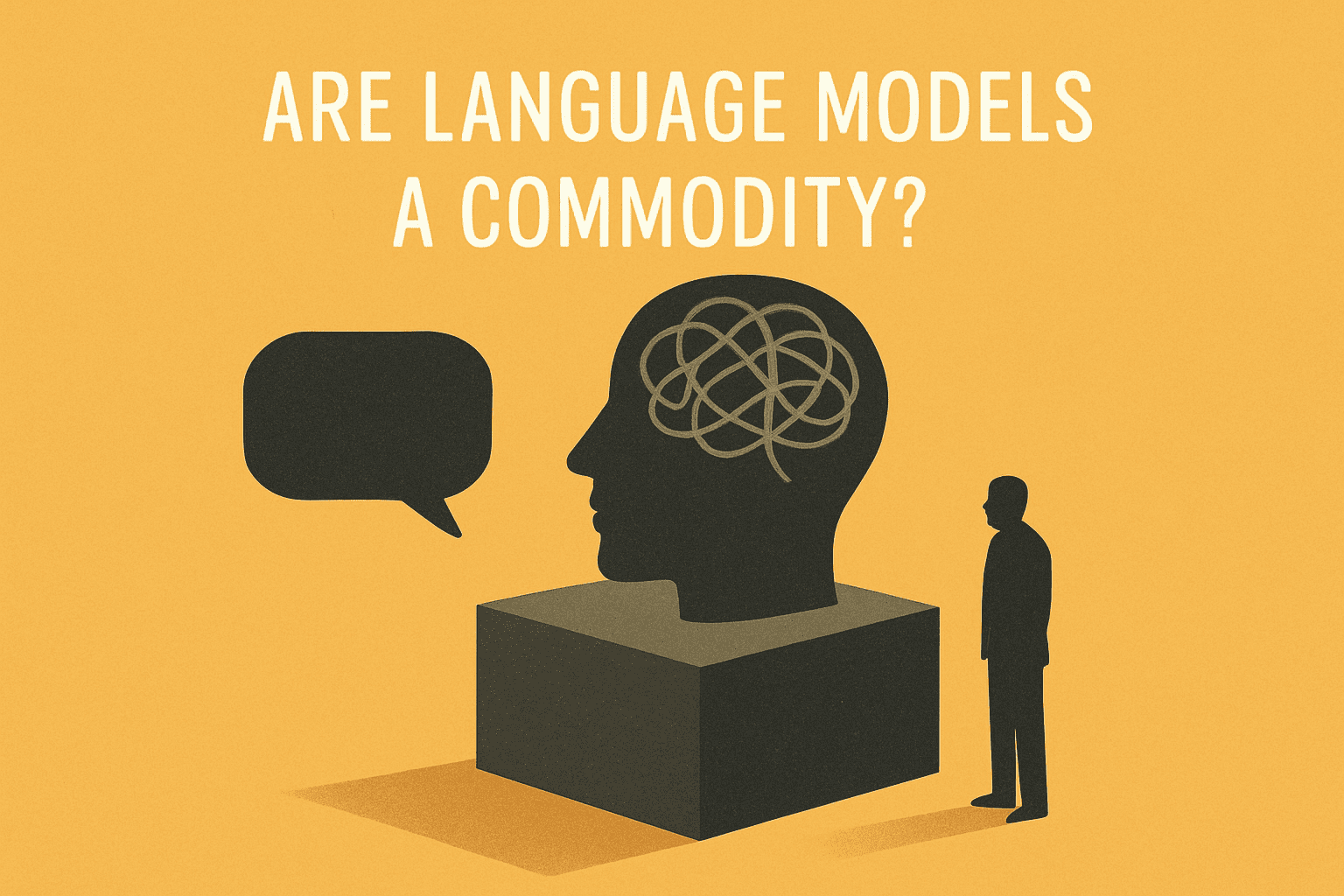
Image by Editor
# Introduction
What do things like electricity, wheat, mobile phones, and the Internet have in common? Arguably, for many, they have become what we call a commodity, that is, “a resource or good that has full or substantial fungibility (or is simply deemed essential for a modern lifestyle).”
Most of the examples mentioned became commodities at particular turning points in history. In the late 90s, for instance, mobile phones were still something of a budding novelty — at least, as far as I recall. Yet in the current century, who can imagine living without one?
Fast-forwarding to present times, and looking at the language model tech wave that has swept through our lives for the last 3 to 4 years, this article analyzes a set of objective facts. It adds a pinch of personal thoughts on the following question: are language models the new commodity we can no longer live without?
# Reviewing The Facts
Just a couple of years ago, an advanced language model was deemed a luxury tech asset, but today it has become a ubiquitous solution many organizations can no longer dispense with.
There are several facts about the current market reality that explain this expansive accessibility to language models:
- Falling costs: this may sound counterintuitive in a modern global context of rising prices for almost everything, but one exception to this norm has been the cost of “raw intelligence” solutions. One example is the cost of processing one million tokens (about 750K words) in frontier models, which used to cost tens of dollars even a few years ago, but can now cost tens of cents.
- Free access revolution: open-weight models have contributed to breaking the exclusivity barrier. Language model families like Meta’s Llama or Mistral have demonstrated, based on public benchmarks, that they can equal or even outperform many commercial alternatives.
- Zero cost: nowadays, any user can download free language model tools like Ollama and execute highly capable models locally on their own machine. This completely eliminates the need for paid subscriptions or API quota usage, as well as removing dependence on third-party services. As a result, AI access as a basic and free resource has become a new standard.
“In the late 90s, for instance, mobile phones were still something of a budding novelty — at least, as far as I recall. Yet in the current century, who can imagine living without one?”
# Exploring Fact-based Views
Basic AI capabilities may have become a commodity, but having a model with its “own personality” that goes the extra mile with complex, fine-grained tasks, cannot be seen as such just yet. Many foundation models — which are foundational from an upstream, general-purpose point of view, and which represent the initial, large-scale pre-training phase before a model is adapted for specific tasks — can generate text responses or code for free, but there is still a noticeable difference between a human’s natural narrative and the conversational style of a model, sometimes still being slightly robotic and predictable in the words and expressions it uses. Many outputs generated by these models still need final refining, and that is the differentiating factor in various domains.
On another note, many users do not invest in the models themselves, but in the experience that comes with them. Having a free text generation engine on our own computer sounds great, but businesses need to charge for solutions in which that model has been refined to interact with your documents, code, or workflow in a specific fashion. We are still relatively far from the point at which everyone would fully accept delegating to (often paid) language model solutions to do this task, instead of carrying it out themselves.
# Delivering The Verdict
Based on the facts revealing how the role of and access to language models have evolved in recent years, becoming almost free, we could think these factors pushed such models into becoming the new commodity of the ongoing decade. But there are still other aspects like reliability, fully guaranteed privacy, and adaptation to niche application domains (like medical or legal reasoning), that are still not within everyone’s reach, being still premium goods, and making the “commodity” term slightly debatable within the landscape of language models.
Iván Palomares Carrascosa is a leader, writer, speaker, and adviser in AI, machine learning, deep learning & LLMs. He trains and guides others in harnessing AI in the real world.
