

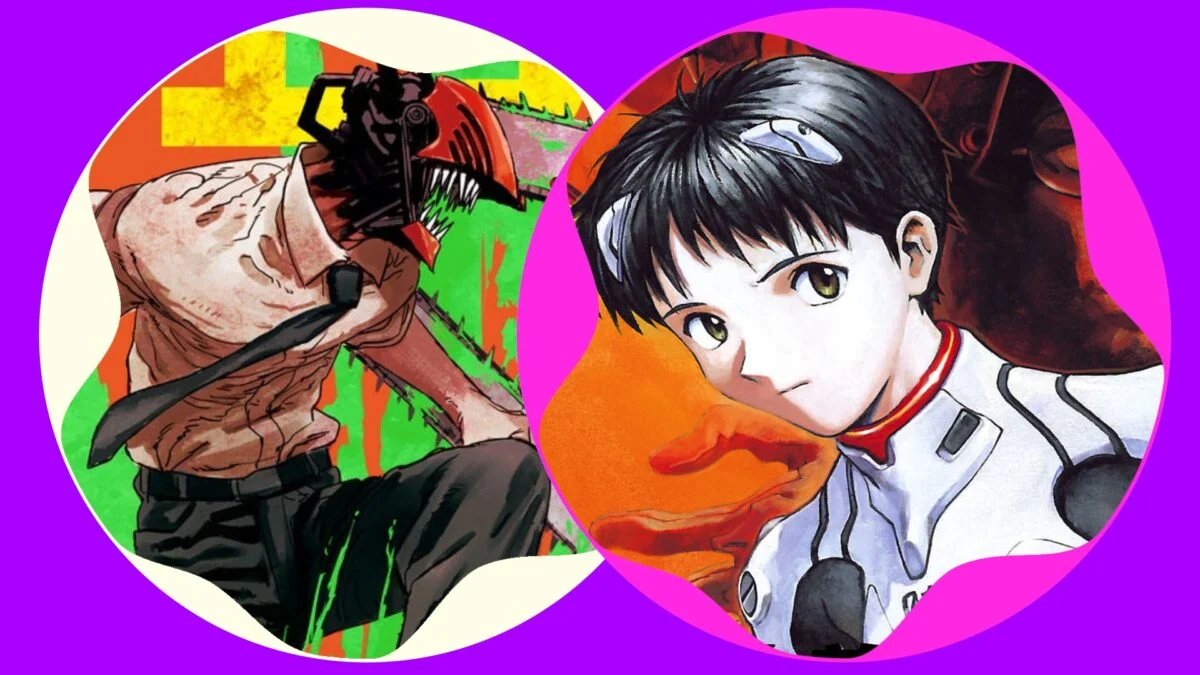
True to his word, Tatsuki Fujimoto penned chapter 232 of Chainsaw Man, bringing the mega-popular shonen series to an end. And predictably, the way it ended has fans split over whether it was good or bad, just like they were with the original TV ending of Neon Genesis Evangelion.
In chapter 232 of Chainsaw Man, aptly titled “Thank You, Chainsaw Man,” we see Denji back where he started at the start of the series—sitting in the podunk shed he and Pochita were ballers on a budget in. Only Denji can’t remember anything that happened before, noting that it all felt like he was in a good and bad dream. All of this is thanks to Pochita, who’s been a silent observer in the manga’s in-between chapter pages throughout the series, while making occasional appearances in dream sequences, and gave Denji the honest truth: that it’s time for Pochita to leave. Their “say it ain’t so” goodbye has a twinge of hilarity to it, with Denji spouting off that he hasn’t had sex yet, a looming carrot on a stick for the boy with a backwards hierarchy of needs chart, only for Pochita to hit him with the honest truth that he hasn’t been happy at all in his pursuit to fulfill his promise to Pochita to meet cute girls, eat good food, and have a lot of hugs.
© Tatsuki Fujimoto/Chainsaw Man
Ultimately, Pochita characterized their goodbye as a good thing, encouraging Denji to keep on dreaming after he cannibalized a little Pochita-fied version of Denji’s heart. Because Chainsaw Man can erase the concept of something ever existing from humanity, Pochita’s self-cannibalization led to their Neon Genesis Evangelion therapy chat. Fans who watched the beloved mecha series will remember that its TV finale saw all of the caucus action grind to a halt as its core cast had a chat about their own trauma—a chat that ultimately led to protagonist Shinji Ikari’s emotional breakthrough, culminating in the famous clip of everyone surrounding him and applauding his self-actualization.
It’s a moment that, in hindsight, doubled as series creator Hideaki Anno working through his own struggles through his art—something Fujimoto has been slow-cooking in his intermim Chainsaw Man one-shot, Just Listen To The Song, and bookended with the entirety of Chainsaw Man Part 2 as a kind of meta commentary on making something special that suddenly had the added pressure of what it should be.
© Tatsuki Fujimoto/Shonen Jump
But the similarities between the two series don’t end there. Chapter 232 also had its cake and ate it too with a series of Thrice Upon a Time-tinged events that followed, envisioning the world without Chainsaw Man by going through all of the series’ major story beats with him absent. The monkey’s paw to this whole ordeal is that Denji still has an eyepatch and, presumably, one testicle, which he sold off to make rent at the onset of the series. But on the upside, the 32-page finale saw the return of fan-favorite character Power, who found Denji after the battle with the Zombie Devil first instead of Makima, and entered a contract with Denji. Power’s return meant a lot in the grand scheme of the series because she’d entered a contract with Denji, sacrificing herself to save him by giving him her blood with the promise that he’d find her again and be buddies with her once she reincarnated. It was a promise that took a bit of doing to get there, leaving fans sweating over whether it’d happen or not, but we got there in the end.
Makima was there too, in a sense, only this time as Denji’s foster sister in CSM Part 2, Nayuta—the reincarnated version of Makima leading the Special Divisions Unit at the age of 10. What followed was Denji taking on a more Aki Hayakawa-like role in their partnership as they slayed devils. There were some subtle callbacks to Reze; nods pointing to Aki and Himeno still existing in passing; and it was all around a good mix of bittersweet and wholesome. But far more importantly is the note the series ended on, with Denji meeting up with CSM part 2 protagonist and his doomed love interest, Asa Mitaka.
Asa is a character as complex and endearing as Denji. She is to Evangelion‘s Asuka what Denji is to Shinji. She, like him, suffers from a hero complex. Only she saw the War Devil, Yoru, take over her body, Tyler Durden style, after she tripped and squashed her class pet and was ostracized for it. Long story short, Asa and Denji, throughout their ups and downs, made a promise to save each other and kept it in the series’ final hour.
© Sadamoto Yoshiyuki/Viz Media © Tatsuki Fujimoto/Shonen Jump
So when Asa was on the verge of tripping once again, setting off the course of events that ultimately ruined her life, Denji quite literally threw away a chainsaw Power fashioned for him from her blood and saved Asa from falling. In doing so, he pulled her in for a hug in a similar fashion to what Makima did with Denji at the start of the series. After blushing at each other like losers for some time, Asa thanked Denji, calling him “Chainsaw Man” (because he was holding a chainsaw) and making Denji’s heart “thump” as an x-ray of Pochita smiled along. And, true to Aki’s own wishes, Power and Denji walked away into the sunset, planning their next meal and living a life all their own. And again, the echoes of Evangelion and its own endings came through here, feeling very much in the style of Yoshiyuki Sadamoto’s manga adaptation of the series.
It should come as no surprise that Chainsaw Man and Evangelion found some level of sympathetic connection wrestling with how they wanted to end themselves. Even beyond the Chainsaw Man anime referencing Evangelion quite a bit in its earlier episodes stylistically, both series have had long, public grapples with what it means to have become icons of their genres, and what it means to bring those icons to a close. It’s no surprise either then, that Chainsaw Man‘s ending is already starting to feel as infamous as Evangelion‘s multiple endings were, with tons of fans split over it.
Some felt it was rushed and out of place; others outright hated it, calling it “Disneysaw” as an insult to how happily-ever-after its ending felt, while others praised it for being just right. (Perhaps the real devil all along, to borrow the supernatural framing of the series, was the reading comprehension devil that its fandom suffered from along the way.) Tthe ambiguity of Chainsaw Man‘s The Big Lebowski-esque ending (something Fujimoto noted in the past as a comparison he wanted to achieve) is already working in its favor, making the series hotly debated and thought about, in perpetuity, through YouTube video essays and TikTok explainers that break down how you “watched it wrong” and how to enjoy it better.
But on the whole, Chainsaw Man feels so Evangelion in the way Evangelion was so Devilman, in that it stuck to its guns and delivered an ending it wanted to go for, rather than going the fan theory craft route of continuing into a third part like so many readers were hoping in the lead-up to its release.
Endings are hard. It’s something that wracked Attack on Titan creator Hajime Isayama when he visited the States after its conclusion, in fear of the online backlash manifesting IRL (thankfully, that never came to pass). So it’s an unenviable burden to bring a series that’s touched so many people to its end and brace yourself for what may come. Regardless of how people felt about the ending, obviously, they cared enough about the series to crash both the Shonen Jump and Manga Plus websites temporarily the moment the chapter dropped. And with fans making memes and fan art depicting Denji at the end of The Truman Show, Fujimoto’s finale resonated with them. Hopefully, with enough hindsight, others will come around in a similar fashion to Evangelion fans with the anime’s original ending, and the continuations and conversations that have come along with the series ever since.
Of course, Evangelion‘s recent 30th anniversary saw the release of an Asuka Langley Soryu special that gave the character her due, with an emancipation of sorts, and with the closure the series proper never gave her. And with a new series in the wings by Nier Automata‘s Yoko Taro, who’s to say Fujimoto penning the closest thing manga has ever gotten to an Evangelion-esque ending would warrant a revisiting of that same nature down the line. Though for us, the ending was as perfect as it could’ve been.
Want more io9 news? Check out when to expect the latest Marvel, Star Wars, and Star Trek releases, what’s next for the DC Universe on film and TV, and everything you need to know about the future of Doctor Who.
