

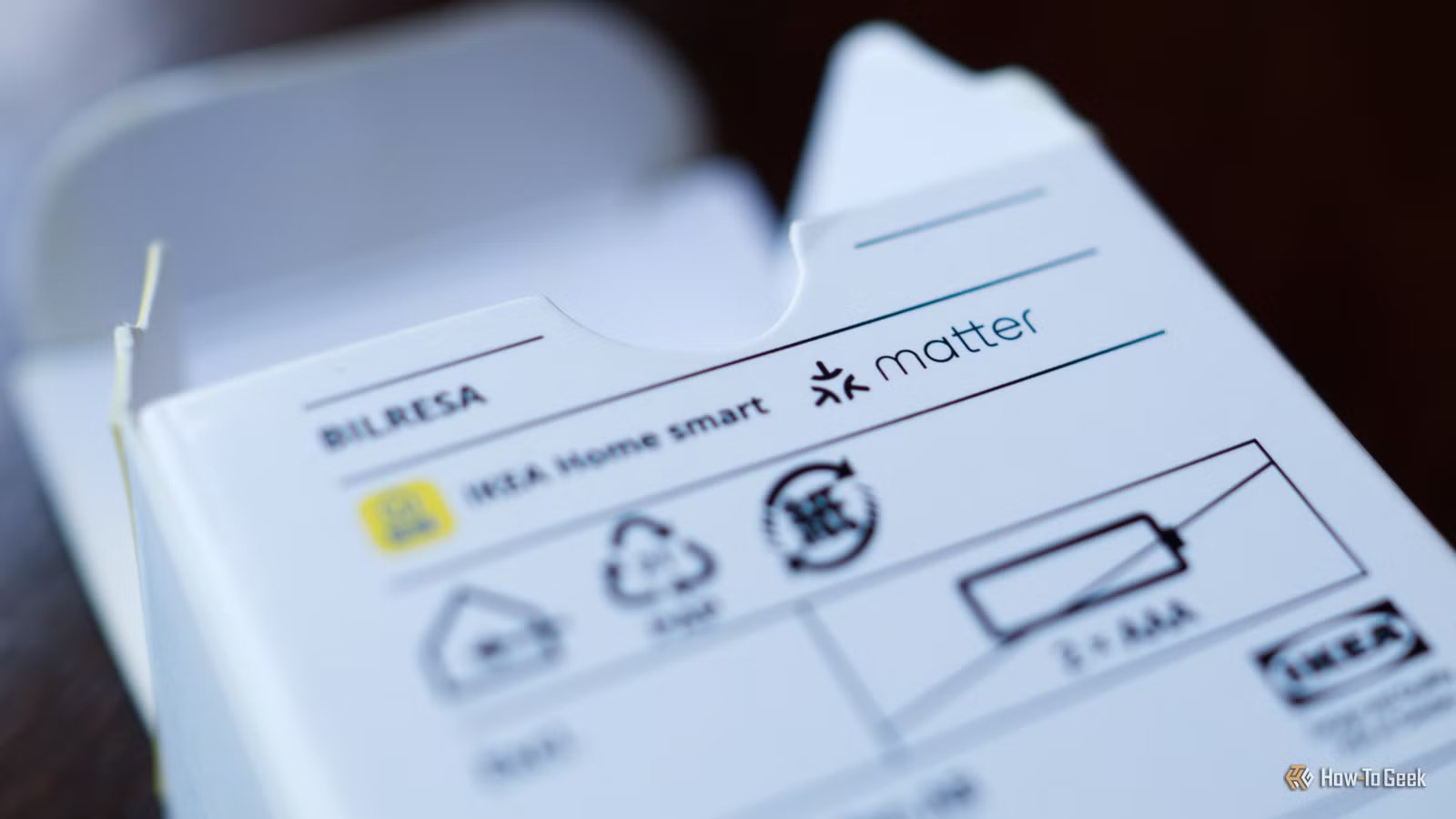
In its quest to build a range of universal smart home devices, IKEA has replaced its Zigbee lineup with one that uses Matter over Thread. On paper, this makes a lot of sense. In practice, the vision has yet to be realized.
Unfortunately, fixing the mess isn’t a simple case of IKEA pushing out an update.
IKEA is all in on Matter over Thread
IKEA first made a dent in the smart home space with its previous lineup of Zigbee devices. The company promoted these alongside its Dirigera hub, but use of the open Zigbee standard meant that platforms like Home Assistant and Homey could also use them with a standard Zigbee radio.
Credit: Tim Brookes / How-To Geek
Unfortunately, the most popular closed smart home ecosystems don’t typically support Zigbee. In 2019, Apple, Google, Amazon, and Samsung all committed to a platform-agnostic smart home standard, which eventually arrived in 2022 in the form of Matter. The future of the smart home was, and theoretically still is, an open standard that works locally with any platform you choose.
Matter is a specification around which hardware manufacturers and platform holders can design their wares. For example, a company like IKEA designs a smart plug that adheres to the Matter standard, and a company like Google makes sure that Google Home also conforms. With everyone onboard, you can theoretically buy any IKEA Matter device and add it to your smart home, whether you have an iPhone and a HomePod or a Google Pixel and a Nest speaker.
Thread is a low-power wireless protocol that handles communication. It’s a lot like Zigbee in that it uses the 2.4GHz band (like older Wi-Fi networks do), and it forms a mesh between powered devices. It’s a more reliable way for smart home devices to communicate than relying on Wi-Fi for everything.
Credit: Bertel King / How-To Geek
IKEA has combined both of these technologies into its new range of sensors, plugs, remote controls, and who-knows-what future products they have coming in the future. But the transition hasn’t been easy.
Matter is the weak link in the chain
There are three main problems with Matter as it stands. These issues crop up constantly on message boards, subreddits, and in online comment sections. The first is an inability to pair Matter devices with a smart hub, with some coordinators posing more of an issue than others.
A recent report in The Verge documented one journalist’s tribulations when pairing the new Bilresa remote and Grillplats smart plugs with Apple Home using the Apple TV. Shifting the hub to a HomePod seemingly fixed this issue, after which the Myggspray motion sensor failed to pair. After testing, the same sensor paired with Google Home on the first try.
Such problems are well documented online, with many users complaining of an inability to pair their new IKEA Matter devices (and, more broadly speaking, Matter devices in general).
The second problem is one of Matter adoption. While the “big four” proprietary smart home platforms have all committed, not all of them are on the same page. The Matter standard evolves over time, with support for more devices and functions added with each revision. The problem here is that while Samsung has raced ahead in Matter adoption, Google has dragged its heels.
It’s true that IKEA’s current lineup of devices was all included in the Matter 1.0 release. A quick glance at the Matter release notes shows that improvements to reliability and commissioning (adding devices) are made with most version upgrades. Google’s own documentation at the time of writing states that support for Matter 1.2 is as far as the company has got, while the current version is 1.5.
Credit: Tim Brookes / How-To Geek
This version mismatch problem exposes early adopters to a problem that Matter was supposed to solve. A universal smart home platform is supposed to simplify control and get rid of proprietary apps. That’s not possible if your smart home platform hasn’t implemented the latest standard and is still missing features.
Lastly, there’s the issue of firmware updates. Right now, the only way to update an IKEA smart home device is with an IKEA smart home hub (the aforementioned Dirigera). So if there’s a problem with the device that IKEA can address, but you don’t have the hub, you can’t really do much about it except buy multiple hubs and complicate your setup.
I’m sticking with Zigbee for now
In time, Matter and Thread will likely mature into reliable smart home technologies that just work (and for many, they already do). That said, I can’t say I’m not a little bit sad that IKEA decided to ditch the Zigbee ecosystem that already worked so well.
Sure, it’s limited to those who have a compatible mesh network and a Home Assistant (or similar) smart home. But I have 25 IKEA Zigbee devices connected to my Home Assistant network, and I’ve never had a single problem. I even went out of my way to pick up a few spares before they all sold out.
Those days are gone, and I’m yet to invest in a Thread network. The beauty of Home Assistant is that I don’t need to ditch everything and start again, but I’m still convinced that a Zigbee network is the better buy given the current state of affairs.
Heading to IKEA soon and looking to pick up some smart home devices? Here are the best IKEA Matter over Thread devices you can buy right now.
