

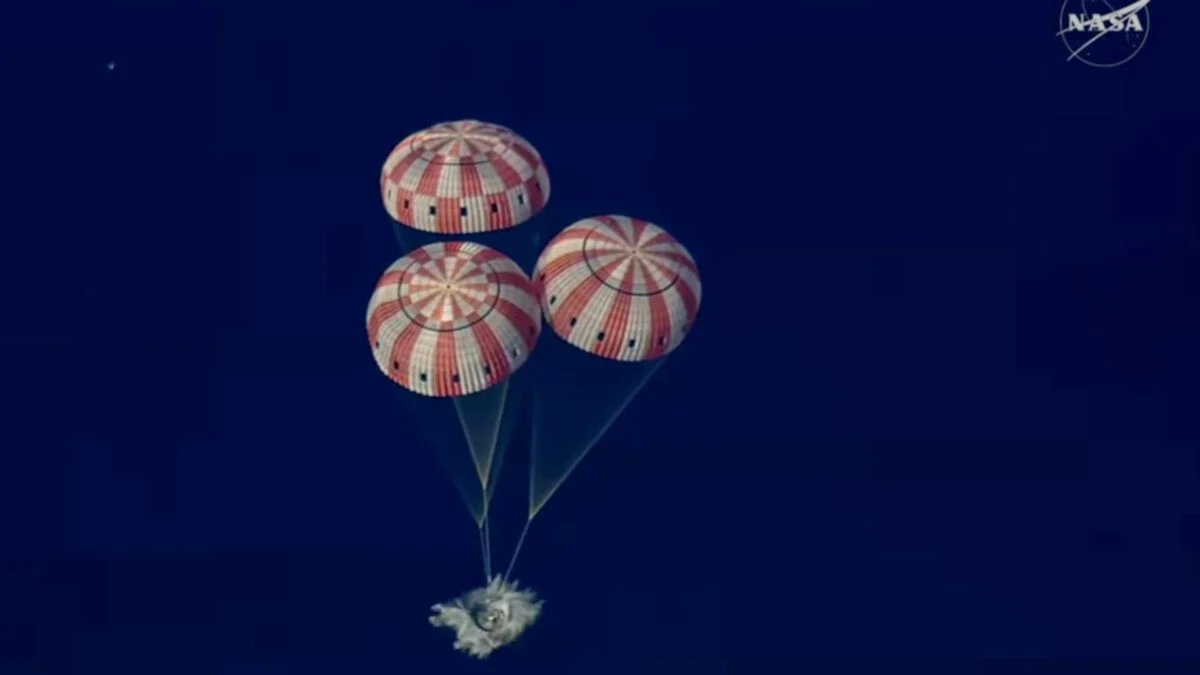
NASA’s Artemis 2 mission has returned to Earth, bringing an end to this historic 10-day flight around the Moon.
The Integrity Orion spacecraft looked like a blazing fireball as it and the four brave souls inside reentered Earth’s atmosphere. After six excruciating minutes, the plasma around the capsule dissipated, and the planned communications blackout ended, restoring contact between mission control and the crew.
At an altitude of 22,000 feet (6,706 meters), the drogue parachutes deployed, slowing and stabilizing the capsule. The drogues were then released at 6,000 feet (1,829 meters), and the three main parachutes deployed. This slowed Integrity to less than 136 miles per hour (219 kilometers per hour). At the point of atmospheric entry, the capsule was falling at about 23,864 mph (38,405 kph)—over 30 times faster than the speed of sound.
After slowing to just 20 mph (32 kph), Integrity splashed down in the Pacific Ocean off the coast of San Diego, California, at 8:07 p.m. ET. This marked the end of the Artemis 2 crew’s 694,481-mile (1,117,659-km) journey around the lunar far side and back again.
Within the next couple hours, recovery teams from NASA and the U.S. military will extract the astronauts—NASA’s Reid Wiseman, Victor Glover, Christina Koch, and the Canadian Space Agency’s Jeremy Hansen—from the capsule and fly them by helicopter to the USS John P. Murtha. Once aboard the ship, they will undergo post-mission medical evaluations. Finally, they will return to shore and board a flight to NASA’s Johnson Space Center in Houston, Texas.
A stunning success
The safe return of this mission is a major milestone for NASA’s Artemis program. Artemis 2 was the first crewed test flight of the agency’s Space Launch System (SLS) rocket and the Orion spacecraft, and both vehicles passed with flying colors. After a surprisingly smooth launch on April 1, Integrity separated from the SLS and set a course for the Moon. It was the first crewed spacecraft to leave Earth orbit in more than half a century.
After reaching the Moon on April 7, the Artemis 2 astronauts broke the record for the farthest distance humans have ever traveled from Earth. That record was set by the Apollo 13 crew in 1970 at 248,655 miles (400,171 kilometers) from our home planet. As Integrity flew around the lunar far side, the crew observed and photographed parts of the surface humans had never laid eyes on. The images they beamed back to Earth over the past 10 days have been truly extraordinary.
Once Integrity emerged from behind the Moon, it began the long journey home. It took about three days for the spacecraft to fly 252,756 miles (406,771 km) across cislunar space and reach our planet today. Atmospheric reentry was by far the most dangerous part of the mission, so it was a huge relief to see Integrity splash down in one piece.
The success of Artemis 2 has laid the foundation for a Moon landing, a sustained lunar presence, and ultimately, crewed missions to Mars. Perhaps more importantly, the mission showcased humanity at its very best—and not just because of its technological achievements. The crew created precious moments of camaraderie, humility, and reverence throughout their adventure. While looking back at Earth from far, far away, these astronauts reminded us that we are all connected at a time when our world can feel torn asunder.
If you’ve been following along with Gizmodo since launch day, thank you. Until next time, ad astra!
