

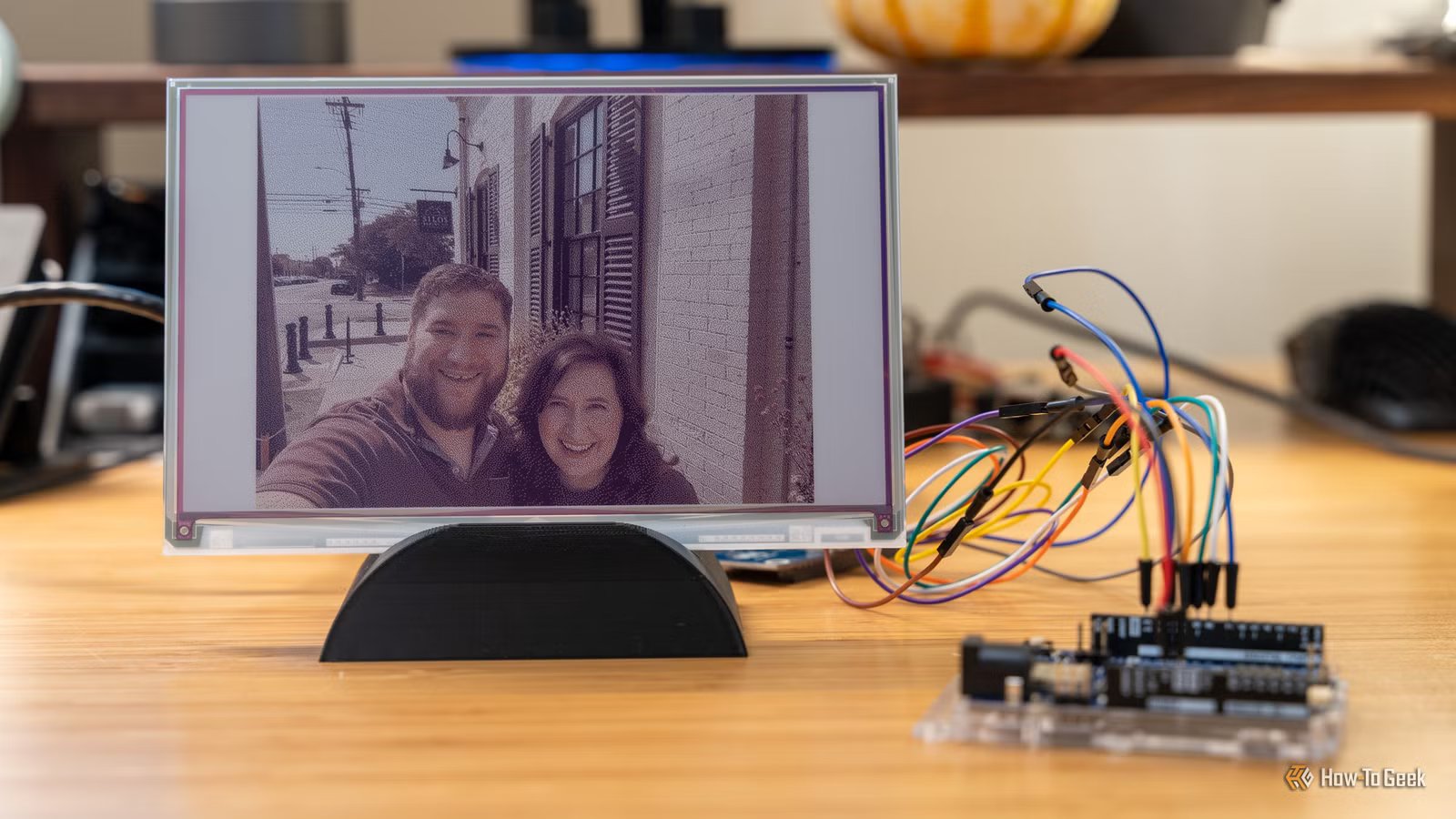
Combine a single-board computer like the Raspberry Pi or ESP32 with an E-Ink display, and you’ve laid the groundwork for a fun visual project like a Home Assistant dashboard, smart photo frame, or weather widget for your desk.
These displays are readable, sharp, and can even display color. Unfortunately, the price makes LCD and OLED displays seem more attractive.
One company produces the vast majority of these displays
You might not know this, but a single company produces most of the world’s ePaper displays: E Ink. This company describes itself as “the originator, pioneer and commercial leader in ePaper technology.” The E-Ink display space is effectively a monopoly, with E Ink holding patents that protect its technology and keep other manufacturers out of the space.
This position has given the company the power to dictate pricing for well over a decade. Consumers get a raw deal since E Ink has little in the way of competition. Whereas companies that produce other display technologies like LCD compete fiercely on price point, the lack of competition means that E Ink has little motivation to drop prices.
Credit: Seeed Studio
There’s no denying that the company has been behind some of the largest innovations in the space. It’s also not fair to say that no form of competition exists. Companies like Good Display, Winstar, and Ynvisible produce similar products, though they’re nowhere near as common as E Ink panels.
E Ink owes much of its success to its deal with Amazon to produce ePaper displays for the Kindle. Manufacturing a core component for the world’s most popular eReader brings with it a nice injection of cash, which has allowed the company to further develop, refine, and scale up its offerings. It’s as if rival companies are competing with Amazon itself.
Scale of production and manufacturing complexity
Despite the popularity of eReaders, it’s important not to lose track of where E-Ink displays land in the grand scheme of things. Though ePaper panels are desirable for a number of reasons, the technology is still somewhat niche.
Consider the near-limitless applications for LCD and OLED displays, for example. They’re in everything from laptops and TVs to smart watches and car dashboards. They’ve been around for far longer than the E-Ink display, and in the case of LCD displays in particular, many of the world’s largest display manufacturers (like Samsung Display) have ceased producing the technology in favor of outsourcing.
LCD won the game, but OLED has also dramatically come down in price despite big improvements in technology year-on-year (notably brightness and image retention resilience). Had ePaper as a technology seen anywhere near the adoption of its more versatile and responsive rivals, we might have seen the economies of scale driving those prices down.
Credit: Andrew Heinzman / How-To Geek
ePaper displays are also considered to be more complex in terms of manufacturing, involving millions of microcapsules containing positively and negatively charged particles. These must be evenly distributed and then manipulated using waveforms.
Big players like Amazon have sway
Amazon is one of (if not the) largest customers for E-Ink displays in the world. It’s fair to say that ePaper displays don’t get much more common than the Kindle, an eReader that has dropped in price considerably since it was first introduced.
You can now get a basic Kindle for $110 (with ads) and a Kindle Paperwhite for $160—and that’s before any sales or discounts are applied. Amazon has the power to negotiate bulk pricing since it needs vast quantities of these displays. A Kindle might seem relatively cheap, but E-Ink displays in other retail products can be surprisingly pricey.
Storage
16GB
Screen Size
6-inches
Even in the budget department, the Amazon Kindle is a stellar value, from its light and compact design, to its adjustable front light and 6-inch display.
Brand
Amazon
Screen
7-inch, 300 ppi, 16-level gray scale
With a 7-inch display, high contrast, and sharp image quality, the Amazon Kindle Paperwhite will help you fall in love with eReaders. It even supports Bluetooth devices for setting aside the eReader and enjoying audiobooks through headphones or earbuds.
This point is illustrated nicely in Android Police’s interview with the creator of the Daylight DC-1 Android tablet, Anjan Katta. The price of the tablet was three times the cost of a comparable LCD model, with the limited run of a niche product being a driving factor: “We actually make very little money on it. We tried to pick the lowest price we could. It’s just extremely expensive,” said Anjan.
Amazon can squeeze its unit price and still make money through the sale of books on its platform. The Kindle is famously locked down (something you can defeat with a jailbreak), so Amazon could even use it as a loss-leader that eventually will generate a profit and entrench users within its ecosystem.
Change is slow
For now, E Ink looks set to continue to dominate the market. Though patents expire all the time, newer ones are registered for better implementations. ePaper displays have improved dramatically since their inception, and a company producing panels that only match the quality of early models likely wouldn’t capture enough of an audience to warrant the expenditure involved.
Credit: Bertel King / How-To Geek
That said, there are promising rival technologies on the horizon. Perhaps the most notable of these is Good Display’s Display Electronic Slurry (DES) technology, which promises “simplified layer construction and enhanced structural precision.” Benefits include a higher contrast ratio, reduced power consumption, and 4096 colors.
It’s important to remember that, as nice as ePaper displays are to look at, the technology is limited. Refresh rates are slow, partial refreshes leave undesirable artifacts on the screen, and many don’t even include a backlight. It’s the sort of technology that feels like it should be a lot cheaper than it is, because of its inherent limitations.
For that reason, LCD and even OLED displays continue to be the more versatile option.
For now, you can get a slice of the action by opting for small E-Ink displays for around $10 with embedded microcontrollers from companies like Seeed Studio. Larger, full-color displays like SwitchBot’s AI art frame retail for up to $1300 for the largest version.
Brand
SwitchBot
Size
7.3, 13.3, or 31.5 inches
The SwitchBot AI Art Frame is an E Ink picture frame able to generate images from prompts or modify an existing image. It can also display your collection of photos or pre-existing digital artwork. The frame comes in three sizes: 7.3, 13.3, and 31.5.
