

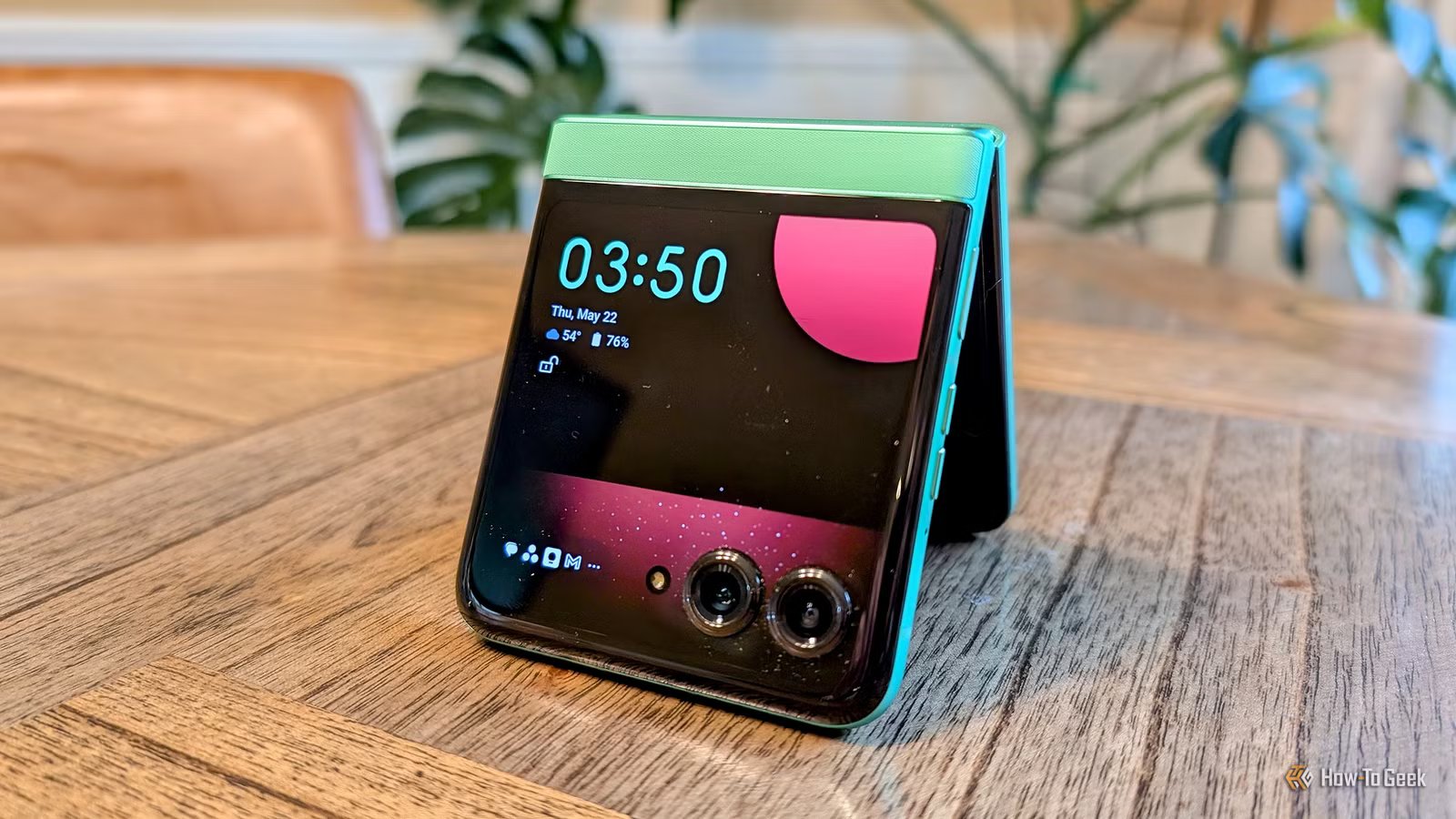
Samsung has dominated the foldable phone space ever since the introduction of the first Galaxy Fold in 2019, followed by the vertical flip-style Galaxy Z Flip in 2020. While plenty of other brands have tried to challenge that early lead with their own foldables, none have really come close—except for one underdog, and believe it or not, it’s Motorola.
Samsung built the foldable market, but it’s starting to slip
The once undisputed leader is losing its grip fast
Credit: Bertel King / How-To Geek
Samsung has been the leader in the Android foldable segment for years. It set the tone with the ultra-premium Fold and the more “affordable” (but still pricey) Z Flip, firmly placing both in the flagship space for users who want something different.
While several brands have tried their hand at foldables, such as Oppo, Huawei, Xiaomi, and Google, none have built a major presence in the US (aside from Google, to some extent). That’s not too surprising given Samsung’s long-standing dominance in the broader Android smartphone market.
Samsung has also continued to iterate every year, releasing new Fold and Flip models with gradual improvements across hinges, displays, cameras, and overall durability.
However, despite that strong “home-field” advantage, Samsung’s share of the foldable market is slipping. Motorola increased its US foldable market share from 30.1% to 44.1% between 2024 and 2025, while Samsung fell from 65.6% to 50.9%, according to Counterpoint Research.
Credit: Counterpoint Research
So how is Samsung, after years of dominance and steady refinement, starting to lose ground in one of the fastest-growing smartphone categories—and why is Motorola suddenly closing the gap?
Related
5 Ways the Galaxy Z Fold 7 Is Worse Than Last Year’s Model
The sequel is fire, but I still enjoyed the last one more.
Motorola didn’t win on innovation—it won on price
Specs matter less when affordability takes over
When Motorola announced it would be reviving the Razr name—so closely associated with the flip phone era of the mid-2000s—with an all-new foldable in the form of the Motorola Razr (2020), enthusiasts were excited at the return of the clamshell form factor.
Unlike the sharp crease of the Samsung Galaxy Fold and Flip, the 2020 Razr had a gentle curve that tucked away as the phone folded, allowing it to close with minimal visible crease. However, despite the arguably more elegant design, the early Razr was plagued with issues—poor durability (like most early foldables), mediocre specs, a small battery, and a $1,500 price tag. The last issue was arguably the most problematic.
Fortunately, Motorola has managed to significantly reduce prices across the Razr lineup over the years while improving nearly everything else. In the 2025 lineup—which includes the Motorola Razr, Razr+, and Razr Ultra, along with heavily discounted previous-generation models—the phones have become genuinely compelling. The Samsung Galaxy Z Flip 7 (256GB) currently costs around $900, whereas the Motorola Razr Ultra (2025) comes in at around $800 while offering significantly stronger specs and 512GB of storage.
For those on a tighter budget who simply want to try a foldable, the barrier to entry has never been lower. A 2024 Razr can be found for around $400, or about $22.22 per month with 0% APR over 18 months—less than a Netflix Premium subscription for a brand-new, unlocked foldable phone.
But the regular pricing is only part of the story. Aggressive carrier deals, discounts, and perks like bundled cases, Moto Tags, and earbuds have helped Motorola strengthen its position even further. That roughly 14% swing in foldable market share is, ultimately, a reflection of consumers voting with their wallets.
7/10
SoC
MediaTek Dimensity 7400X
The Moto Razr 2025 refines the popular foldable clamshell design with key upgrades for enhanced durability and performance. It features a robust titanium-reinforced hinge and an improved IP48 rating for dust and water resistance, making it more resilient for daily use.
The Motorola Razr is quietly bringing foldables to the masses
It feels like the flip phone era all over again
Credit: Hannah Stryker / How-To Geek
Motorola has closed the gap by taking share from Samsung through a combination of aggressive pricing, carrier deals, and, most importantly, genuinely solid phone design that leans into flip phone nostalgia. The Razr phones feel great to use and hold, and with decent internal specs, you’re no longer sacrificing performance just to get a foldable.
Now, don’t get me wrong, the Dimensity 7400X powering the 2025 Razr is no Snapdragon 8 Elite Gen 5, but it’s still more than adequate for the average user. The 4,500 mAh silicon-carbon battery also delivers battery life comparable to a typical non-foldable in this price range.
Whether you’re a tech enthusiast or just an average buyer, these phones make a lot of sense. If you’ve got $500 to $600 to spend on a new phone, you could go for a reliable but boring Samsung Galaxy A56 or even something a bit more stylish like the Nothing Phone 4a Pro. Or you could get something entirely different—something that feels like a futuristic sci-fi device and doubles as a conversation starter for years—with a Motorola Razr.
The point is simple: it’s far easier to justify spending $500 to try a foldable today than the $1,500 it used to cost when the 2020 Razr first launched.
This upset is exactly what the foldable market needed
Aggressive competition is finally forcing the category to grow
Motorola’s aggressive pricing shows something we’ve known for a long time: competition is a good thing, especially when a market segment is dominated by a single brand like Samsung. With the upcoming release of the Motorola Razr Fold, we could see yet another shake-up in the higher-end foldable segment, where the Galaxy Z Fold 7 currently sits as the undisputed king.
Related
5 Ways the Galaxy Z Fold 7 Is Worse Than Last Year’s Model
The sequel is fire, but I still enjoyed the last one more.
