

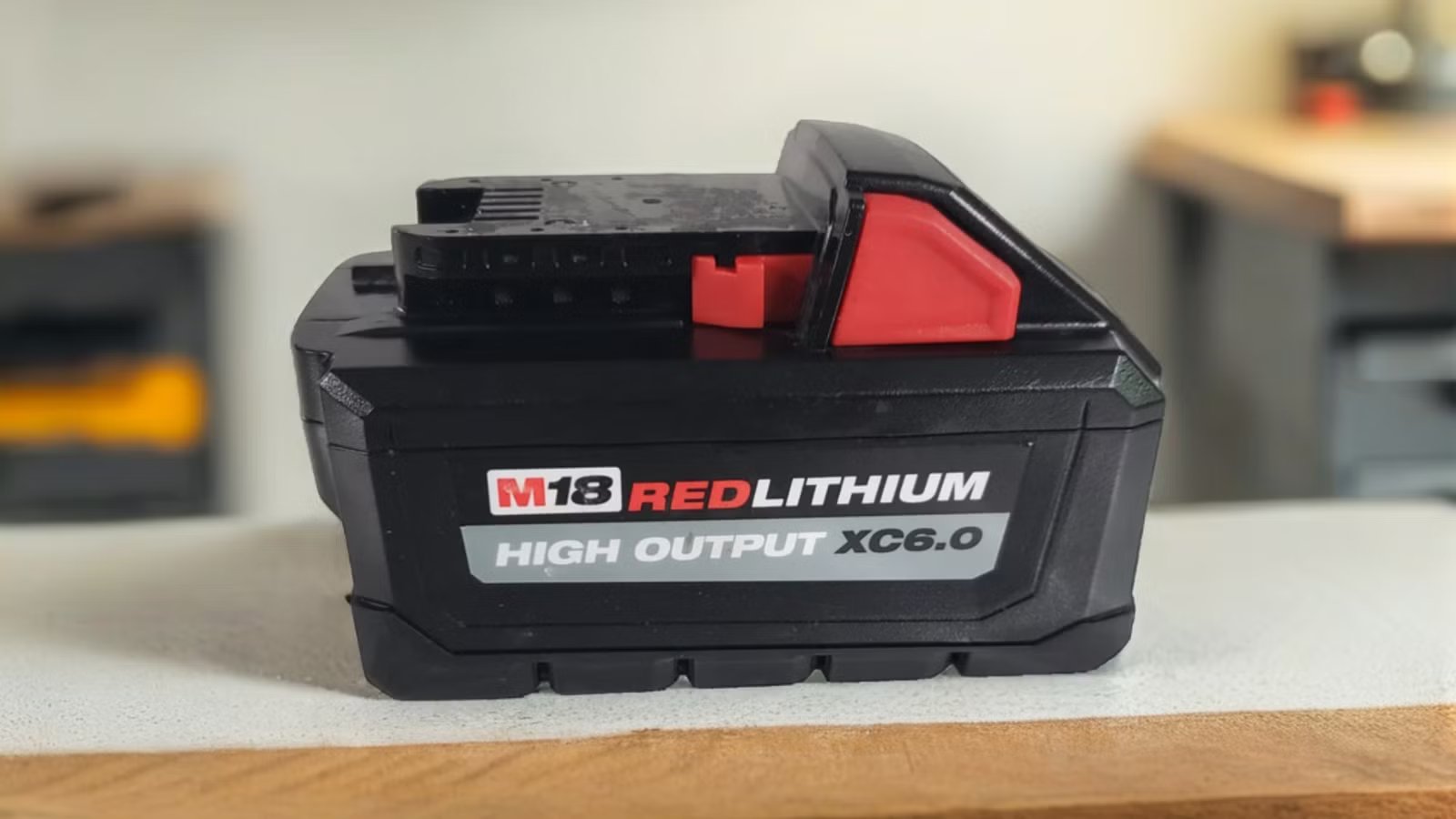
When you’re busy on a home repair, DIY project, or renovation, do you just reach for the biggest battery pack for your power tools? If so, you might not be doing yourself any favors. If anything, it only weighs you down and makes things more difficult than they need to be.
While it might be tempting to throw your best 8.0 or 12.0Ah “High Output” or HD battery into your Milwaukee drill, you might want to think twice next time, and you’re probably not getting the performance gain you think you are. Milwaukee makes a wide range of batteries for different tools, and those battery labels mean more than you think.
Milwaukee battery types explained
CP, XC, and more
Credit: Milwaukee
Without diving into all the nitty-gritty details about cell type and configuration, let’s just talk about the battery types and labels real quick. These days, almost all Milwaukee batteries are lithium-ion, as indicated by the large REDLITHIUM branding on every M18 battery pack.
Then, many Milwaukee tools come with an M12 or M18 battery labeled as 1.5Ah, 2.0Ah, 3.0Ah, or higher, along with terms such as CP, XC, HO, or even FORGE. Those can mean anything from runtime to power output to heat dissipation.
Milwaukee has four main M18 battery types or form factors: CP, XC, HD, and HO. To simplify things, look at it this way: the Ah rating refers to runtime or battery life, while CP, XC, or HD denotes the physical size, performance, and power output.
- CP — Compact (or small)
- XC — Extended Capacity (medium)
- HD — High Demand (large)
- HO — High Output (various sizes)
Many users will reach for an XC or HO/HD battery, thinking it’ll run longer or deliver better performance on their drill or driver. And while that’s true, to a degree, it’s more nuanced than that.
The biggest battery doesn’t give you the best performance
That HO or HD battery might be overkill
For those unaware, Milwaukee actually makes several different types of battery packs, not just bigger models with longer runtime. Walking through the hardware store, you’ll see all the models mentioned above. The most popular is XC, which is typically what comes with most power tool combo kits.
However, if you own a few Milwaukee High Output (HO) or High Demand (HD) battery packs, don’t just throw them into your drill and think you’ll benefit. Why? Well, these high-amperage packs are engineered to run stronger for longer and better dissipate heat, providing massive current to high-draw power tools. The key is “high-demand” tools.
By high-draw or demanding tools, I’m talking about table saws, grinders, hammer drills, sawzalls, and rotary hammers. So, if you’re running an M18 Fuel drill or angled impact 6.0Ah HO or going crazy with a 12.0Ah HD battery, the tool cannot consume all the power the battery provides, and all you’re doing is dealing with an unbalanced tool that’s now heavier. It might run a little stronger, but at a cost.
High-demand items like a circular saw have electronics inside that talk to the battery, demand all that power, and actually benefit from it. When you’re doing overhead work or quick tasks with a drill or driver, opt for a compact CP (1.5Ah–3.0Ah) or a standard XC (3.0Ah–5.0Ah) to enjoy lighter weight and better ergonomics while still getting optimal runtime.
Basically, pay attention when you’re reaching for a battery pack, and remember the difference between demanding tools like a saw or grinder, and Milwaukee’s more standard items like drills or impact drivers.
Color
Red
Warranty
Returnable within 90 days
Milwaukee’s M18 XC (extended capacity) 5.0Ah battery is a perfect blend of weight, power, and performance, ideal for any job.
What’s Included
(2) M18 REDLITHUM XC5.0 Battery, (1) M18 & M12 Multi-Voltage Charger
Battery Life
5.0 amp-hours of runtime
Get two Milwaukee XC 5.0Ah battery packs and a charger, and be ready to tackle any project.
The right battery for the job
Don’t get me wrong, you can certainly use that 6.0Ah HO battery in your drill and be fine, and it does deliver more watts and power, but you’ll have just as much success with a lightweight CP or XC model that’s a bit smaller. In fact, you might even finish faster due to less fatigue and a more enjoyable overall experience.
At the end of the day, it’s all about the tool you’re using and how big the job is. Choose bigger and better batteries when you need them, and lighter, smaller models when you don’t. And if you don’t have any big HO, HD, or FORGE battery packs, that’s fine. Only buy those if you have the tools that need all that power.
