

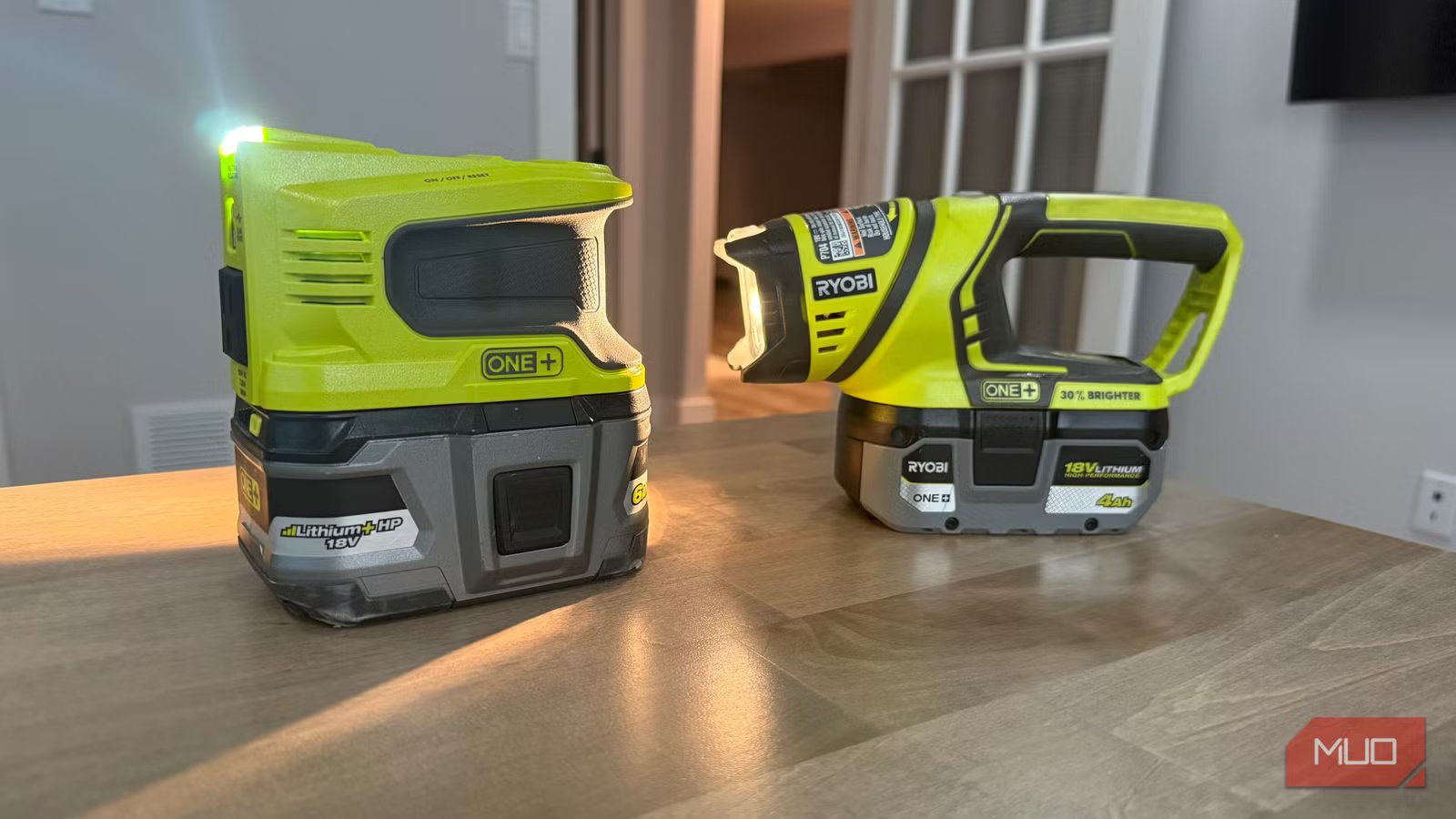
Working under a sink with a flashlight clenched between your teeth is a rite of passage nobody asks for. The fix is a cordless work light that hangs, sticks to metal, or props itself up while you work. Most run on the same batteries as your existing tools, so there’s no separate charger to deal with. I use the Ryobi version myself — it came with the ONE+ system I built my workshop around and gets grabbed more often than most of the actual tools. The four others here cover Milwaukee, DeWalt, Makita, and Ridgid — one for whatever platform you’re already running.
Ryobi 18V ONE+ cordless LED light (PCL660B)
Why it works for tight spots
The Ryobi PCL660B puts out 280 lumens with a 130° pivoting head, which is more than enough for a crawl space, the interior of a cabinet, or the area behind a water heater. I have an older model with different ergonomics, but it works just as well. The pivoting head on the new version is what makes it actually useful — set it on the ground, a shelf, or a wall hook then point it where you’re working. The runtime is rated at up to 22 hours, though that figure assumes a smaller battery; larger 4Ah and 5Ah packs extend that considerably. At around $25–$30 tool-only, it’s one of the cheaper accessories in the ONE+ lineup. If you already have 18V ONE+ batteries on the shelf, there’s no reason not to own this.
I have to add an honorable mention about my Ryobi Power Inverter as a pinch-hitter work light. It is designed to provide you with USB and AC power in areas without outlets (like camping). However, its built-in LED is bright enough for some dark tasks.
Milwaukee M18 LED work light (2735-20)
Built tougher than you’ll probably need
Credit: Milwaukeetool.com
The Milwaukee 2735-20 is a compact option for M18 users that punches above its weight in durability. The head is sealed aluminum — impact-resistant and weather-resistant — which matters when a light gets knocked off a hook in a dark space. 160 lumens through a 135° rotating head isn’t a massive number, but aim it correctly, and it’s enough. The hanging hook doesn’t rattle or flex, which is a small thing that matters when it’s overhead.
Keep your battery storage habits consistent across your M18 platform, and this light just slots right in. At just over a pound, it disappears into a tool bag without adding much bulk. One honest trade-off: the output is lower than the Ryobi and Ridgid picks here, so it’s better suited to close work than lighting a big open area.
DeWalt DCL044 20V MAX LED work light
The most mounting options of the group
Credit: Dewalt.com
What separates the DeWalt DCL044 is the number of ways it can stay put without being held. There’s a heavy-duty magnet for ferrous surfaces — the inside of an electrical panel, a furnace housing, a car door frame — plus a kick-stand, a belt hook, and a hanging feature. A full 360° pivot and rotation means aiming it isn’t really a problem: put it anywhere and redirect the beam.
The 160 lumens is on the lower side, though. It’s fine for working close-up, less impressive if you’re trying to light a wider area. It runs on 20V MAX batteries, the same platform as the rest of DeWalt’s cordless line. If you regularly work around cars or in mechanical rooms where metal surfaces are everywhere, the magnet alone justifies choosing this over the alternatives.
Makita DML812 18V LXT flashlight/spotlight
When you need actual brightness
Credit: Makitatools.com
Four modes make the Makita DML812 the most adaptable light on this list: Spot (600 lumens), Flood (1,000 lumens), Spot/Flood combined (1,250 lumens), and a Strobe setting you’ll likely never need but won’t miss having. That range makes a real difference across different jobs — a focused beam when you’re under a car, flood mode when you’re opening up a dark attic.
The 90° pivoting head gets the beam where you need it. The metal hang-hook is durable. It runs off 18V LXT batteries, the same ones powering Makita’s drills and saws. The trade-off is size — this is closer in feel to a spotlight than a compact stick light, and it doesn’t disappear into a tool bag quite as easily. For jobs that demand output, though, the brightness ceiling here is the best of the five.
Ridgid R86901B 18V magnetic LED task light
The most flexible placement of the group
Credit: Ridgid.com
The Ridgid R86901B earns its spot here on placement options alone. It puts out 900 lumens from a head that pivots 225° and rotates 270° — you can aim this thing almost anywhere without moving the base. The magnetic base sticks directly to metal surfaces, the retractable hook handles hanging, and it sits flat if neither of those works. Two modes give you a tradeoff between brightness and battery life; low mode with a bigger battery pack stretches to 24 hours, longer than most jobs need.
Ridgid’s Lifetime Service Agreement applies here too — register within 90 days and parts and labor are covered indefinitely. For anyone rounding out a Ridgid toolkit — say, once you’ve settled the drill versus impact driver question first — this is a strong next purchase.
The right light is the one that fits your battery
The core decision here is simpler than it might seem. Stick with the platform you’re already on — every option above runs on batteries you probably have sitting on the charger right now. That said, the DeWalt is worth a second look if metal surfaces are involved. Choose the Makita if brightness matters more to you than portability. A hands-free work light is one of those tools that sits unused for months and then earns its place the moment you need it. When you’re deep in a tight space with both hands already full, even a basic one changes everything.
