

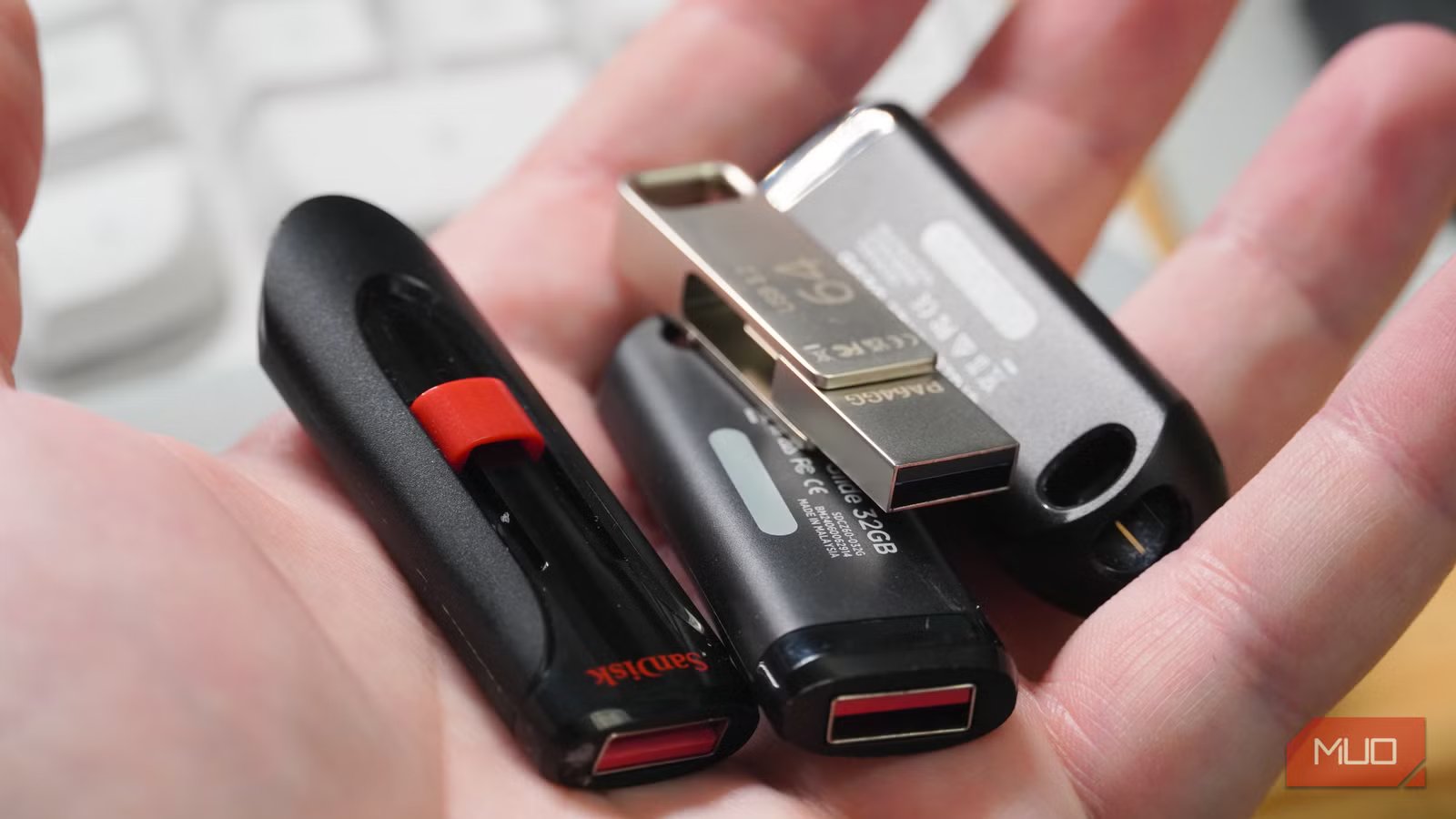
Usually, when a new technology becomes prolific, the tech’s inventor gains legendary status. Perhaps no consumer technology product reached the same ubiquity in the 21st century as the flash drive, also known as USB sticks or thumb drives. Even in a modern cloud-based world, you’ll still find flash drives in retail stores, classrooms, and offices. They are cheap, physical, and reliable ways of moving files and more between multiple devices. In 2026, you can even use flash drives to run operating systems or portable apps without actually installing them onto your computer.
There’s just one oddity — no one really knows who invented the USB flash drive, and we’ll probably never get the answer. A handful of companies and individuals stake their claim to the invention of thumb sticks, and all of them have varying degrees of evidence to prove their involvement. Although the emergence of flash drives single-handedly killed off the floppy disk for good, their true inventor is shrouded in mystery. This is the origin story of the thumb drive, and the major players that think they’re responsible for one of the most important inventions of the 2000s.
Related
That old USB drive might still be worth keeping
Every time I toss an aging USB drive, I wish I would’ve kept it. These are the things I use them for instead.
This company was the first to sell flash drives
Trek 2000 went to market first, but might not have invented them
We do concretely know the first company to bring USB sticks to market, although this isn’t a definitive indicator of which person or company invented them. That would be Trek 2000 International, a smaller company based in Singapore run by Henn Tan. Tan came up with the idea after being approached by Toshiba about making an MP3 player, according to IEEE Spectrum. The report explains that Toshiba Electronics began working with Trek 2000 International as one of its original equipment manufacturers (OEMs). In simple terms, Tan’s company Trek 2000 made Toshiba products, like the MP3 player.
As the story goes, Tan thought the music player features of the device Toshiba wanted actually limited the scope of its capabilities. The Trek 2000 International executive reportedly got the idea to yank out the “music player” features of common MP3 players, keeping only the flash storage and connectivity features. Think about early MP3 players — the ones that predated the iPod. Remove the screen, buttons, and headphone jack, and you’re left with what is effectively a USB storage device. This is said to be the foundation for Tan’s vision of the flash drive.
The thumb drive name came from Trek 2000 International’s first commercial USB stick. Although Tan and Trek 2000 International are responsible for being the first to sell flash drives, patent applications and claims happening at the exact same time make it difficult to determine the exact inventor.
Related
This number on a USB thumb drive that actually tells you how fast it is (and it’s not USB 3.0)
Stop guessing USB speed—this detail tells you everything you need.
At least two companies take credit for the invention
M-Systems and IBM each filed patent disclosures in 1999
Credit: Brady Snyder / MakeUseOf
One of those companies was the Israeli brand M-Systems, led by Dov Moran. He patented a technology called “DiskOnKey” in April 1999, generally known as the world’s first USB flash drive. The title for M-Systems’ patent application was “Architecture for a Universal Serial Bus-Based PC Flash Disk,” and it was granted in November 2000. It described a device that used flash storage, a USB controller, and a USB connector for quick and easy storage and data transfer.
However, at around the same time, the Chinese company Netac Technology filed a patent for a USB flash drive in November 1999. By the early 2000s, Netac ended up with multiple patents related to USB drive technology in China and the United States. Although M-Systems and Trek 2000 International reject Netac’s claim to the technology, the courts have largely sided with Netac, awarding the Chinese company royalties and licensing fees related to patent disputes. Netac obtained the critical U.S. copyright for USB flash drives in 2004. It defended its claim to the patent in the following years, including with a high-profile lawsuit against storage maker PNY in 2006.
Another important player in the USB drive’s invention is Pua Khein-Seng, who co-founded the Taiwanese company Phison. Khein-Seng likely wasn’t the first to make a USB drive, but crucially, created a system-on-a-chip flash drive that used a single chip controller instead of multiple. It made flash drives cheaper and less complex to produce, further helping thumb drives go mainstream.
In case there weren’t enough claimed inventors of the flash drive already, IBM engineer Shimon Shmueli filed an official invention disclosure in the U.S. in 1999 for USB flash drive technology.
Related
I spent years perfecting my rescue USB—now it can save any PC
This free rescue USB can recover any computer.
Thumb drives repackaged existing technology
USB connectors and flash storage weren’t innovative apart — they were together
Credit: Brady Snyder / MakeUseOf
If we’re being honest, there are even more people that deserve credit for the success of the USB flash drive. This invention was a brilliant repackaging of other creations, which made for a great consumer product. For instance, Toshiba’s Fujio Masuoka developed the flash storage technology that made USB drives possible. Ajay Bhatt drove the invention of the Universal Serial Bus (USB) connection standard that facilitated the invention of flash drives. At their core, flash drives are flash storage, controllers, and a USB connector — they wouldn’t exist without flash and USB coming before them.
The creation of the USB drive was clearly a collaborative effort, with many great technological minds separately working to achieve the same goal. We probably won’t ever know definitively who invented the flash drive. Trek 2000 International was the first to market, M-Systems and Moran are usually credited for the invention, and Netac ended up with the U.S. patents. It’s an open-ended conclusion to a wild story about the origin of the flash drive.
