

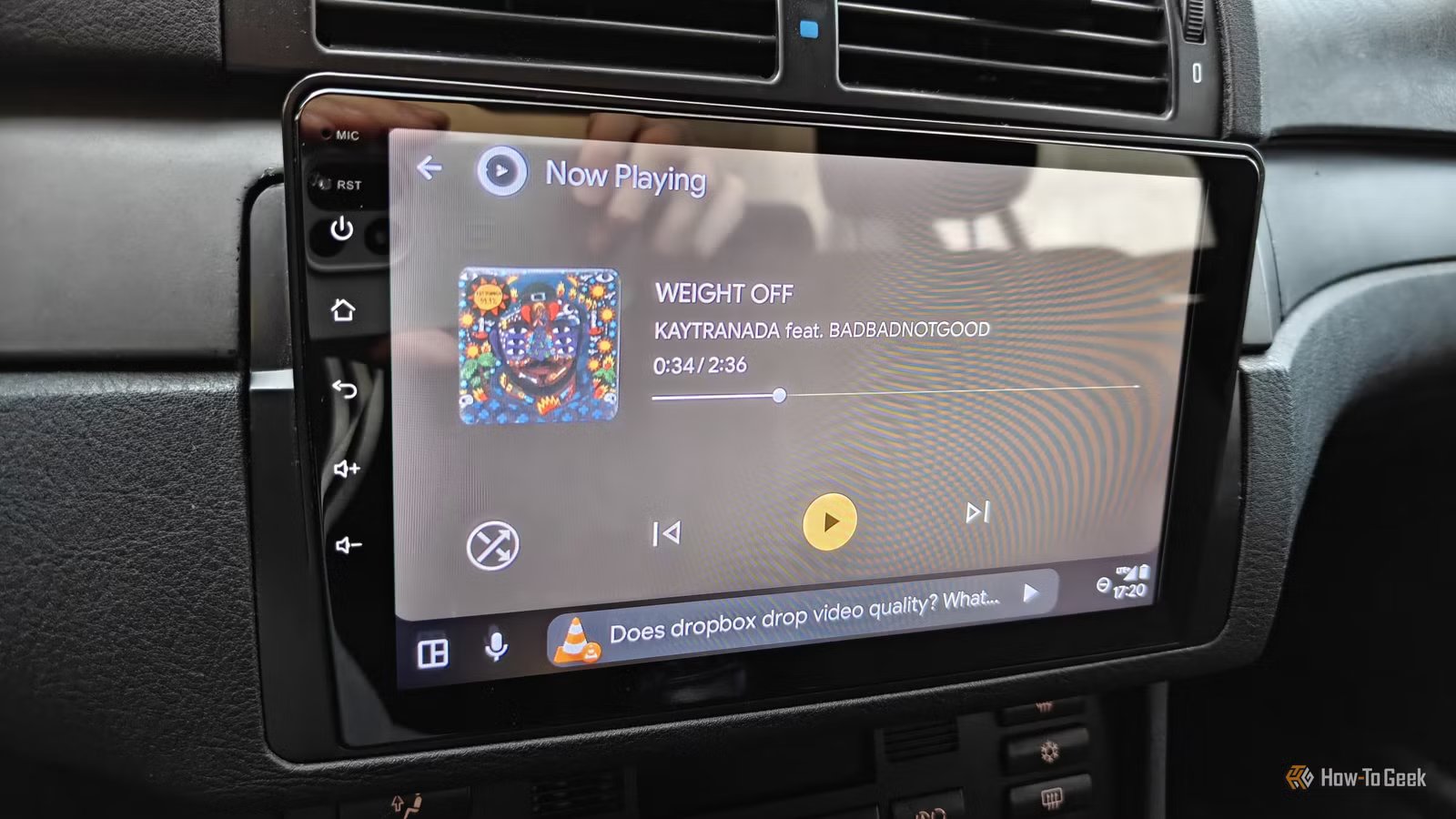
Most of us rely on the convenience of Android Auto to handle music in our cars, and given how streaming is so dominant at home, it’s natural to default to apps like Spotify or YouTube Music on the road too. However, streaming is not the best fit for driving—playing music stored on your phone offers a far better experience.
Streaming apps love to interrupt your music
Buffering, dropouts, and ads
One of the most annoying things about free music streaming services is that they constantly bombard you with repeating ads.
It doesn’t matter if you’re doing a quick grocery run or visiting your extended family that lives in a different state; ad breaks are annoying—especially when you’re driving on a straight, empty highway for hours on end, and that music is the only thing keeping you entertained.
Ads are far from the only thing that’s going to interrupt your music, though. A far bigger problem is reception.
Music streaming services work great when you’re cruising around city streets and get a perfect 4G or 5G internet connection. However, not everyone gets to enjoy this luxury, and they certainly don’t get it on every trip. If you frequently take your car on country back roads, you know exactly what I’m talking about.
There are plenty of areas with poor reception, like deep valleys, canyons, and states with massive stretches of highways that get no coverage or poor coverage. Weather can cause signal strength to change as well—good luck getting stable reception in the middle of a heavy storm or when a power outage knocks out a cell tower’s backup power.
The moment your internet connection is lost, or you hit a signal dip, your seamless music streaming experience turns into moments of buffering, stuttering, and eventually complete silence.
Another problem with free streaming plans is that they often come with severe restrictions on what songs you can listen to. You might get a limited number of skips per hour, forced shuffle, daily limits on how many songs you can hand-pick, and browsing itself is often limited.
Even audio quality takes a hit—on top of the already reduced quality you’re getting if you’re using a wireless connection, free plans typically limit the bitrate to a point where it becomes quite noticeable, especially if your car is equipped with an advanced sound system.
Admittedly, you can circumvent these issues somewhat by paying a monthly subscription to unlock premium features of whatever your preferred streaming service is. Spotify Premium, for instance, removes ads and lets you download music for offline listening, so you can continue listening to your tunes, assuming you planned ahead and downloaded your music in advance.
If you’re trying to limit how many services you’re subscribing to, though, like I am, it can be hard to justify paying for a service that you can technically still use for free.
Subscription with ads
No ads on any paid plan
Price
Starting at $12.99/month, or $6.99/month for students
Spotify offers both a free, ad-supported plan and a paid subscription tier. With Spotify Premium, you can remove ads and download music for offline listening, making it a good option when you’re driving and don’t have a stable connection.
Local music players are fast, simple, and dependable
Reliability beats the convenience you get with streaming
Credit: Ismar Hrnjicevic / How-To Geek
Let’s face it: more often than not, a typical everyday car trip only takes around ten to fifteen minutes, if even that. Do you really want to waste time fiddling with Spotify? If the app crashed or didn’t sync properly, it won’t continue playing whatever you had streaming at home, and even if it does, there’s a good chance you’ll want to switch up your playlist. And once you do start driving, your already brief music listening session will get cut even shorter by those unskippable ads.
Switching to a local music player removes all that friction—it’s as plug-and-play as it gets. You get in your car, hit play, and it starts playing your entire music library or your carefully curated playlist. There are no ads to interrupt it, and you can skip as much as you want or pick a specific song you’ve had in mind.
Another often overlooked benefit of local music is that the audio quality is noticeably better. The free Spotify plan maxes out the bitrate at 160kbps, but it can go as low as 24kbps if it’s set to Auto, which is honestly the option you end up using if you don’t want poor signal strength to interrupt your music playback.
At 160kbps, the heavy compression has a noticeable impact on audio quality—higher frequencies can sound a bit muddy, and bass lacks punch.
Now compare that to a typical MP3 file, which can go up to 320kbps. In simple terms, it can hold roughly double the data, which results in crisper highs, more natural-sounding vocals, punchier bass, better dynamic range, and even a more defined soundstage that all make a noticeable difference in your car’s sound system.
While you could argue that the differences aren’t always obvious in a car environment due to road and traffic noise, it becomes more noticeable once you’re out on the open road. I can easily tell whether I’m listening to Spotify or my MP3 music player without even looking at my screen, based on sound quality alone.
Technically speaking, lossless audio like FLAC also becomes an option, but you’re realistically only able to take full advantage of it if you plug in your phone and have a seriously good sound system. It’s also worth noting that music players with DVC (Direct Volume Control) support can take your local music listening a step further compared to streaming.
Realistically speaking, the only downside of switching to local players is that you have to create your music collection yourself. This is what puts most people off, but it’s not nearly as difficult as it seems. It can even be a fun hobby, and there are tens of thousands of free songs you can find online to kickstart your collection.
Keep streaming as a backup, not your default choice
Useful when needed, unnecessary most of the time
Although I’ve mostly switched to listening to music stored locally on my phone through Android Auto, there are still a few situations where I’ll switch back to Spotify. For example, if I want to listen to a specific song that I haven’t downloaded and I’m really in the mood for it, I’ll just use Spotify.
The other case is when I have passengers who want to play a specific song. Since my music library is relatively small, I’ll usually just ask them to find it on Spotify and play it from there. But if you ask me, I can’t wait until they get out of the car so I can switch back to my local music player.
Related
I Quit Spotify and Started Buying Music Again—It’s Cheaper Than I Expected
$12 a month for unlimited music isn’t as unbeatable a deal as it sounds.
