

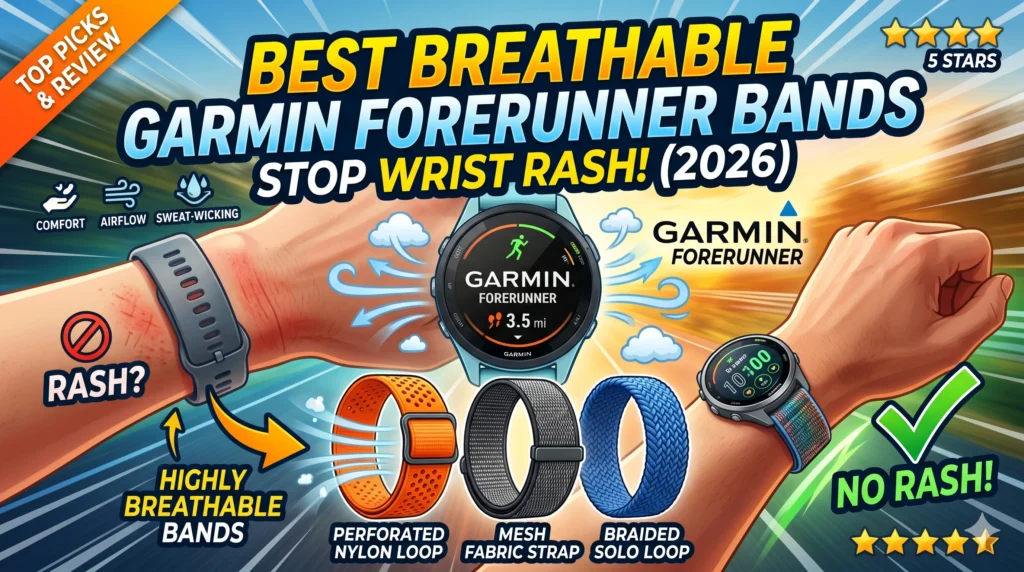
If your Garmin Forerunner is leaving a red, itchy, or peeling ring around your wrist after long runs, you are not alone — and the problem is almost certainly not your skin. It is the stock watch band.
The standard thermoplastic elastomer (TPE) bands that ship with most Garmin watches are solid and non-porous. When you sweat, moisture, friction, salt crystals, and dead skin cells get trapped directly beneath the band with nowhere to escape. This creates the exact conditions for irritant contact dermatitis — a skin reaction caused by prolonged exposure to moisture and friction, not an allergy to the material itself.
Disclosure: This article contains affiliate links. As an Amazon Associate, I earn a small commission if you buy through these links — at no extra cost to you. All product selections are based on independent research from runner communities, verified Amazon reviews, and Garmin’s official specifications. No brands were contacted or paid for inclusion.
The fix is simple: switch to a band designed with physical ventilation channels or moisture-wicking fabric so sweat can actually evaporate. Based on extensive research across runner forums, thousands of verified Amazon reviews, and Garmin’s official specifications, here are the best breathable alternatives for 2026.
Quick Comparison: All Picks at a Glance
BandLug WidthMaterialBest ForDrying TimeTencloud Breathable Silicone Band18mmSiliconeSmall wrists (S models)Under 5 minAncool Perforated Sport Band20mmSiliconeAll-round daily runningUnder 5 minMeliya Nylon Loop Band20mm / 22mmWoven nylonEndurance & sleep tracking20–30 minKartice Breathable Silicone Band22mmSiliconePremium Forerunner modelsUnder 5 min
Step 1: Find Your Exact Lug Width (Do Not Skip)
Garmin’s Forerunner lineup does not use a single universal band width. Buying the wrong size means the spring bar pin will not seat properly, and your watch can fall off mid-run. Check your exact model in the table below before ordering anything.
Garmin Forerunner ModelLug WidthBand MechanismForerunner 45S / 255S / 265S18mmStandard Quick ReleaseForerunner 55 / 70 / 165 / 170 / 24520mmStandard Quick ReleaseForerunner 570 (42mm case)20mmStandard Quick ReleaseForerunner 255 / 265 / 74522mmStandard Quick ReleaseForerunner 570 (47mm case)22mmStandard Quick ReleaseForerunner 955 / 965 / 97022mmQuick Release + QuickFit compatible
2026 note: The new Forerunner 570 comes in two sizes. The 42mm watch face uses a 20mm band. The 47mm watch face uses a 22mm band. Check the case size printed on the back of your watch before ordering.
Best 18mm Band: Tencloud Breathable Silicone Sport Band
Fits: Forerunner 265S, 255S, 45S
Runners with smaller wrists tend to suffer more from wrist rash because the standard Garmin band does not have enough adjustment notches to give a snug fit without pressing too tightly. The Tencloud 18mm band is specifically sized for Garmin’s small-case Forerunner lineup.
Why runners choose it: The band features large pill-shaped ventilation cutouts running the full length of the strap. Unlike micro-perforations that clog with sweat residue, these larger holes allow airflow and dry quickly. It is also shorter in overall length than standard bands, so smaller wrists do not end up with excess strap folding back over itself.
What verified buyers say: Reviewers consistently mention it solved their rash within the first week of switching, and that it is significantly softer than Garmin’s stock band. A common complaint is that the two-tone sporty look is not office-appropriate.
Pros
- Large ventilation holes — fastest-drying silicone option for 18mm models
- Shorter strap length is ideal for small wrists
- Uses standard 18mm quick-release pins — no tools needed
Cons
- Sporty two-tone design may not suit formal workplaces
- Limited colour options compared to solid-colour alternatives
→ Check current price on Amazon (affiliate link)
Best 20mm Band: Ancool Perforated Silicone Sport Band
Fits: Forerunner 170, 165, 70, 55, 245, and 570 (42mm case)
If you want a direct upgrade from the stock band without changing materials, this is the straightforward choice. Instead of solid rubber, the Ancool band features three rows of laser-cut ventilation channels running the full length of the strap.
Why runners choose it: The perforated design prevents sweat pooling beneath the band. Runners in hot and humid climates report noticeably less skin irritation compared to stock Garmin bands. The silicone is softer and more flexible than Garmin’s TPE material. Quick-release spring bars mean you can swap it without tools in seconds.
What verified buyers say: Frequently described as “the band Garmin should have shipped.” Highly rated for daily runners who found the stock band caused redness within an hour of running. A minor downside noted by buyers is that the matte silicone surface picks up lint and dust.
Pros
- Laser-cut holes eliminate sweat pooling — the most common cause of wrist rash
- Softer and more flexible than Garmin’s stock TPE material
- Easy to rinse and air dry after workouts
Cons
- Matte finish attracts dust and lint
- Not suitable for swimming (silicone ventilation holes trap pool water briefly)
→ Check current price on Amazon (affiliate link)
Best Nylon Band: Meliya Woven Nylon Loop Band
Fits: 20mm and 22mm models — select your size at checkout
Silicone is not the only option. For endurance athletes and people who also use their Forerunner for overnight sleep tracking, a woven nylon loop is the most breathable choice available. Nylon is naturally porous, meaning sweat wicks away from the skin rather than pooling beneath the band.
Why runners choose it: The hook-and-loop (no-buckle) closure allows micro-adjustment by a millimetre at a time — useful when your wrist swells slightly during a long run or half-marathon. It is also significantly lighter than any silicone band and far more comfortable for overnight wear.
What verified buyers say: Consistently praised by users who tried multiple silicone bands without success. Many report it eliminated their rash completely within days. The main trade-off noted by buyers is drying time — if you run in heavy rain or swim, the nylon stays damp against your wrist for 20 to 30 minutes.
Pros
- Infinite micro-adjustment — adapts to wrist swelling during long runs
- No metal buckle pressing into your wrist while typing or sleeping
- Lightest band type available for Garmin Forerunners
- Available in both 20mm and 22mm — works across most Forerunner models
Cons
- Takes 20–30 minutes to fully air dry after heavy rain or swimming
- Casual or worn-in look — not ideal for formal settings
→ Check current price on Amazon (affiliate link)
Best 22mm Band: Kartice Breathable Silicone Sport Band
Fits: Forerunner 970, 965, 955, 265, 255, 745, and 570 (47mm case)
For premium Forerunner owners who want the cleanest look alongside breathability, the Kartice 22mm perforated silicone band is the most recommended option across the r/Garmin community. It sits closer to a premium feel than most budget alternatives.
Why runners choose it: Well-finished edges, a firm but flexible silicone, and ventilation holes that are large enough to allow real airflow but spaced evenly enough to still look intentional. Compatible with both standard 22mm quick-release pins and Garmin’s QuickFit 22 system.
What verified buyers say: Buyers who own the Forerunner 965 and 970 specifically call it out as matching the watch’s premium aesthetic better than cheaper alternatives. Praised for holding its colour and shape after months of daily use. A small number of buyers note the clasp pin requires a firm push to lock.
Pros
- Premium feel appropriate for high-end Forerunner models
- Compatible with both quick-release and QuickFit 22 attachment systems
- Holds colour and shape well over months of daily use
Cons
- Clasp pin can be stiff initially — needs a firm push
- Slightly higher price than basic perforated silicone alternatives
→ Check current price on Amazon (affiliate link)
How to Clean Your Garmin Band and Prevent Odour
A breathable band solves the rash, but you still need to clean it regularly. Bacteria build up in ventilation holes and nylon weave over time, causing odour and eventually irritation even on the best band.
The right cleaning routine:
- Remove the band from the watch first. Never scrub the watch case itself with soap — surfactants can degrade the waterproofing seals over time.
- Silicone bands: Use a drop of mild dish soap and warm water. Scrub ventilation holes gently with a soft toothbrush. Rinse and pat dry with a microfibre towel.
- Nylon bands: Soak in warm water with a small amount of gentle laundry detergent for 10 minutes. Scrub the weave with a soft brush. Air dry completely in a ventilated space overnight.
- What to avoid: No alcohol wipes on silicone (degrades the material over time). No bleach on nylon. Never put a nylon band in a dryer — the heat warps the plastic spring bar housings.
Frequency: Clean your band every 1–2 weeks if you run daily. If you notice redness returning before that, clean more often and consider leaving the band off for 30 minutes after your run to let the skin breathe.
Frequently Asked Questions
Why does my Garmin watch give me a rash?
It is usually not an allergic reaction to the silicone itself. The stock Garmin TPE band is solid and non-porous. When you sweat, moisture, friction, salt crystals, and dead skin cells get locked beneath the band. This creates friction and bacterial overgrowth, leading to irritant contact dermatitis — a form of skin irritation caused by prolonged exposure to moisture and friction, not an allergy.
Can I use generic third-party bands on my Garmin Forerunner?
Yes. As long as the band uses standard quick-release spring bar pins and matches the exact lug width of your model (18mm, 20mm, or 22mm), it will fit perfectly. You do not need to buy official Garmin-branded accessories. All bands recommended in this article use standard quick-release mechanisms.
Is nylon or silicone better for running in rain or swimming?
Silicone is better for wet conditions. It does not absorb water and dries almost instantly. Nylon, while more breathable in dry conditions, absorbs water and stays damp against your skin for 20 to 30 minutes after swimming or running in heavy rain. For predominantly dry or humid environments, nylon wins on overall breathability. For swimmers and wet-weather runners, perforated silicone is the safer choice.
What is the difference between Quick Release and QuickFit bands?
Quick Release bands use a tiny metal lever on a spring bar that you slide with your fingernail to pop the strap out — this is the standard system used by most third-party bands. QuickFit is a proprietary Garmin system found on premium models like the Forerunner 955, 965, and 970, where the strap snaps directly over a fixed metal pin without any tools. Premium 22mm Forerunners accept both styles, giving you the widest band choice.
How long should I leave my watch off to let my wrist recover?
Dermatology advice from the British Association of Dermatologists and similar bodies recommends giving irritated skin at least 30 to 60 minutes of air exposure after prolonged band contact. Many runners find that taking the watch off immediately after a run and letting the wrist air dry completely before putting it back on — even with a breathable band — eliminates the rash entirely within one to two weeks.
About this article: This guide is based on research from Garmin’s official support pages, runner communities including r/Garmin and Garmin Connect forums, and analysis of verified purchase reviews. It is updated for 2026 Forerunner models. If you spot a sizing error or a product that has been discontinued, please contact us so we can update it.
