

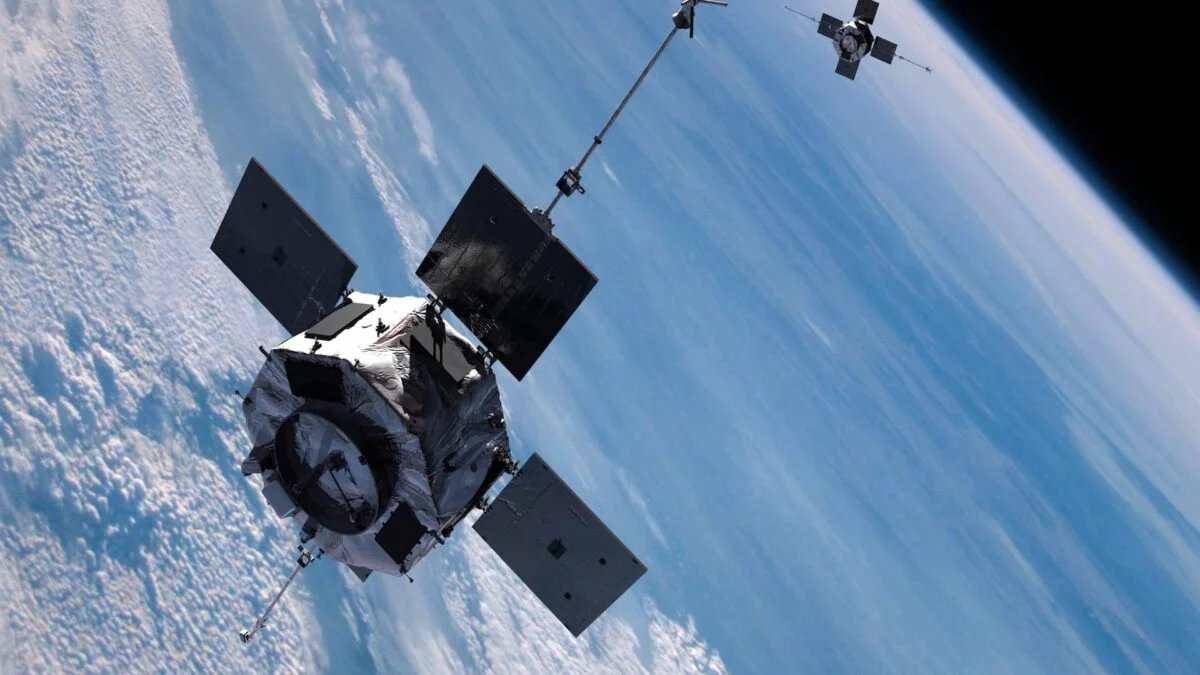
A NASA probe tasked with gathering data on Earth’s radiation belts has run out of fuel and is set to reenter through the atmosphere on Tuesday.
NASA’s Van Allen Probe A is expected to re-enter the atmosphere at approximately 7:45 p.m. ET on March 10, according to data provided by the U.S. Space Force. The space agency expects most of the spacecraft to burn up during its journey through the atmosphere, but some parts may survive the uncontrolled reentry. Although the risk of harm to anyone on Earth is low, it’s not exactly zero.
Twin probes
The probe launched in August 2012 along with its twin, Van Allen Probe B, to study the two permanent radiation belts around Earth. The two probes were originally designed for a two-year mission but ended up spending nearly seven years gathering unprecedented data on charged particles passing through Earth’s magnetic field.
NASA deactivated the two spacecraft in 2019 after they ran out of fuel and were no longer able to orient themselves toward the Sun. At the time, it was predicted that the spacecraft would reenter through Earth’s atmosphere in 2034.
Those calculations, however, were made before the ongoing solar cycle, which has proven far more active than expected. The Sun’s intense outbursts increased atmospheric drag on the spacecraft, resulting in an earlier reentry date. Van Allen Probe B, on the other hand, is expected to reenter through the atmosphere in 2030, outliving its twin spacecraft by a few years.
Take cover
Most of the 1,323-pound (600-kilogram) spacecraft is expected to burn up during its fiery reentry, but some components are expected to survive the journey home, according to NASA.
Since the probe will undergo an uncontrolled reentry, it’s hard to predict exactly where parts of it might fall on Earth. Based on its trajectory, NASA estimates that the risk of injury for anyone on Earth is about 0.02%, or approximately 1 in 4,200. Those are very low odds indeed, and any remaining probe chunks will most likely end up falling in remote, uninhabited parts of the planet. NASA and the Space Force will continue to monitor the spacecraft’s reentry and update predictions for the exact time and place.
During their mission, the twin spacecraft, formerly known as the Radiation Belt Storm Probes, helped scientists make several discoveries on the Van Allen radiation belts that surround Earth. Data from the probes also helped in the discovery of a transient third belt, which forms during intense solar activity.
“Data from NASA’s Van Allen Probes mission still plays an important role in understanding space weather and its effects,” NASA wrote. “By reviewing archived data from the mission, scientists study the radiation belts surrounding Earth, which are key to predicting how solar activity impacts satellites, astronauts, and even systems on Earth such as communications, navigation, and power grids.”
