

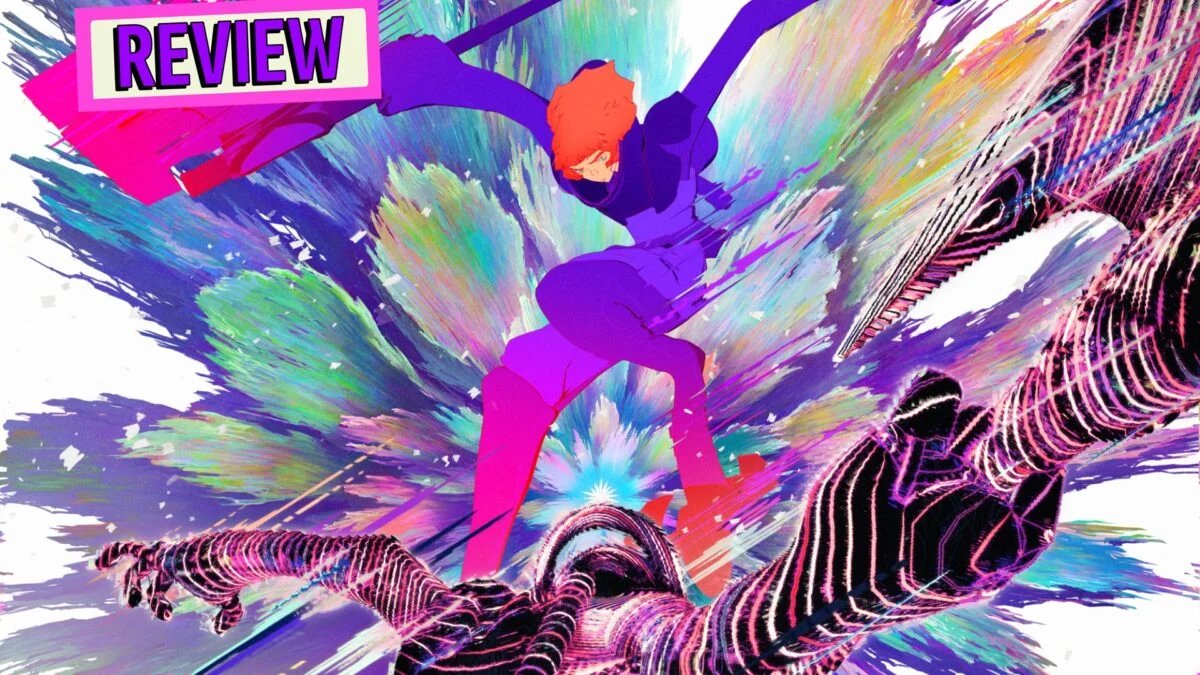
All You Need Is Kill, the latest U.S. theatrical anime release from GKids, exists—like its space-faring threat—as a bit of an anomaly. The film, from anime production house Studio 4°C (Children of the Sea), marks the third adaptation of Hiroshi Sakurazaka’s beloved 2004 sci-fi light novel. In 2014, it became both a manga and the cult-beloved Tom Cruise action flick Edge of Tomorrow. It’s also the directorial debut of Studio 4°C’s Kenichiro Akimoto. In essence, Studio 4°C’s All You Need Is Kill is a time‑loop tale entering its third retelling in a new medium, fighting from underneath to prove it’s as unique—if not more so—than its predecessors.
While this third go‑around never quite swings for the fences, All You Need Is Kill still brims with dazzling animation and sparks of heart, laying down a reinvigorated layer atop a well‑trodden tale diehards already treat as a modern myth worthy of retelling alongside Hercules and Gilgamesh. And for newcomers, the flexing on display in its artful spectacle, moody atmosphere, and crisp action is pure eye candy and further proof of why this story has looped through so many incarnations.
Set in the perpetually not-so-far-off future of 20XX, All You Need Is Kill follows Rita, a reclusive, emotionally guarded young woman volunteering to rebuild Japan after the sudden appearance of a gigantic alien flower that humanity has taken it upon itself to name “Darol.” One day, the docile plant turns hostile, releasing a swarm of monsters that kill Rita and her fellow volunteers. Upon her death, Rita is caught in an endless time loop, starting the day of Darol’s sudden attack all over again. While fighting to live for a tomorrow that may never come, Rita joins forces with a timid young man named Keiji, also trapped in the loop, as the pair die over and over again in their fight to live to see tomorrow.
Off the bat, All You Need Is Kill—despite the oddness of its scribbly, rough‑hewn, lumpy‑yet‑charming, crude‑cute aesthetic—is still one hell of a looker, thanks in major part to the sheer artistry baked into its inimitable visual identity. Whenever the film isn’t unfurling an entrancing, picturesque tableau of the awe-inspiring vistas and quiet solitude of its sci-fi world, clinging to its last vestiges of beauty before its inevitable collapse, it captivates in a different register, the chest-pounding variety, making you sit forward as trippy, kaleidoscopic battles erupt and a camera that can’t sit still for the life of itself whips and weaves around to catch every dramatic angle of its action.
© GKids/Studio 4°C
Studio 4°C’s blend of 2D and 3D CG is so seamless that, aside from the obvious choice to render anything mechanical—from automobiles to pitchy‑voiced robot companions to oversized construction mechs—you can’t tell where one ends and the other begins. It never reaches the point where your immersion is shattered by the kind of distractingly contrasting animation sequences this style is sometimes prone to. It’s a crucial strength, especially as the film loops and permutes Rita’s no‑good, very‑bad day again and again, repeating both the action and the monotony of her cycle without ever dulling its own premise or hammering the audience with the frivolousness and despair of her hellish loop of trauma and violence.
By the half‑hour mark, we’ve watched Rita shift from an understandably fraught, hapless victim of cosmic circumstance into a competent warrior hacking away at aliens with an oversized cyber‑axe. All thanks to the nearly 100 deaths she’s suffered at the hands of Darol’s hostile monster spawns. Funnily enough, it’s here where the film explicitly hews closer to showcasing Rita’s prowess, moving with confident precision and persistence, like someone trying to perfect a no‑damage run in a roguelike.
© GKids/Studio 4°C
The film further emphasizes this decision with gusto through snappy, first‑person POV shots that capture both Rita’s melancholic meditation, verging on doom‑spiraling, and her rushes of adrenaline. It’s here that the movie truly sings, allowing audiences to feel trapped alongside Rita as she cycles through freeze, flight, and ultimately fight—making every logical decision a person sat in the theater would make as their next steps—clawing her way out of her time loop and seeing battles from her perspective, over her shoulder, or close to the action, as she pushes herself to her absolute limits to seize victory from the jaws of defeat, all to a booming, techno‑synth‑heavy soundtrack by Yasuhiro Maeda.
One unique alteration—and a major selling point—of the film is that its story isn’t told from Keiji’s POV but from Rita’s. In other versions, she’s framed as a badass, confident warrior; here, we see the long road that leads to that bravado. She’s still a loner, but Studio 4°C’s Rita is a far cry from her adaptation counterparts. She’s no warrior; she’s simply a volunteer at a research facility mining a weird alien space plant that appeared years earlier. While resourceful, the isolated Rita we meet is a bit more prickly and standoffish than past iterations, though understandably so, given how more frivolous her life feels with a death-looping cycle piled on top of her traumatic relationship with her mother. A relationship that the film frustratingly offers only enough breadcrumbs for, leaving audiences to fill in the blanks.
© GKids/Studio 4°C
In essence, the film’s treatment of its lead never feels fully realized. By the time the credits roll, you’re left with only a partial silhouette of an iceberg and a shallow cross-section of one at that. Although it’s just enough to sense the deeper emotional strata beneath the surface, the film never truly submerges its narrative to give audiences a wide-eyed look at Rita as a character beyond what other iterations have already showcased. While that keeps the film nimble, it also means it doesn’t immerse itself in her emotional wash as deeply as it could. Still, many of the cathartic, big-cry emotional breakthroughs between her and Keiji, her “guy in the chair,” serve as the film’s beating heart as they shift from a polar-opposite partnership to something more. They go from fighting simply to escape their death loop to fighting to ensure they both survive.
The film slows down just enough to spark the leads’ budding relationship—simmering with humor and heart—yet it never quite comes to a full boil. Its constrained runtime becomes a pressure cooker that might’ve landed harder with a bit more room in the middle, rather than rushing their connection through a syncopated montage. It’s a commendable adaptation that refuses to overstay its welcome, but it still feels like it needed more space, especially for Rita’s carefully built agency, which ends up feeling like a fire hose clamped shut the moment it felt like it was going to burst.
© GKids/Studio 4°C
Even after sleeping on it, the ending still feels like a stutter‑step landing rather than one that sticks. The emotional overture is there—dying in an endless today, fighting for a tomorrow that isn’t promised—but the quieter moments between loops only spark glancing compassion, never full‑blown empathy. As the film shifts into a matter‑of‑fact march toward its finale, it leans on a burst of sudden exposition to ferry us to a climax that feels a bit unearned and abrupt, even as the visual marvel on screen never falters. Its old‑school, Casablanca‑tinged ending is sound enough on paper, sure. But emotionally, it lands a touch shallow.
All You Need Is Kill‘s finale may be as bittersweet as previous adaptations, but it still dismounts as a mildly pyrrhic one—especially after spending so much time laying track for Rita, only to push her onto half‑built narrative rails and strip away bits of her hard-fought agency by the end. Despite this, All You Need Is Kill remains a vibrant—if not fully stirring—tale of two opposites finding hope in a bleak world, stealing a few bases to set itself apart from past adaptations, but never quite cracking a home run-worthy swing.
All You Need Is Kill releases in theaters on January 16.
Want more io9 news? Check out when to expect the latest Marvel, Star Wars, and Star Trek releases, what’s next for the DC Universe on film and TV, and everything you need to know about the future of Doctor Who.
