

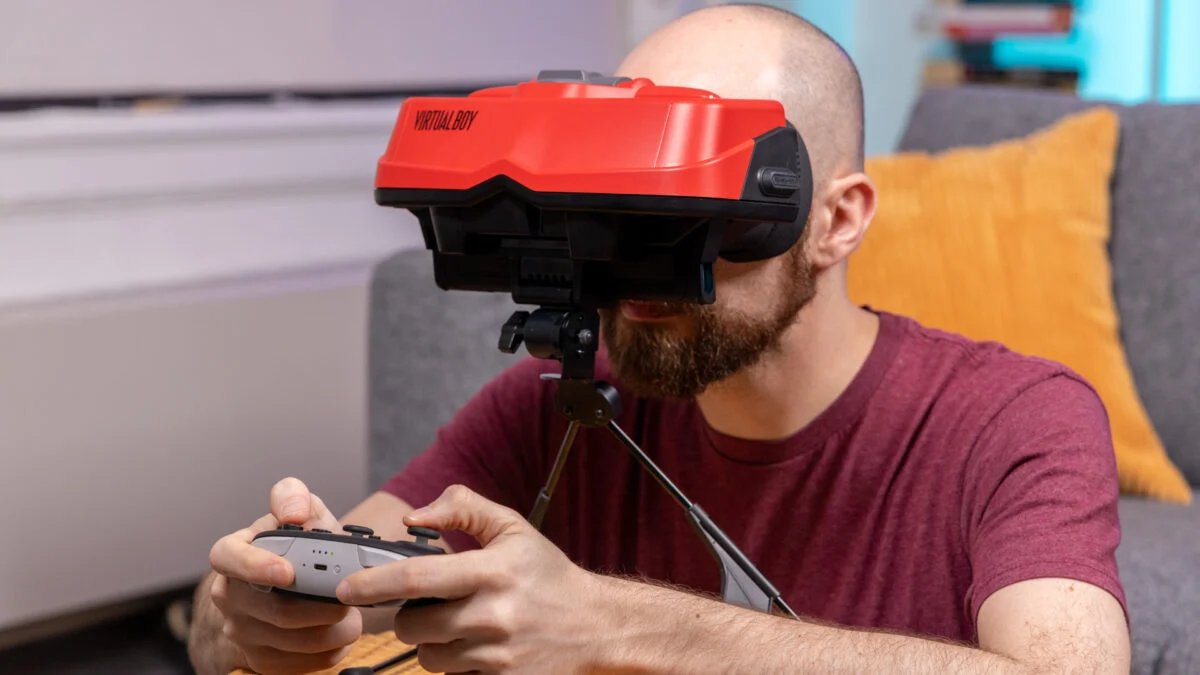
I imagine most gamers who approach Nintendo’s new $100 Virtual Boy peripheral will be as skeptical as my brother. I loaded up the games for him, plugged the Switch 2 into the Virtual Boy’s awaiting slot, and let him shove his head into the goggles. He sat with his shoulders hunched over, unmoving with an uncomfortable, Quasimodo-like poise. He was as bemused playing it as I was watching. He ran a few minutes through Red Alarm, an old-school vector graphics Star Fox-like spaceship game, and mumbled, “oh, the opening to that was pretty cool.” He spent around 15 minutes playing Wario Land and intoned, “this is actually pretty brilliant.”
Then he stood up, cracked his back, and said, “That was cool. I’m never doing that again.”
Virtual Boy for Nintendo Switch / Switch 2
This is a surprisingly accurate recreation of one of the most-loathed consoles in Nintendo’s history, and its a peek at a different time in gaming history.
- Extremely accurate to the original
- Works with Switch and Switch 2
- Modular with removable lenses
- Games showcase a different era of gaming
- No Virtual Boy controller
- Requires a Switch Online subscription
- No screen recording or GameChat in app
- Some app issues
Nintendo’s recreation of the Virtual Boy has many of my colleagues at Gizmodo scratching their heads. The original device, with its bipod stand and oversized pair of goggles, first arrived in 1995 and sold so poorly it ended up in the trash bin of gaming history. It became Nintendo’s worst-selling console of all time, selling just north of 770,000 units. The company’s next worst-selling console, the Wii U, sold 13.56 million, nearly 18x more.
And it’s obvious why the Virtual Boy did so poorly at the time. The big red pair of goggles could run a limited number of games, all of which were papered in a red and black color that made even jolly first-party titles look like a trip through hell. Users complained of eye strain and sore backs from having to lean over to peer through the tiny screens. The parallax 3D effect, while unique, didn’t add much to most of the titles that came to the system.
You’re better off stacking up some books to make it more comfortable. © Raymond Wong / Gizmodo
And despite all that, the original was a conceptually brilliant device that was ahead of its time. The fact that I have the chance to understand it within the context of Nintendo’s current Switch platform only makes the whole product more enticing. We may be entering a new era of Nintendo’s retro revival. From this point, I can imagine we could see even more peripherals meant to recreate the storied Japanese game maker’s least- and most-successful devices from its almost 50 years of making consoles. I’m hoping we may one day see a dual-screen add-on to play Nintendo DS titles. What’s stopping Nintendo from giving us a Wii Remote shell so we can play Super Mario Galaxy the old-fashioned way? The Switch/Switch 2 may become a stepping stone for understanding the past history of Nintendo platforms, so long as you pony up for the $50 annual Switch Online + Expansion Pack subscription.
Accurate recreation down to the fake volume wheel
The bottom of the Virtual Boy includes a fake volume wheel, headphone jack, and controller port. © Raymond Wong / Gizmodo
The Virtual Boy for Switch isn’t quite a 1:1 recreation of the original, but it allows for the right amount of verisimilitude to make you forget it’s just a big plastic shell for Nintendo’s hybrid handheld/console. The accessory accepts either an original Switch or Switch 2 (thanks to a swappable adapter), which acts as the screen for users to peep at behind twin, red-tinted lenses. There’s no option to set IPD (interpupillary distance) or focus at the hardware level, like you could on the 31-year-old Virtual Boy. That’s all handled with software when first setting up the Virtual Boy Nintendo Classics app. The recreation of the Virtual Boy also doesn’t come with the original’s odd, dual D-pad controller. In fact, there’s no way to connect a wired controller while your Switch is mounted inside.
Nintendo even went as far as modeling a fake volume wheel, headphone jack, and controller port on the bottom half of the device. All of that is useless, but it helps sell the Virtual Boy as a kind of facsimile for a historical artifact. Nintendo did allow some modifications for the sake of comfort. The nosepiece is more pronounced, supposedly to make it more convenient for people with extra-long schnozzes like yours truly.
The Switch 2 or original Switch will work on the Virtual Boy with the included adapter. © Raymond Wong / Gizmodo
To insert a Switch, you need to pry open the top half of the shell and slide your handheld into the awaiting cradle. This means you can’t use it with a case. I tried it with the thinnest Switch 2 protector I owned, the Genki Attack Vector case, and it was still too tight of a fit and I was worried it would scratch the screen.
Users are supposed to load up the Nintendo Classics Virtual Boy collection on the console’s home screen before inserting their naked Switch into the case. That’s because the screen itself creates a pseudo binocular-like appearance to make the same image appear twice, one for each eye. This creates a stereoscopic effect, where your mind recognizes both scenes as a single image. By offsetting the image in one eye, it tricks the brain into creating a sense of depth.
What you see on-screen will look different behind the Virtual Boy’s lenses. © Raymond Wong / Gizmodo
You can see the evolution of this technology in the Nintendo 3DS (a handheld that was notoriously less popular than its forbearer, the Nintendo DS). Stereoscopic screens are still trying to make a case for themselves, such as with Samsung’s Odyssey 3D monitors and even this oversized Abyxlute 3D One handheld PC. Sure, the new Virtual Boy isn’t using the same technology as the original from 1995, but the benefit of using an IPS LCD screen instead of the Virtual Boy’s original mirror-based displays is that you’ll endure less eye strain when leaning over to peer into the two square-shaped lenses.
The Virtual Boy stand is made mostly from metal with a plastic clamp that holds the goggle unit in place. While the base is sturdy, if you shake it enough, the clamp will separate from the goggles. If you’re concerned for your Switch 2 housed inside, you should keep it steady on the table and not let your toddler or dog get their hands on it.
Modular and capable of VR… sort of
You can remove the Virtual Boy’s two lenses. © Raymond Wong / Gizmodo
If you want to play these Virtual Boy games, you’ll also need to sign up for a Nintendo Switch Online + Expansion Pack subscription, which normally costs $50 per year. Unlike many of Nintendo’s other recreation controllers, including its most recent, faithful GameCube controller, you likely won’t be using this device for anything other than Virtual Boy titles. The good news is, unlike the GameCube, the Virtual Boy is compatible with the original Switch. You simply need to unscrew the Switch 2 adapter and swap it with the included Switch 1 bottom plate. I tried it with both, and I didn’t notice a single difference playing Virtual Boy with the sequel handheld’s 1080p screen versus the smaller, 720p original Switch.
The device is more modular than it looks once you open up the box. The plush face mask is removable, and underneath you can rip out the plate housing the square red filters. Ostensibly, this will allow future players to play Virtual Boy games with various other color filters through software once it arrives in a future update.
That IPD dial and Focus slider don’t actually turn. They’re just plastic accents. © Raymond Wong / Gizmodo
Underneath the filters are two concave lenses that seem the same size as the old Nintendo Labo VR kit. This means it’s technically compatible with the few games that supported a VR mode, like Super Mario Odyssey and The Legend of Zelda: Breath of the Wild. What you’ll immediately realize is that it’s impossible to maneuver the goggles and use a controller at the same time. I forced my brother to hold the Virtual Boy up to my eyes while I tried to find all the singers in Odyssey. It wasn’t the kind of lark he was keen on sustaining for long, despite my pleading.
Nintendo is also selling a much cheaper $25 cardboard Virtual Boy kit that uses the two Joy-Cons as handholds to press up to your eyes. If you don’t have a Labo kit, that flimsier Virtual Boy may be your best option if you want one device for Labo VR and Virtual Boy. I don’t know who out there is still desperate for a Labo experience, but I’m not here to judge.
What’s the nostalgia value for games nobody played?
The Virtual Boy uses a stereoscopic effect to make games appear 3D. © Raymond Wong / Gizmodo
The app is loaded up with just seven games to start. These include 3D Tetris, Teleroboxer, Galactic Pinball, Golf, Red Alarm, The Mansion of Innsmouth (Insmouse no Yakata in Japanese), and Wario Land. Nintendo promised we’ll get more games on the platform throughout 2026. That should include titles like Mario Tennis, Space Invaders Virtual Collection, Virtual Bowling, Vertical Force, and V-Tetris. Nintendo also says we’ll see never-released titles, including Zero Racers and D(ragon)-Hopper. The original console failed too quickly for those games to ever hit the scene.
If you were hoping for one game among these that would actually grab your attention for more than a few minutes time, that’s Wario Land. If you enjoy old-school 2D Super Mario titles, the game is a unique take on that tried-and-true formula. Wario can’t jump with any of the grace of Mario, but he can body slam and belly flop to take out enemies. The game is full of inventive use of 3D, where players need to jump from the foreground to the background to navigate levels.
© Raymond Wong / Gizmodo
The rest of the games on the slate show their age as soon as you load them. Teleroboxer is Mike Tyson’s Punch-Out!!-style game that’s quirky until you get punched in the face too often. Red Alarm is unique, but with only red and black vector graphics, it becomes excessively difficult to dodge enemy fire when each shot blends in with everything else on screen. 3D Tetris is a unique version of the classic puzzler, though without the classic music it feels more devoid than what we got on the old green-tinged Game Boy.
Gamers who are too used to the excessively well-paced Nintendo titles of our current generation will likely bounce off most of the games on offer. These retro games don’t have nearly the same nostalgia factor as many other games in the Nintendo Classics collection.
Instead, these Virtual Boy titles offer a fascinating look at an early stage of glasses-less 3D gaming. Once you look at this software slate from the frame of a video game historian, they start to take on a different tenor. This recreation console is a pain in the neck, literally. It would be worse if it weren’t. If Nintendo worked to let you telescope the stand or use it without the goggles, you wouldn’t comprehend what made the console fail in the first place.
© Nintendo; screenshot by Gizmodo © Nintendo; screenshot by Gizmodo © Nintendo; screenshot by Gizmodo
That being said, the Nintendo Classics Virtual Boy app itself still has to work out the kinks. I had some trouble exiting the software when I was done playing. As you try to close the app, the Switch will tell you to extricate the handheld and hit close. I couldn’t click on the “Close” button with any controller. Only the touchpad would work. Plus, you can’t do any kind of game recording or use Switch 2 GameChat when inside the app. Nintendo may be able to improve things with software updates, but as it stands the app is more janky than other Classics collections.
Based on sales numbers for the 1995 console, even if you were old enough to play the Virtual Boy back then, you probably didn’t. Whether or not it’s worth it to you to try them now depends on your appreciation for history. If you have a soft spot for video game archival, this is the best option for trying this console beyond sourcing a used version three decades ago. The only limiting factor is how to play these games; you need a Switch Online account. You’ll never own these retro titles. If Nintendo ever ends its service, you’ll have nothing but a giant Virtual Boy statue—a literal empty shell.
The original Virtual Boy was an honest attempt at something unique
If you want the Virtual Boy, know you should use it as a way to comprehend a console everybody had long ago written off. © Raymond Wong / Gizmodo
The Virtual Boy was also one of the most innovative consoles of all time. The man credited with inventing the original Game Boy, Gunpei Yokoi, led development on the console. Instead of a screen, the device sported two single-pixel-wide LED strips that blinked in rapid fashion. A pair of oscillating mirrors vibrated at such speeds you could see the game running at 50.27Hz at a resolution of 384 x 224 pixels. This wasn’t a crapshoot game console made spur of the moment by corporate overlords. The Virtual Boy was an honest attempt to debut something novel in the gaming space.
To understand the Virtual Boy, you have to be the kind of person who appreciates history in all its many facets. Rarely do we as a hobby have the opportunity to return to past works to enjoy them and learn from them. You can stream any number of early Jelly Roll Morton songs to comprehend the early elements of jazz or search for Buster Keaton’s landmark silent films that have had lasting impact on comedies in cinema. There are repositories like TCM that supply film buffs access to old cinema. There is no similar service that allows us access to gaming history’s past. That’s a problem, since previous studies show nine out of 10 games remain commercially unavailable even today.
No matter what, a pair of gaming goggles will never make you look cool. © Raymond Wong / Gizmodo
What resources do we have to identify the success and foibles of early video games? Either you source a used console and older games while you hope you don’t spend too much money on broken hardware. If there’s no way to acquire these games commercially, the only other recourse is often emulation—which is full of its own legal pitfalls.
The Virtual Boy is special in how you can’t get the full experience without the goggles. The fact that Nintendo went to such pains to recreate the shell of the Virtual Boy is what I find so appealing about this peripheral. If you already have a Switch Online account, the big, red goggles offer an experience you won’t find anywhere else. Is it a fun experience? It will depend on your appreciation for aging tech. What about a unique experience? Absolutely.
