

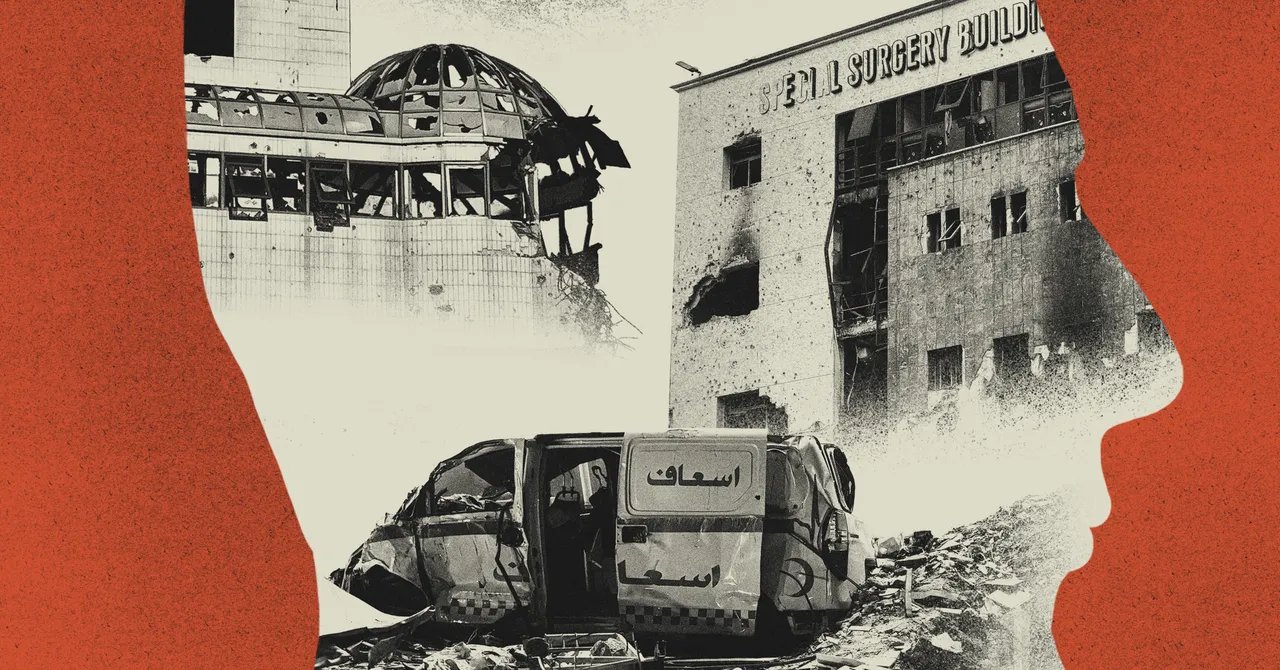
Gauze saves lives, but Al-Shifa Hospital in Gaza City must ration what little it has, months into a supposed ceasefire.
Both gauze and its English name are widely thought to derive from Gaza and the Arabic word for blended silk, khazz. While perhaps apocryphal, the presumed connection testifies to the bounty that the small strip of land at the eastern edge of the Mediterranean, rich in weaving traditions, has provided humanity. As a wound dressing, gauze is an everyday miracle. Its loose weave ironically strengthens its durability, making it able to absorb blood, discharge, pus, and drainage without becoming oversaturated and thereby returning such material to a wound site.
Gauze’s value becomes evident during its absence. Bacteria like to sit in pools of bodily fluid. An undressed wound beset by bacteria will become infected. Then “the problem explodes,” says Nahreen Ahmed, a pulmonary specialist from Philadelphia who lived and worked at Al-Shifa, the largest hospital complex in the Gaza Strip, from November 25 to December 11, 2025.
The near-absence of gauze in the land of its apparent birth means that health care providers have no choice but to send patients home without it. Those patients do not typically return to a sterile home. More than two years after Israel responded to Hamas’ October 7, 2023, massacre with a military ferocity that the International Association of Genocide Scholars found to “meet the legal definition of genocide,” the patients’ homes are tents. The winter flooded many tents with filthy water. Infections that begin at the wound site will spread to the bone and require a preventable amputation. A similar shortage of antibiotics compounds the problem. “It started with gauze,” Ahmed reflects.
From Minnesota to the Middle East, WIRED reports from the modern world’s many battlefields.
Although hospitals are supposed to be protected under international law, the Israel Defense Forces (IDF) included them in a campaign of devastation that familiarized the world with the neologism “domicide,” or the destruction of residences. According to the World Health Organization, only 14 of the strip’s 36 hospitals are functioning. By last summer, the Israeli military had killed more than 1,700 health care workers; it still holds 220 in detention. When the Israeli government announced in October that its forces would abide by a US-brokered ceasefire, Palestinians in Gaza who had survived two years of unrelenting devastation hoped for a return to normalcy. So did a network of foreign health workers, many of whom had previously entered Gaza at extreme physical risk.
Those foreign doctors knew their Palestinian colleagues faced an enormous task. A genuine ceasefire would be challenging enough for Gaza’s decimated health care infrastructure. For two years, it only had space to address emergencies caused by military attacks. An actual end to the slaughter would overwhelm the remaining doctors with patients seeking care for everything not immediately life-threatening, from chronic conditions to mundane illness, all of which the devastation of Gaza exacerbates.
Gauze was supposed to be abundant. But seven foreign doctors and aid workers who volunteered in Gaza, including four who were there after the ceasefire was meant to have taken effect, described a perverse situation in which Israel permits doctors into Gaza but not medical equipment, prompting several to smuggle vital implements of care into their personal belongings. And the reality since October is that Gaza’s remaining doctors must deal with both an influx of patients needing routine treatment and a continuing, if reduced, pace of casualties from the IDF, and do it all without crucial supplies. Doctors told WIRED the public-health crisis they witnessed looked to them more like a new phase of the genocide than its aftermath. During this phase, the Israelis no longer need to open fire to kill Palestinians, though they still do that, too. (In a statement to WIRED, the Israeli occupation authority, known as the Coordination of Government Activities in the Territories, or COGAT, said it “continues to facilitate the entry of medical equipment and medicines in line with requests from international organizations.”)
“The war is not over,” says an international doctor who spoke to WIRED from Al-Shifa and who requested anonymity for fear of Israeli reprisal. “The casualties are not the way they were before. They’re isolated incidents, but they’re still happening.” It happens with intensity when Israeli soldiers perceive Palestinians to cross the poorly demarcated “yellow line” into Gazan territory occupied by the IDF. “All the people that are being injured, the people that are dying—it’s all within this arbitrary yellow line.”
Between the ceasefire declaration and mid-February, Israel killed more than 600 people, pushing the official death toll from the Palestinian Ministry of Health above 72,000, which is likely an undercount. While Israel partially reopened the Rafah crossing earlier that month, in two weeks Israel permitted the departure of only 260 people out of more than 18,500 in desperate need of medical care no longer available in Gaza, according to the United Nations. As ominously, during that period, Al Jazeera reported that Israel allowed only 269 people back into Gaza, raising fears that those who leave will never be permitted to return home.
Palestine famously provides Israel and its allies with a laboratory for its weaponry of the future, from artificial-intelligence targeting to quadcopter drones stable enough to fire guns. Meanwhile, Gaza’s remaining hospitals are reduced to “Civil War [era] medicine,” Ahmed said. To help, foreign doctors smuggle in 9-volt batteries, cochlear implants, and Tylenol, putting themselves at risk of being banned from Gaza. Perhaps most importantly, they smuggle gauze.
PHOTO-ILLUSTRATION: JOAN WONG; Original photographs by Nahreen Ahmed
International medical workers began traveling to Gaza soon after Israel besieged it. To enter Gaza, doctors, nurses, and other aid workers flew to Cairo and caravanned up through the Sinai Peninsula to the Rafah Crossing. The Egyptians permitted Israeli inspections of the trucks, ostensibly to prevent weapons smuggling, a process that slowed the advance of aid to a crawl. Mark Perlmutter, a North Carolina–based hand surgeon who first visited Gaza in the spring of 2024, recalled seeing lines of 18-wheelers “30 miles long, bumper to bumper,” filled with food—“dead chickens, rotting vegetables”—that were idling, in line with former Israeli defense minister Yoav Gallant’s pledge that “no electricity, no food, no fuel” would be allowed into Gaza.
