

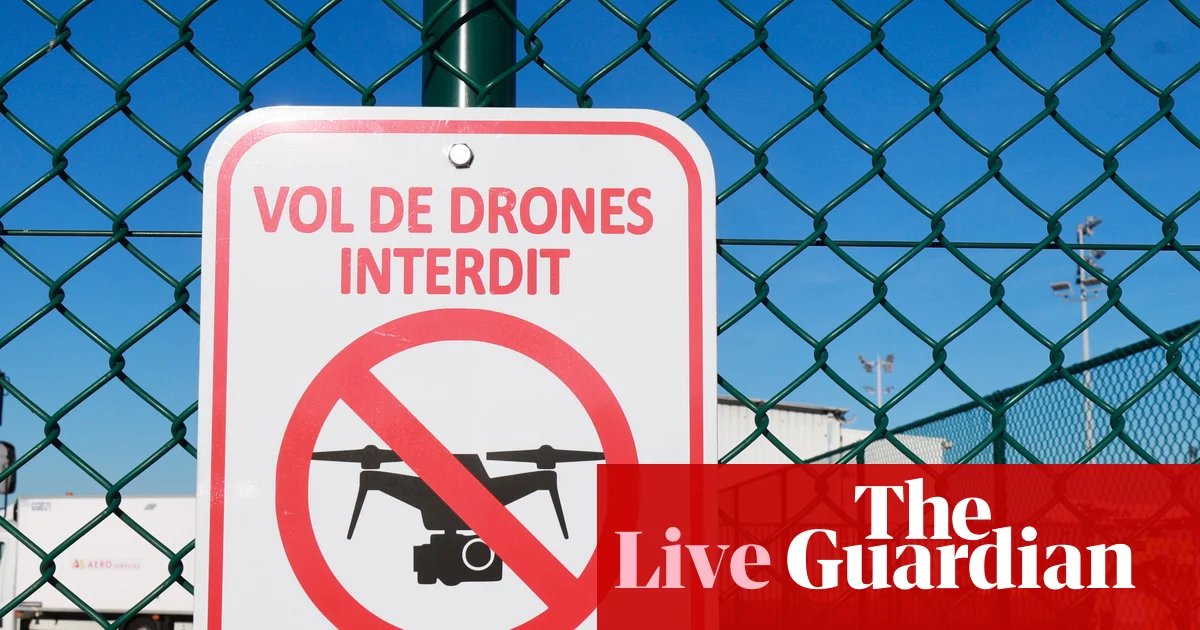
Drone sightings over Belgium could be linked to discussions over use of Russian frozen assets, German minister says
German defence minister Boris Pistorius suggested that this week’s repeated drone sightings over Belgium were “likely connected with the fight over the use of Russian frozen assets held by Belgium,” Reuters reported.
German defence minister Boris Pistorius gestures as he answers questions of journalists after the German Bundeswehr Conference 2025 in Berlin, Germany. Photograph: Clemens Bilan/EPA
Earlier, in a strongly worded speech, Pistorius also warned that Russia continues to seek to “sow doubt, divide us, and influence elections,” and that “these are no longer abstract scenarios” as Russia “will not relent in its attempt to forcibly redraw borders.”
Last month, EU leaders failed to agree on the €140bn reparation loan for Ukraine which was meant to be underwritten by frozen Russian assets.
Leaders need the agreement of Belgium, which hosts €183bn of Russian central bank assets at Euroclear – 86% of all Russian state assets in the EU and two-thirds of the worldwide total.
Belgium’s prime minister, Bart De Wever, said last month the biggest problem was how to guarantee that the cash was available immediately if something went wrong.
“If you want to do this, we will have to do this all together. We want guarantees if the money has to be paid back that every member state will chip in. The consequences cannot only be for Belgium,” he said.
Asked about the progress in talks with Belgium, the commission’s deputy chief spokesperson Olof Gill said today “there is no update on timelines,” but the EU’s executive arm was “aiming to present the options as soon as possible, with a view to having decisions made at the European Council in December.”
Share
Updated at 13.47 CET
Key events
Show key events only
Please turn on JavaScript to use this feature
China poised to lift ban on chips exports to European carmakers after US deal
Lisa O’Carroll
The vital flow of chips from China to the car industry in Europe looks poised to resume as part of the deal struck last week between Donald Trump and his Chinese counterpart, Xi Jinping.
The logo of Chinese-owned semiconductor company Nexperia is displayed at the chipmaker’s German facility, after the Dutch government seized control and auto industry bodies sounded the alarm over the possible impact on car production. Photograph: Jonas Walzberg/Reuters
The Netherlands has signalled that its standoff with Beijing is close to a resolution amid signs China’s ban on exports of the key car industry components is easing.
The dispute began when the Dutch government took control of chipmaker Nexperia at the end of September amid US security concerns about its Chinese owner, Wingtech. Beijing retaliated by halting all exports from Nexperia’s factories in the country, threatening to disrupt car production in Europe and Japan.
The White House had put Wingtech on a list of companies that would have their exports to the US controlled under its “affiliate rule”.
However, as part of the deal between Trump and Xi in Korea, the US authorities will now delay the implementation of this rule for a year in exchange for China pausing its own restrictions on exports of chips and crucial rare-earth minerals.
The Netherlands’ economy minister, Vincent Karremans, said on Thursday he trusted that Nexperia chips would reach customers in Europe and the rest of the world in the coming days.
Meanwhile, one of the main suppliers to the German car industry, Aumovio, confirmed on Friday it had received notice from China that chips supply would resume to its operations.
Share
Oleron car ramming incident suspect charged with attempted murder
The 35-year-old French man suspected of ramming his car into pedestrians and cyclists on Île d’Oléron earlier this week have been charged with attempted murder, French media reported.
The local prosecutor’s office has also asked for him to be detained ahead of the trial.
Forensic police and French gendarmes inspect the site where a burnt car was found in Saint-Pierre-d’Oleron. Photograph: Christophe Archambault/AFP/Getty Images
Early inquiries indicated that the man was under the influence of cannabis at the time of the incident, which impaired his judgment.
Despite his comments about acting on “Allah’s orders,” his acts continue to be not classified as terrorism given no known links to any terrorist group, Le Figaro and Liberation noted.
Of the five injured people, aged 22 to 69, two remain in very serious condition, the report said.
Share
Updated at 15.08 CET
Belgian ministers close to agreeing €50m plan to counter drone threat – report
Back to Belgium, news agency Belga is reporting that ministers have provisionally reached an agreement on the proposed €50m package of measures to strengthen the country’s anti-drone systems.
The proposal still requires some finetuning before it can be formally adopted by the government, the agency added.
Share
Four people arrested over protest at Israeli orchestra concert in Paris
French police have arrested four people after a Paris concert by Israel’s national orchestra was disrupted, a prosecutor said, with organisers saying protesters lit smoke flares at the event, AFP reported.
The visit drew criticism from several groups ahead of the concert at the Paris Philharmonic hall, over Israel’s conduct during its two-year military offensive in Gaza.
Several individuals repeatedly interrupted Thursday’s concert by the Israel Philharmonic Orchestra, the venue said.
Videos posted on social media show a protester holding a red flare inside the concert hall with smoke billowing. Other people present were then seen to rush to strike the individual.
French culture minister Rachida Dati condemned the protest, saying “violence has no place in a concert hall”.
“Freedom of programming and creation is a fundamental right of our republic,” she added.
Share
Meanwhile, Brussels Airlines said the company braced for “a significant” economic impact from this week’s drone incidents affecting traffic at Brussels airport.
The carrier’s spokesperson, Nico Cardone, was reported by VRT and Niuewsblad as saying that while the exact figures has not yet been calculated, there would be a number of elements adding up, including petrol, diversions, alternative transport, accomodation costs, and others.
Share
Drone sightings over Belgium could be linked to discussions over use of Russian frozen assets, German minister says
German defence minister Boris Pistorius suggested that this week’s repeated drone sightings over Belgium were “likely connected with the fight over the use of Russian frozen assets held by Belgium,” Reuters reported.
German defence minister Boris Pistorius gestures as he answers questions of journalists after the German Bundeswehr Conference 2025 in Berlin, Germany. Photograph: Clemens Bilan/EPA
Earlier, in a strongly worded speech, Pistorius also warned that Russia continues to seek to “sow doubt, divide us, and influence elections,” and that “these are no longer abstract scenarios” as Russia “will not relent in its attempt to forcibly redraw borders.”
Last month, EU leaders failed to agree on the €140bn reparation loan for Ukraine which was meant to be underwritten by frozen Russian assets.
Leaders need the agreement of Belgium, which hosts €183bn of Russian central bank assets at Euroclear – 86% of all Russian state assets in the EU and two-thirds of the worldwide total.
Belgium’s prime minister, Bart De Wever, said last month the biggest problem was how to guarantee that the cash was available immediately if something went wrong.
“If you want to do this, we will have to do this all together. We want guarantees if the money has to be paid back that every member state will chip in. The consequences cannot only be for Belgium,” he said.
Asked about the progress in talks with Belgium, the commission’s deputy chief spokesperson Olof Gill said today “there is no update on timelines,” but the EU’s executive arm was “aiming to present the options as soon as possible, with a view to having decisions made at the European Council in December.”
Share
Updated at 13.47 CET
EU tightens rules on visas for Russians amid ongoing Ukraine aggression
The European Commission has adopted stricter rules for issuing visas to Russian nationals to enter the European Union in response to what it said were “increased security risks stemming from Russia’s unprovoked and unjustified war of aggression against Ukraine.”
Under the new rules, “Russian nationals will no longer be able to receive multiple-entry visas,” and have to apply individually every time they plan to travel to the EU, the commission said.
“The goal is to mitigate threats to public policy and internal security while allowing exceptions for limited and justified cases such as independent journalists and human rights defenders, ensuring uniform application across Member States and preventing circumvention,” it explained.
All applications made by Russian nationals will also be subject to “enhanced verification procedures and elevated levels of scrutiny,” the statement read.
EU’s foreign policy chief Kaja Kallas stressed that “travelling to and freely moving within the EU is a privilege, not a given.”
Share
Centrist D66 party formally confirmed as winners of Dutch election
Meanwhile, we now have a formal confirmation that the centrist D66 party triumphed in last week’s parliamentary election in the Netherlands, setting its 38-year-old leader, Rob Jetten, on course to become the country’s youngest-ever prime minister, AFP noted.
Coalition scout Wouter Koolmees (R) receives D66 party leader Rob Jetten for a meeting, in The Hague, the Netherlands. Photograph: Remko de Waal/EPA
Jetten scored a razor-thin victory of 29,668 votes over anti-Islam leader Geert Wilders and his PVV party, the Dutch Electoral Council said, after an election seen as a bellwether for the rise of Europe’s far right.
A total of 15 parties won seats in parliament, including a party campaigning for animal rights and a group representing the interests of people over 50.
The coalition talks formally started earlier this week, and are expected to continue for weeks or even months.
ShareJakub Krupa
Just to add a word on Orbán’s potential domestic motives for getting closer to Trump…
Close watchers of central eastern European politics will know that there is a precedent for what some experts believe Orbán is trying to achieve here.
Earlier this year, Poland’s Karol Nawrocki was endorsed by Trump in the final weeks of the presidential campaign in May, and repeatedly praised by the US president and his senior administration officials before he unexpectedly won the election in June.
You could see why Orbán would want to emulate that success.
Polish presidential hopeful Karol Nawrocki and US president Donald Trump at The White House in May this year. Photograph: The Whitehouse/XShare
Orbán to visit US to try to broker another Putin summit but questions raised over motives
Andrew Roth in Washington and Flora Garamvolgyi in Budapest
In other news, Viktor Orbán will visit the White House on Friday as Hungary’s far-right prime minister tries to broker another summit between Donald Trump and Vladimir Putin that his advisers claim could help end the war between Russia and Ukraine.
US president Donald Trump and Hungary’s prime minister Viktor Orbán shake hands as they pose for a photo, at a world leaders’ summit on ending the Gaza war in Sharm el-Sheikh, Egypt last month. Photograph: Yoan Valat/Reuters
Orbán, who has proposed hosting the summit in Budapest, will also seek an exemption from US sanctions against Russian energy in what will be a major test of Trump’s tougher line on the Kremlin after he accused Putin of slow-rolling negotiations to end the conflict.
Yet Orbán’s priority, insiders say, is to get Trump to visit Hungary as he faces an unprecedented domestic challenge from a new opposition leader ahead of the parliamentary elections in April. A visit by Trump would reinforce Orbán’s role as a statesman and energise his conservative base, his advisers believe.
“Orbán wants Trump to come to Budapest before the elections,” said a source working for a Hungarian government foreign policy institution. “This is a top priority. They will discuss the Russian gas issue, but the thing Orbán cares about the most is the elections.”
Share
Morning opening: Drones, once again
Jakub Krupa
Brussels and Liège airports in Belgium faced disruptions overnight once again over suspected drone sightings, just hours after the Belgian government’s national security council discussed its response to the emerging threats.
A “No Drone Zone” placard is seen at Brussels international Airport in Zaventem. Photograph: Yves Herman/Reuters
Both airports reported limited effect on their operations.
More unconfirmed drone sightings were also reported in the vicinity of the Doel nuclear power plant and the nuclear research center SCK in Mol, as reported by Het Laatste Nieuws, and Antwerp port, as per VRT.
Amid growing frustration with the continuing problem, Belgium is expected to receive anti-drone support from the German army, local media reported, in a bid to put an end to the repeated incidents of drone sightings near civil airports and military bases.
Separately, Sweden’s second-largest airport in Gothenburg also reported drone disruptions, prompting police to open an investigation into “suspected aviation sabotage.”
The airspace above Landvetter Airport was temporarily closed on Thursday evening after drones were observed around the airport, in Gothenburg, Sweden. Photograph: Adam Ihse/TT/Shutterstock
The incidents come as a top German military official issued a stark warning that Russia would have capacity for a limited strike against Nato territory at any time, Reuters reported.
“If you look at Russia’s current capabilities and combat power, Russia could kick off a small-scale attack against Nato territory as early as tomorrow,” Lt Gen Alexander Sollfrank told Reuters in an interview. “Small, quick, regionally limited, nothing big – Russia is too tied down in Ukraine for that.“
Sollfrank said whether Moscow might choose to attack Nato would be determined by three factors: Russia’s military strength, military track record and leadership, Reuters reported.
“These three factors lead me to the conclusion that a Russian attack is in the realm of the possible. Whether it will happen or not depends to a large extent on our own behaviour,” he added, alluding to Nato’s deterrence efforts.
Let’s see what reactions we are going to get to these latest incidents.
It’s Friday, 7 November 2025, it’s Jakub Krupa here, and this is Europe Live.
Good morning.
Share
