

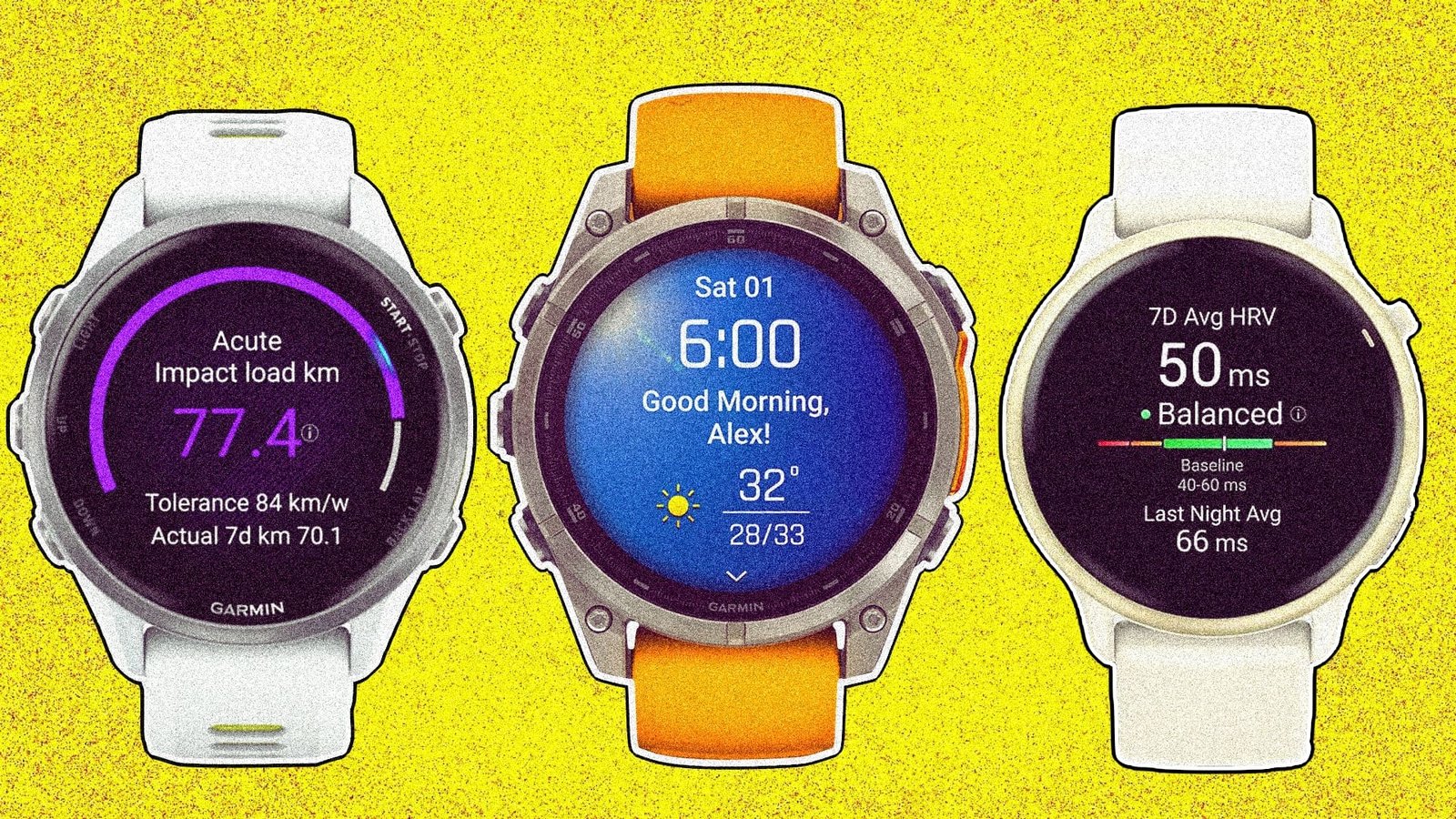
Find your perfect Garmin with this comprehensive guide to features, performance, and value
Garmin offers the industry’s broadest range of running and fitness watches. The beauty of this is that there are usually several watches for every type of user available at various price points.
However, selecting the right option for your needs and budget requires learning about various aspects, such as features, design differences, and which choices perform best for different tasks.
This guide is a must-read if you’re thinking about a Garmin watch. It summarizes Wareable’s real-world testing results on fitness tracking, health monitoring, smart features, and battery life for each top Garmin we recommend.
Our experienced team of testers has reviewed every Garmin watch available to help you make the best decision. This includes the latest models, such as the Venu 4, Fenix 8 Pro, and Instinct Crossover AMOLED.
Read on to understand the subtle differences and choose the best fit for your wrist.
Advertisement
Quick overview: Our top Garmin choices
(Image credit: Wareable)
Best for beginner runners: Garmin Forerunner 165
We previously recommended the Forerunner 55 here, which remains an excellent budget option from Garmin. However, the Forerunner 165 features an AMOLED screen, impressive battery life, reliable GPS, training plans, and an array of Garmin’s performance analytics. It’s ideal for those beginning their running journey.
Best for PB hunters: Garmin Forerunner 265
Although it’s been replaced by the 570, the price makes the 265 a solid step up for those beginning to focus on their underlying running data. It boasts a sharp AMOLED display, good battery life, thorough training analysis, performance metrics, recovery guidelines, and personalized training plans. Dedicated runners, cyclists, and swimmers will find this device well-suited to their needs.
Best Garmin smartwatch: Garmin Venu X1
The Venu X1 is a triumph of design, bringing the original concept of the Vivoactive (launched back in 2015) full circle. In short, it offers nearly all the same high-end features and analytics as the Fenix 8 and Forerunner 970, but in a sleeker, smartwatch-like form. Its slimness and wearability are unmatched in the Garmin lineup, and we found the accuracy generally excellent during testing. It’s not a watch for everyone, but it’s an intriguing premium option nonetheless.
Best for multi-sport athletes: Garmin Fenix 8
The king of multisport watches, the Fenix 8 range is virtually unbeatable. Its long-lasting battery allows you to spend all day on the trails while enjoying mapping and navigation features. Plus, every sport benefits from the most advanced analytics available on any Garmin. You’re also spoiled for choice, with double-digit versions available in different case sizes, materials, screen technologies, and display glass types. The Pro edition also adds excellent built-in inReach services.
Best Fenix alternative: Garmin Instinct 3
The Fenix reigns supreme in Garmin’s lineup, yet many potential buyers may understandably hesitate due to its high cost. During these challenging times, we recommend considering the Instinct 3—a lightweight and enjoyable outdoor/fitness watch that boasts outstanding battery life and impressive performance analysis capabilities.
Advertisement
SQUIRREL_PLAYLIST_10207701
What to expect from Garmin in 2026
(Image credit: Wareable)
With major additions to its Forerunner, Fenix, and Venu lines—not to mention new entries in the Instinct range and niche wearables like the Index Sleep Monitor—2025 was an especially busy launch year for Garmin.
We’re not expecting quite the same number of high-profile launches, given that many of these lines operate on a two-year release cycle, but that still leaves plenty of room for refreshes in 2026. Now, we should note that no significant rumors or leaks of the brand’s plans have emerged thus far, but we can make plenty of educated guesses based on previous years.
Fenix 9, entry-level Forerunners, and maybe more
With that in mind, the Garmin Fenix 9 is the most obvious big-name candidate for release, as the brand offers a new version of its flagship outdoor watch every calendar year. This is likely being prepared for the summer, though we’ll know more over the coming months.
Elsewhere, the entry-level end of the Forerunner line is well overdue for a refresh. The Forerunner 55 is now approaching 4 years old, while the step-up model, the Forerunner 165, is closing in on its 2nd birthday. Both are still solid watches, but we’re expecting a rethink at the budget end at some point in H1 2026.
Advertisement
Past those models, it becomes harder to predict. The Instinct, Vivoactive, and Venu lines are very unlikely to see any new models this year, given their entire refresh last year. Yet we may see a long-awaited new generation of the Vivosmart fitness tracker, and perhaps even a return to hybrid smartwatches from Garmin. We’ll update this section when we know more.
Best Garmin running watches
How we test: Our reviewers wear the watch for several weeks, integrating it into their daily routines, which include running, cycling, swimming, and strength training. We evaluate the optical heart rate accuracy by comparing it to a chest strap and assess GPS precision on familiar routes alongside a dual-frequency GNSS competitor. Health metrics are measured against an Oura Ring 4, Apple Watch Ultra 3, and Whoop 5.0. Below are our selections.
Garmin Forerunner 165 (2024): A great starting point for runners
(Image credit: Wareable)
The Forerunner 165, released in February 2024, fills a gap in Garmin’s running watch lineup with an affordable AMOLED display. At 43mm, it is lightweight and comfortable for both women and men. It’s perfect for beginner and intermediate runners; we found excellent GPS accuracy, and it doesn’t shy away from offering performance analytics.
You receive VO2 max estimates, adaptive training suggestions, and Training Effect metrics, enhanced further by updates to Garmin Coach. Another distinct and impressive feature is the ability to plan your races and leverage PacePro for live pacing strategies.
Advertisement
Battery life is significantly longer than that of a typical smartwatch. You can achieve around 17 hours of pure GPS time and a couple of weeks in smartwatch mode. Our tests using the always-on display saw it last around a week, which is superb.
It features Garmin’s last-gen Elevate 4 HR sensor, but accuracy remains good for steady runs and rides. We recommend a chest strap if you depend on low-latency HR data during sessions, but that’s true for every watch.
The only significant complaint is that Garmin has separated music features into a more premium version, meaning you’ll have to spend more to access Spotify offline on your wrist. Boo. However, this is a top Garmin GPS watch for most runners, and 90% of people will find the combination of features just what they need. And if the price is still too steep, consider the Forerunner 55.
Light and bright design
Accurate HR and GPS
Long-lasting battery
Pricier than rivals at this range
A separate edition for music – why?
Pretty slow GPS lock-on
Advertisement
Garmin Forerunner 265 (2023): Still the best mid-range Forerunner
(Image credit: Wareable)
Released in March 2023, the Forerunner 265 remains a superb mid-range option in the Garmin sports watch lineup, even with the recent arrival of the Forerunner 570.
Although it lacks some of the features of the newer generation, the price difference makes this a far better mid-range option for most people. And if you did want a step up from this model, we recommend the Forerunner 965 (the last-gen flagship Forerunner), which is available at roughly the same price as the 570.
The standard 265 model features a 46mm case size, while the 41mm 265S variant is a more unisex choice, particularly suited for women. It builds on the 165 (mentioned above) by including Training Status, Daily Readiness, Endurance Score, and Hill Score. It also features Garmin’s Multi-Band GPS/GNSS, which excels in urban environments, offering better accuracy than the 165.
Advertisement
Elsewhere are Morning Report, Training Readiness, Training Status, and Race Calendar. In short, there’s more analytical data; however, now that the new generation is here, don’t expect Garmin to deliver many significant feature updates going forward.
The only downside is the battery life. We found it lasted around four days of heavy usage between charges—though, interestingly, this is better than the newer 570 (in daily use, at least).
Display and UI are hugely improved
Battery life remains very good
Great accuracy across the board
AMOLED won’t be for everyone
Same tracking experience as FR255
Misses out on ECG hardware
Garmin Forerunner 970 (2025): The brand’s best running watch
(Image credit: Wareable)
Advertisement
Though a price increase ensures the newest flagship Forerunner is only really suitable for those with lofty budgets, there’s no doubting its credentials as the best running watch we’ve tested.
It arrives with a brighter AMOLED display than its predecessor, a much-needed durability boost thanks to a sapphire lens, a flashlight, and unrivaled insights; it’s a runner’s dream.
The more vibrant screen does result in a slight dip in the daily-use, ‘smartwatch’ battery life, but Garmin has still performed admirably; the Forerunner 970 can last around days during relatively intense training in its always-on mode, which surpasses the competition significantly. Its staying power is also slightly improved when GPS tracking is enabled, which is welcome.
It also remains remarkably accurate. Through our extensive testing, we found that the Multi-Band GNSS accuracy and heart rate monitoring align with our expected baselines, which are comparable to those of some of the most precise wearables available on the market. It also features numerous upgrades from the 265/570 devices, including detailed offline maps.
The only major downside, as we mentioned, is the price. To get the most out of this model by unlocking Running Economy and the Step Speed Loss addition to Running Dynamics, you must pair it with the $170 Garmin HRM-600 chest strap. And when you begin to tot up the price, it’s hard not to consider the longer-lasting, sturdier Fenix 8 (below) range, instead.
Advertisement
Improved display durability
Unparalled insights for runners
GPS battery life gets a boost
Flashlight FTW!
Huge price increase from the previous generation
Additional hardware required to unlock its full potential
Smartwatch battery life takes a hit
Best Garmin sport/outdoor watches
How we test: We provide Garmin’s outdoor and multisport watches to our marathon and ultrarunning testers, who utilize them on trails to evaluate battery life and mapping features. Additionally, the watches are tested in swimming and include a standard review of smart and wellness insights.
Garmin Fenix 8 (2024): The premium do-it-all option
(Image credit: Wareable)
Note: As mentioned above, the Fenix 8 has now been usurped by the mid-cycle Fenix 8 Pro update. It remains a thoroughly recommended watch—hence why we’ll leave our original analysis below—but proceed with the knowledge it’s no longer the latest model.
The Garmin Fenix has always stood at the pinnacle of the Garmin lineup, yet the remarkable capabilities of the Epix range (and Forerunner 965) previously made it a challenging recommendation. That all changed with the release of Fenix 8.
Advertisement
You can check out the key differences between the Fenix 8 and Fenix 7, Fenix 8 and Epix Pro, and the Fenix 8 and Enduro 3, but the Fenix 8 is undoubtedly the most capable in most use cases.
You can choose between a full AMOLED display (with sapphire glass available) or a solar-powered model designed to extend battery life, featuring the older memory-in-pixel (MIP) display type. This version is ideal for individuals who require every bit of battery for extreme ultra-runs or long through-hikes. If you identify with this need, though, the Enduro 3 is another option.
The Fenix offers every Garmin sports tracking profile, metric, and data point in the form of an impressive adventure watch. This look is even more pronounced with the AMOLED display, though we would recommend a sapphire version after badly scratching our standard unit during testing.
Overall, accuracy was generally solid, although there were a few questions regarding the performance of the Elevate Gen 5 sensor during testing. This has evened out with software updates six months after launch, but we still suspect that the makeup of the case causes some signal issues compared to smaller and lighter Elevate Gen 5 devices, such as the 570/970.
As always, it provides a good estimate of your fitness. Yet, if you’re training based on heart rate, it’s recommended to use a chest strap.
Advertisement
Great AMOLED battery life
Class-leading mapping and navigation support
A more thoughtful approach to strength training
It’s a lot more expensive than the Fenix 7 Pro
Core performance not too dissimilar to previous Fenix
Heart rate tracking during exercise still not flawless
Garmin Epix Pro (2023): The top Fenix 8 alternative
(Image credit: Wareable)
Epix OGs will recall the first edition that debuted in 2015, with the line returning in the new Epix (Gen 2) in 2022 with a fresh purpose, and then again in 2023 for the Epix Pro (Gen 2).
We don’t recommend the standard model in 2026, but the Pro is still an incredibly feature-packed option to consider—and it’s consistently available at a cut-rate price, which makes it a perfect Fenix 8 alternative.
Essentially, it’s a Fenix 7 Pro with an AMOLED display, offering all the top flagship features without compromise. The 1.3-inch, 454 x 454-pixel resolution color AMOLED touchscreen provides a powerful smartwatch experience.
Advertisement
The Epix Pro (Gen 2) features a built-in flashlight and an Elevate V5 sensor, with both smaller and larger size options (42mm and 51mm) available. The line also retains the mapping, advanced performance analytics, tip-top GNSS tracking, health sensors, and sports modes of the Fenix.
Of course, the AMOLED display does diminish battery life, but not by as much as you might think. We consistently achieved 16 days of battery life (also estimated to last 42 hours during GPS tracking) without the always-on display enabled, compared to 18 days and 57 hours on the standard Fenix 7.
For daily use, which includes daily GPS use and the AOD turned on, we found that it lasted six days. Most people will like that compromise, we think. So, don’t miss out if you can pick up the Epix Pro for a tidy deal.
Advertisement
Solid hardware additions
Finally available in three sizes
Great accuracy across the board
Epix 2 and FR965 are better value
ECG hardware not being used
Mediocre smart features
Garmin Instinct 3 (2025): For rugged outdoor adventures
(Image credit: Wareable)
The Instinct range is no longer just an outdoor watch; it’s an exciting, all-action multi-sport watch. The third generation remains a budget-friendly alternative to the Fenix, retaining the plastic case and generous touch of Casio style. We love it – and it’s an unsung hero of the Garmin range.
Released in early 2025, Garmin has introduced an AMOLED display option while still offering a classic, solar-powered MIP model. It’s also available in 45mm and 50mm sizes.
The watch’s key upgrades, in addition to AMOLED, include improved GNSS for enhanced GPS accuracy (now standard after being featured on the Instinct 2X, but not the Instinct 2) and more advanced training tools. GPS accuracy was dependable in testing, and heart rate tracking was satisfactory. However, like most devices on this list, the sensor sometimes struggles during high-intensity workouts.
Advertisement
We only have a couple of issues with Instinct 3. The first is the absence of touchscreen functionality, which is a strange oversight for an AMOLED screen. Garmin has also once again left out full mapping support. You can upload routes, use real-time breadcrumb navigation, and utilize TrackBack, but ‘proper’ mapping is not included.
Battery life remains excellent, though, lasting up to 18 days in smartwatch mode or around a week with the always-on display enabled. Ultimately, the Instinct 3 is a capable, durable watch and a worthwhile upgrade for Instinct fans. It’s still a great alternative to the Fenix line.
Keeps that playful, fun Instinct look
Multi-Band GPS boosts tracking accuracy
Battery life is good on the whole
Baffling move not to include touchscreen support
Still no full mapping support
Keeping sub-display in UI seems odd
Garmin Enduro 3 (2024): For endurance athletes
(Image credit: Wareable)
Advertisement
The Enduro 3 is a specialized version of the Fenix series, designed for ultrarunners. Few will require the extreme 320 hours of GPS tracking (in solar mode), though.
To contextualize the latest model’s battery life, using the appropriate power modes ensures it can comfortably endure most week-long and multi-day challenges. And it has sufficient power to sustain a month-long routine for those running, cycling, or swimming for an hour each day.
In our tests, we got 20 days of usage on a single charge. That included 8 hours of training, covering a mix of indoor sessions and outdoor GPS-tracked workouts in various power modes. On average, an hour’s GPS-only training with the Enduro 3 burned no more than 1%.
Our 3-hour New Forest Marathon test using All Systems + Multi-Band GNSS consumed only 5% of the battery. This extrapolates to 60 hours of tracking in the highest accuracy mode.
However, during an 8-hour 5 Valleys Ultra Marathon in GPS-only mode, the battery drained 14%. This falls short of Garmin’s estimates and highlights that various factors can affect battery performance, including terrain and tree cover. Nonetheless, this is a battery life powerhouse for those who need serious endurance.
This watch is a 51mm beast, as you would expect given all the battery power it requires, but that also means the 51mm case is too large for most. It’s not unisex. The titanium construction is lighter than the original stainless steel, but it’s still uncomfortable to wear.
Advertisement
Our main criticism of the Enduro 2 is the absence of an AMOLED display. While this choice suits its long battery life focus, the significant price increase this generation makes it disappointing.
Incredible battery life
Lighter design
Boosted nav smarts/Offline music
Price drop
Best Garmin smartwatch
How we test: We evaluate Garmin smartwatches under the same conditions as the sports watches, even though they provide fewer performance metrics. We use them daily to gauge the accuracy of sleep and wellness tracking, comparing heart rate measurements to those from a chest strap and assessing battery life in different scenarios.
Garmin Venu X1 (2025): The premium smartwatch choice
(Image credit: Wareable)
Advertisement
The Venu X1 is a fascinating and unique proposition within Garmin’s lineup. It is, without a doubt, the best-looking and most comfortable watch Garmin has ever made. The ultra-thin 7.9mm titanium case and vibrant AMOLED display make the Fenix and Forerunner ranges feel bulky by comparison.
It’s not just a pretty face, either. The Venu X1 retains a powerful suite of Garmin’s best metrics, including Training Readiness, Endurance Score, and a full mapping experience. It even includes the fan-favourite LED flashlight, proving its practical, sporty credentials.
However, this sublime design comes at a steep price, both in terms of cost and features. In a stark departure from the brand’s norm, battery life is reduced to just two days with the always-on display active. It also sacrifices key modern Garmin hallmarks, including the class-leading Multi-Band GPS, making it a less compelling choice for hardcore athletes.
The Venu X1 is for the Garmin devotee who has always prioritized form over outright function. If top-tier GPS accuracy and battery life are your priorities, the Forerunner 970 or Fenix 8 are superior choices. But if you’re willing to make those compromises for an unparalleled design, the Venu X1 is in a class of its own.
Incredibly thin, light, and comfortable design
Core sports tracking accuracy is outstanding
An LED flashlight—in this design!
Two-day AOD battery life
No ECG or dual-frequency GPS
No killer smart feature (like LTE) to differentiate it
Advertisement
Garmin Venu 4 (2025): A polished (but pricey) mid-tier option
The 45mm Garmin Venu 4 (Image credit: Wareable)
The Garmin Venu 4 represents a shift for the series, moving from a sporty plastic build to a premium, full-metal design that feels far more substantial on the wrist. It successfully bridges the gap between a lifestyle wearable and a serious sports tracker, boasting a brighter 2,000-nit AMOLED display and a built-in LED flashlight (a Wareable favorite).
Its primary strength remains the comprehensive suite of daily wellness metrics. It features Garmin’s most advanced sleep tracking to date (including a new ‘Sleep Alignment’ metric that compares your rest to your circadian rhythm), and a beta Health Status feature that monitors key biometrics (HRV, skin temp, Pulse Ox) to flag abnormalities.
On the fitness front, the Venu 4 also delivers a significant accuracy boost with dual-frequency GPS, which, as we always find when testing Garmin’s interpretation, provides gold-standard tracking even in city environments.
Covering the bases
Yet, this is still a Venu. So, while it now supports things like multi-sport transitions for triathletes and strength coaching, it still lacks the deepest performance analytics found in the Forerunner 970 or Fenix series.
Advertisement
It’s a similar story for its smartwatch capabilities. It covers the bases like Garmin’s high-end options, but still falls way short of Apple or Google. So, you get reliable notification handling, offline syncing for Spotify and YouTube Music, and Garmin Pay.
The sore spot of this update is the price bump, which has jumped significantly. The Venu 3 is still a fantastic option that offers 90% of the experience in a cheaper build (and slightly better battery life), which makes the fourth-gen more of a luxury pick than the best fit for everyone.
More premium feel than previous generations
Flashlight on both case sizes
Wide range of tracking software upgrades
A hefty price jump from Venu 3
Still quite limited smart features
Fewer physical buttons
Garmin Vivoactive 6 (2025): A superb entry-level tracker
(Image credit: Wareable)
Advertisement
The Vivoactive 6 is a slightly refreshed version of its predecessor, which effectively rebooted this entry-level smartwatch line after a four-year hiatus. As before, it remains a Venu Lite series that balances affordability with tracking features.
At $299/£299, it’s almost half the price of the current smartwatch flagship, the Venu 3, and offers the same wellness tracking, sleep features, and sports tracking lineup as the flagship.
Its AMOLED display and aluminum case feel less sophisticated, though, and it still houses the brand’s last-gen Elevate 4 optical sensor. It falls short when placed next to the more expensive Venu, while the absence of ECG and features like voice commands remains notable.
Yet, it remains a solid jack-of-all-trades that provides an excellent intro into the Garmin ecosystem. There are solid (if not in-depth) insights for runners, swimmers, cyclists, golfers, and others, with richer coaching plans, slicker software, and improved GNSS all standout points of the Vivoactive 5.
Battery life is also excellent, with 11 days as standard, and around five days with the always-on display enabled (or four days with AOD and blood oxygen sensing enabled).
Advertisement
More intuitive interface compared to Vivoactive 5
Good mix of sports and fitness tracking features
Adds some basic route following support
Virtually the same design as Vivoactive 5
No big new smartwatch features added
Misses out on latest multi-band GPS and ECG technology
Garmin hybrid watches
Garmin’s hybrids feature physical hands over a smaller screen, moving away from typical full-screen MIP or AMOLED displays.
To be clear, there aren’t many options nowadays. Before the Instinct Crossover AMOLED was announced in September 2025, the brand’s offerings were limited to the not-recommended Instinct Crossover (2023) and Vivomove series (below).
Again, as mentioned, we’ll have our full verdict on that latest edition in the coming months (and it will feature in this guide if it’s recommended). For now, stay patient if you’re after a hybrid Garmin smartwatch.
Garmin Vivomove series (2022)
(Image credit: Wareable)
Advertisement
Garmin’s Vivomove series blends analog and smartwatch aesthetics. If you want a stylish watch without fully committing to the sports tracking features of a Forerunner or Fenix, this is the ideal choice.
The Sport is the latest addition to the Vivomove family. It features the same screen setup, although it has a lower-quality display and a polymer case design. Like the old Vivomove 3 or Luxe, it features a digital display for heart rate, stress, fitness tracking, notifications, and music controls.
Since there’s no GPS, those wanting accurate run or cycle tracking will need to use their phones, but you do have a good range of overall tracking options. Long-press the screen to select activities, cycling through runs, cycles, walks, gym workouts, and more.
Despite occasional software hiccups, hidden screen technology performs exceptionally well and offers many features. The promised battery life is up to 5 days, which is precisely what we experienced.
Consider it more in terms of a fitness tracker rather than a sports watch when evaluating the battery performance. We wouldn’t recommend serious athletes choose one of the Vivomove devices; they should look to Garmin’s other offerings. However, it’s a highly capable fitness tracker for everyday users.
Advertisement
Light, attractive design
Well integrated digital display
Lots of data to view
Just the 5 days of battery
Screen a bit dim in bright outdoor light
Lack of battery percentage status
Garmin watch FAQs:
What is the best Garmin watch?
The Fenix 8 is the best Garmin on the market, but be prepared to spend $1,000 (or more). The best Garmin is one that includes necessary features and excludes unnecessary ones. You don’t want to pay for things you don’t require.
What’s the difference between Forerunner, Venu, and Fenix?
Forerunner is the company’s line of running watches. However, as you move up in price, the watches become more focused on triathlons. Venu/Vivoactive represents the smartwatch range, which offers more basic sports tracking. Fenix is the outdoor range, emphasizing durability, battery life, and mapping features.
What is the cheapest Garmin watch?
If you’re looking solely at price, consider the Forerunner 45 and 55.
I want to save money – what are the best Garmin alternatives?
Most dedicated sports watches tend to be expensive. The Coros Pace 3 provides excellent value, as does the Suunto Race S and Amazfit T-Rex 3. Don’t overlook a device like the Huawei Watch Fit 3, either. It’s an outstanding sport-focused smartwatch with impressive battery life, even if it may not suit advanced athletes.
Garmin alternatives to consider
If Garmin isn’t floating your boat, check out the following guides listed below. The recommendations vary depending on your requirements, but we highly rate devices like the Coros Pace 3, Suunto Race S, and Apple Watch Ultra 3.
This article was first published in July 2015. We frequently update it to reflect the newest Garmin devices, testing the latest available models.
Advertisement
