
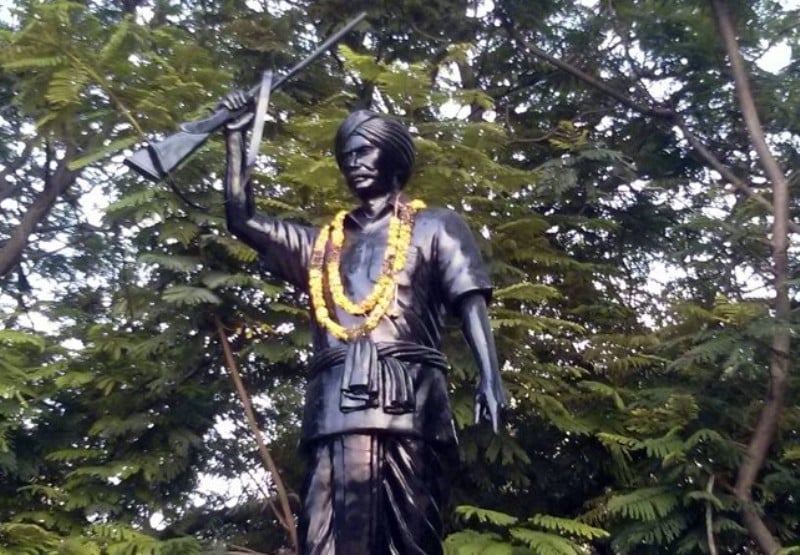
 Featured Biography
Image source: StarsUnfolded
Quick Info
Date of birth22 October 1901
Age39 Years (at time of death)
BirthplaceSankepalli, Hyderabad State, British India (present day Telangana, India)
ProfessionFreedom Fighter
NationalityBritish Indian
Marital statusMarried
SpouseSom Bai
FamilyFather - Komaram Chinnu; Younger brother - Kumra Jangu; Grandson - Sone Rao
Komaram Bheem Biography
Komaram Bheem (born Kumram Bheem) was a Gond tribal leader and freedom fighter from the Hyderabad State who led an armed movement defending Adivasi land,森林
Early life and backgroundKumram Bheem, widely known as Komaram Bheem, was born on 22 October 1901 in Sankepalli in the Hyderabad State of British India (present-day Telangana). He came from a Gond tribal community that lived in forested, often isolated regions and moved frequently as families sought to escape economic pressure and exploitation by local zamindars and forest officials. Bheem did not receive formal schooling in his youth.
His family experienced direct conflict with authorities: his father, Komaram Chinnu, was killed during a protest against impositions by forest officials. Following that loss the family relocated from Sankepalli to Sardapur near Karimnagar, where the Gonds worked marginal land and faced further demands and harassment from local landlords.
Career
Konfrontations with local officials marked the start of Bheem’s turn toward resistance. In October 1920 he killed a senior official sent to seize crops and then fled; during his flight he lived with a regional activist who exposed him to reading and speaking multiple languages. Arrests of associates and further pressure forced him to leave the region; he spent several years working on tea plantations in Assam, where he became involved in labour activism and was briefly arrested before escaping custody.
Returning to the Hyderabad region, Bheem resolved to defend Adivasi rights more directly. He married Som Bai and settled in Bhabejhari, but land threats continued. After attempts to obtain redress from the Nizam went nowhere, he moved from nonviolent protest to organizing armed resistance. With ties to local communist organizers, he built a secret guerrilla force and began to mobilize tribal leaders and fighters across a dozen traditional districts, including Jodeghat, Bhabejhari and others.
By the late 1920s and into the 1930s his movement had grown. Bheem and his followers declared an independent Gond kingdom to protect Adivasi access to water, forests and land. He articulated the rallying slogan Jal, Jangal, Zameen (Water, Forest, Land), which became a defining call against dispossession and exploitation. His guerrilla force expanded to several hundred fighters operating largely from Jodeghat.
Clashes with state authorities continued for more than a decade. In 1940 he was tracked down by security forces; he and a group of revolutionaries were killed in an encounter at Jodeghat. Accounts record he was killed in October 1940; some in his community observe an alternate date in April 1940 for his death. After the incident authorities cremated the bodies at the encounter site.
Public profile
Komaram Bheem is remembered as a central figure in Adivasi resistance in the Hyderabad region. Among tribal and Telugu folk traditions he is praised in songs and is revered by many Gond people. His slogan and movement influenced later regional struggles and was taken up by Adivasi groups in subsequent decades.
Scholarly attention followed the rebellion he led. An ethnologist was later commissioned by the Hyderabad government to study the roots of the uprising; the resulting research linked the conflict to structural imbalances between tribal communities and the colonial-era and princely-state systems of authority. The rebellion that Bheem helped ignite continued after his death and later merged with the broader Telangana Rebellion in the 1940s.
Legacy and memorials
Bheem’s name and memory have been commemorated in multiple ways. A 1990 film about his life won a Nandi Award. In 2011 a dam and reservoir project was named for him. After the formation of the separate Telangana state, plans and funding were announced for a museum in his honour at Jodeghat; the museum and a memorial at the Jodeghat hill rock were inaugurated in 2016. That year the Adilabad district was renamed Komaram Bheem district.
His death anniversary continues to be observed by Gond communities at Jodeghat, and local leaders who worked with him are remembered for carrying his movement forward after he was killed.
Latest updates
Memorialization efforts and local commemorations have continued into the 21st century, including the museum and memorial at Jodeghat and renaming of the district in his honour. Cultural works and scholarship have also kept attention on his life and on the grievances that motivated the Adivasi resistance he led.
Editorial Review and Sources
This F4U profile is written from publicly available career and profile information, then reviewed for clarity before publication. If you spot an outdated detail about Komaram Bheem, send the page URL and a reliable correction source to f4udotin@gmail.com.
Reference context: StarsUnfoldedAccuracy
Request a Correction
Tell us what needs to be updated and share a reliable source so the editorial team can review it.
Ownership
Claim This Profile
If this profile is about you or your client, send your contact details and verification context.
Recent Work
A 1990 film on Komaram Bheem directed by Allani Sridhar; the production received a Nandi Award.
1990Career Highlights
- Organised a guerrilla army defending Gond land and rights
- Coined and popularised the slogan Jal, Jangal, Zameen (Water, Forest, Land)
- Led a regional Adivasi rebellion against zamindars and state authorities in Hyderabad State
- Movement merged into the Telangana Rebellion after his death
People Also Search For
Frequently Asked Questions
When was Komaram Bheem born?
Komaram Bheem was born on 22 October 1901.
What is Komaram Bheem known for?
Komaram Bheem is known for freedom Fighter.
What is Komaram Bheem’s marital status?
Komaram Bheem's marital status is listed as Married.
Who is Komaram Bheem married to?
Komaram Bheem is publicly listed as married to Som Bai.
Related Biographies
View all → Celebrities
☑️Chandru Raheja
Chandru Lachmandas Raheja is an Indian businessman known for leading K. Raheja Corporation and for his long career in real estate, retail and hospitality.ト
Updated 2026-10-04 Celebrities
✅Neel Raheja
Neel Chandru Raheja is an Indian businessman who serves as Group President of K Raheja Corp. Born in Mumbai in 1974, he has guided the family's expansion—b
Updated 2026-10-04 Celebrities
✅Ravi Raheja
Ravi Chandru Raheja is an Indian businessman known for his leadership role at K. Raheja Corporation. Born and raised in Mumbai, he holds degrees from the H
Updated 2026-10-04 Celebrities
6 Girlfriends Of Salman Khan
A look at six women who have been linked to Bollywood star Salman Khan over the years, from early romances to high-profile relationships that captured wide
Updated 2026-10-04