

Image by Editor
# Introduction
The emergence of agentic AI systems marks a significant shift in how developers approach intelligent application development. The Agent Development Kit (ADK) from Google addresses a critical gap in this ecosystem by providing a framework that simplifies the construction and deployment of multi-agent systems. Recent demonstrations from Google Cloud Labs illustrate how ADK transforms complex agent orchestration into manageable, production-ready applications.
# Understanding Agent Development Kit’s Core Purpose
The Agent Development Kit serves as a specialized framework designed to handle the foundational work required for building AI agents. Rather than forcing developers to implement agent coordination, state management, and tool invocation patterns from scratch, ADK provides these capabilities as built-in abstractions. This approach allows development teams to focus on application-specific logic and business requirements rather than infrastructure concerns.
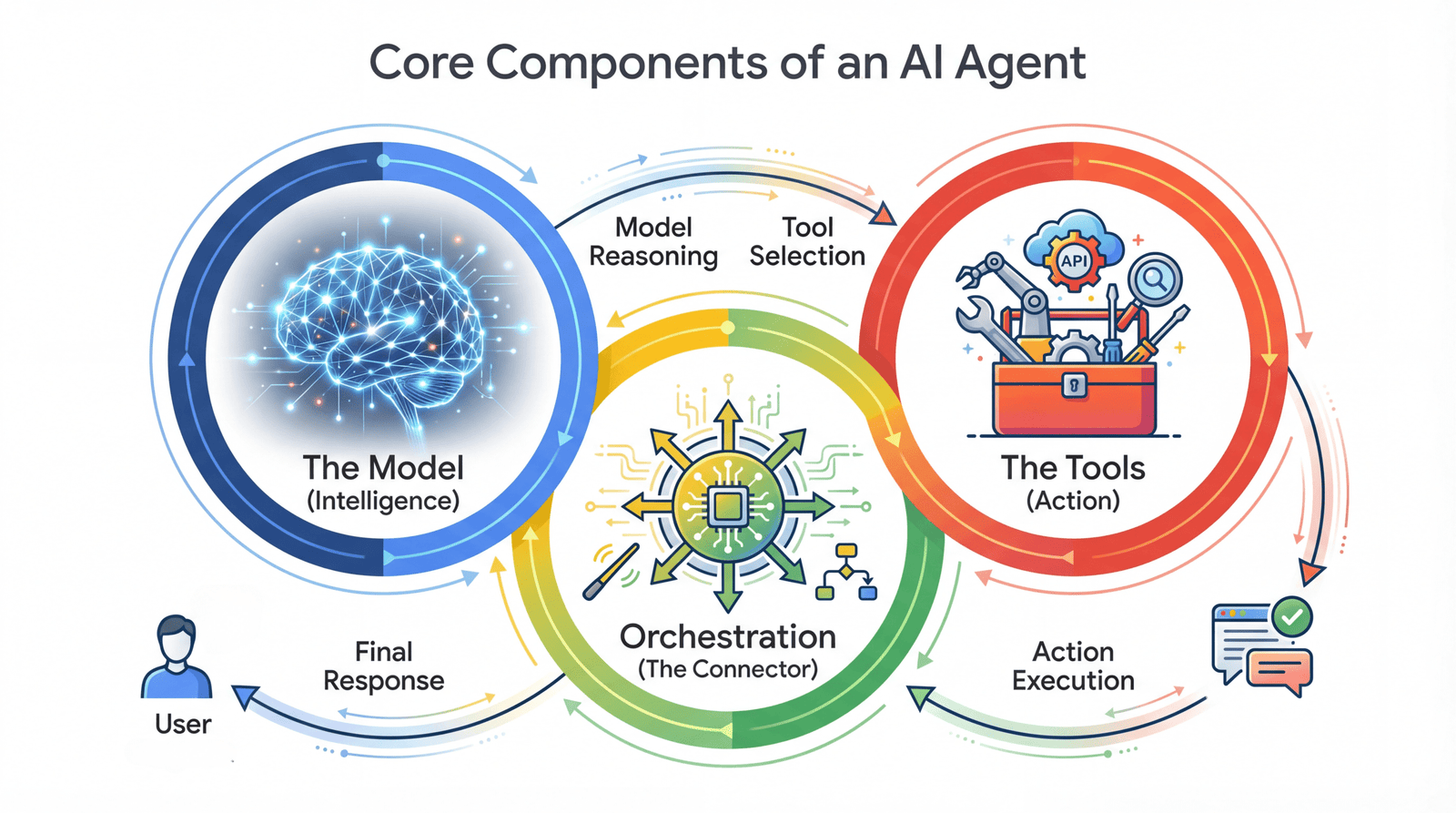
The framework defines an agent as a system that uses a model to reason about and select appropriate tools to achieve specific goals. This definition encompasses three critical components: the model that provides intelligence, the tools that enable action, and the orchestration layer that connects them. ADK specializes in managing this orchestration layer, creating a standardized approach to agent development.
Production AI agent architecture workflow between ADK, MCP, and Vertex AI | Image by Editor (click to enlarge)
# Multi-Agent Architecture and Coordination
One of ADK’s distinguishing features lies in its support for multi-agent systems. Rather than limiting developers to single-agent architectures, the framework enables the creation of specialized agents that work together to accomplish complex tasks. This pattern proves particularly valuable for applications requiring different types of processing or expertise.
A representative implementation might include three distinct agents, each with specific responsibilities. A greeter agent handles initial user interaction and request parsing. A researcher agent retrieves information from external sources such as Wikipedia or enterprise databases. A response agent synthesizes information from other agents into coherent, user-facing outputs. ADK manages the communication between these agents, ensuring proper sequencing and data flow.
This multi-agent pattern provides several architectural advantages. Each agent can be developed, tested, and optimized independently. Specialized agents become reusable across different applications. The system gains flexibility to add or modify agents without restructuring the entire application. Debugging and monitoring become more granular, as issues can be isolated to specific agents.
# Integration with AI Models and Services
ADK operates as middleware between user interfaces and AI models, managing the complexities of model interaction. The framework integrates seamlessly with Vertex AI‘s Gemini models, handling API calls, response parsing, and error management. This integration abstracts away the low-level details of model communication, allowing developers to work at a higher level of abstraction.
The architecture positions ADK between the presentation layer and the intelligence layer. User requests arrive through a web UI or API. ADK receives these requests and determines which agents should handle them. Agents leverage Vertex AI models for reasoning and decision-making. Results flow back through ADK to the user interface. This clean separation of concerns simplifies both development and maintenance.
Importantly, ADK’s design does not lock developers into specific model providers. While demonstrations focus on Vertex AI integration, the framework’s architecture supports connections to various model backends, including self-hosted models like Gemma running on specialized infrastructure.
# Model Context Protocol Integration
A critical capability of ADK-based systems involves integration with Model Context Protocol (MCP) servers. These servers expose tools and data sources that agents can invoke to extend their capabilities beyond pure language processing. ADK manages the discovery, invocation, and result handling for these external tools.
The workflow for MCP integration follows a clear pattern. An agent receives a user query requiring external information or action. ADK facilitates the agent’s analysis of available MCP tools. The agent, using its underlying model, determines which tool best addresses the query. ADK handles the actual tool invocation and captures the results. The agent incorporates tool outputs into its reasoning and response generation.
This integration enables powerful use cases. Agents can query databases through MCP-exposed database tools. External APIs become accessible as agent capabilities. Custom business logic can be packaged as MCP tools for agent consumption. Real-time data sources integrate seamlessly into agent workflows.
The example of a Wikipedia researcher agent demonstrates this pattern effectively. The agent tool connects to Wikipedia through an MCP server, enabling the agent to retrieve current information dynamically rather than relying solely on training data. This pattern extends to any external resource that can be exposed through the MCP protocol.
# Deployment Architecture and Cloud Run Integration
ADK applications deploy naturally to Cloud Run, Google’s serverless container platform. This deployment strategy aligns with modern cloud-native development practices and provides specific advantages for agent-based applications. The typical architecture separates concerns between agent logic and model inference, with ADK managing the former.
In a production deployment, ADK runs on Cloud Run instances configured with CPU-only resources. These instances handle application logic, agent coordination, request routing, and response assembly. The framework uses FastAPI as its web framework, providing efficient request handling and clear API definitions. Because ADK itself does not perform intensive model inference, CPU instances prove sufficient and cost-effective.
The actual model inference occurs in a separate service, often running on GPU-enabled Cloud Run instances. This decoupling creates several benefits. Expensive GPU resources are allocated only where necessary for model execution. The ADK layer scales independently based on request volume. Model updates can occur without affecting agent logic. Different models can serve different agents within the same application.
# Development Workflow and Tooling
ADK integrates with Cloud Shell Editor, providing developers with a complete cloud-based development environment. This integration eliminates local setup requirements and ensures consistent development experiences across teams. Developers can write agent code, test interactions, and deploy to Cloud Run without leaving the browser-based IDE.
The web UI component of ADK serves multiple purposes during development. It provides a testing interface for agent interactions. Developers can observe agent decision-making processes in real-time. Tool invocations and their results become visible for debugging. Multi-agent coordination can be monitored and refined. This visibility proves invaluable when developing complex agent systems.
The framework supports iterative development cycles. Developers can modify agent behavior and test changes immediately. Cloud Run’s deployment speed enables rapid experimentation. The separation between ADK configuration and model selection allows testing with different models without code changes. This flexibility accelerates the development process significantly.
# Handling Concurrent Users and Scalability
Production applications must handle varying loads efficiently. ADK’s deployment on Cloud Run provides natural scalability mechanisms, but the framework itself includes design decisions that support concurrent operations. Understanding how ADK manages multiple simultaneous requests proves essential for production deployments.
Consider a scenario with three concurrent users, each making requests that require several seconds of processing. Without proper architecture, these requests might queue, creating poor user experience. ADK’s integration with Cloud Run enables parallel processing through instance scaling and concurrency configuration.
The framework manages request isolation, ensuring that concurrent requests to the same agent do not interfere with each other. State management becomes critical in this context. ADK handles session data appropriately, maintaining context for individual conversations while sharing agent definitions across requests. This design allows efficient resource utilization without compromising user experience.
When combined with Cloud Run’s autoscaling capabilities, ADK-based applications can handle traffic spikes gracefully. As request volume increases, additional instances spawn automatically. As traffic decreases, instances scale down to minimize costs. The framework’s stateless design for core operations facilitates this elastic scaling.
# Cost Optimization Strategies
The decoupled architecture enabled by ADK creates opportunities for significant cost optimization. By separating agent logic from model inference, organizations can allocate expensive resources precisely where needed. ADK runs efficiently on standard CPU instances, which cost substantially less than GPU-enabled infrastructure.
The pattern works as follows. All agent coordination, tool invocation, and response assembly occur on CPU instances. Only when an agent needs model inference does a request route to the GPU-enabled service. The GPU service handles the inference and returns results. Control returns to the CPU-based ADK service for further processing. This design minimizes GPU utilization and associated costs.
Additional optimization comes from Cloud Run’s scale-to-zero capability. During periods of inactivity, both ADK instances and model services can scale to zero, eliminating costs entirely. When requests arrive, services start within seconds, maintaining good user experience while optimizing resource consumption.
For applications with predictable traffic patterns, developers can configure minimum and maximum instance counts. This prevents cold starts during known busy periods while capping costs during traffic spikes. ADK’s architecture supports these configurations without code changes.
# Tool Integration and Extensibility
ADK’s tool integration capabilities extend beyond MCP servers to include various types of external resources. The framework provides patterns for integrating databases, APIs, file systems, and custom business logic. This extensibility transforms agents from isolated language processors into comprehensive application components.
The tool integration pattern follows consistent principles regardless of the specific tool type. Tools are defined with clear descriptions that models can interpret. Parameters are specified with types and constraints. Results are returned in structured formats that agents can process. Error handling ensures graceful degradation when tools fail. ADK manages these interactions, abstracting complexity from individual agent implementations.
Custom tools can be developed to meet specific application requirements. A financial application might include tools for retrieving stock prices, calculating portfolio metrics, or executing trades. A customer service application might expose tools for querying order status, initiating returns, or updating customer information. ADK treats all tools uniformly, simplifying agent development.
# State Management and Conversation Context
Agent applications often require maintaining context across multiple interactions. ADK addresses this requirement through structured state management approaches. While the framework encourages stateless design for scalability, it provides mechanisms for managing conversational state when necessary.
For simple request-response patterns, ADK operates statelessly. Each request contains all necessary context, and the agent processes it independently. This approach maximizes scalability and simplifies deployment. For conversational applications requiring memory of previous interactions, ADK supports state persistence through various backends.
The framework allows developers to choose appropriate state storage based on requirements. Short-term conversational state might reside in memory or fast caching services. Long-term user preferences or historical data might persist in databases. ADK abstracts these storage mechanisms, allowing applications to evolve their state management strategies without rewriting agent logic.
# Error Handling and Reliability
Production agent systems must handle various failure modes gracefully. Model API calls may timeout or fail. External tools might become unavailable. User inputs may be ambiguous or contradictory. ADK incorporates patterns for managing these scenarios, improving overall system reliability.
The framework provides structured error handling for common failure modes. When a model call fails, ADK can retry with exponential backoff or fall back to alternative models. When external tools are unavailable, agents can acknowledge limitations rather than failing silently. When requests are ambiguous, agents can seek clarification through structured prompts.
Developers can customize error handling behavior based on application requirements. Critical operations might require strict validation and guaranteed execution. Informational queries might tolerate partial failures and approximations. ADK’s flexibility allows appropriate error handling for different use cases.
# Security and Permission Management
Agent systems that interact with external tools and data sources require careful security consideration. ADK incorporates patterns for managing permissions and ensuring secure tool execution. The framework supports authentication and authorization at multiple levels.
The demonstration includes user permission flows for tool execution. When an agent determines that a tool call is necessary, it can request user approval before proceeding. This pattern proves particularly important for tools that modify data or initiate external actions. ADK manages the permission request, user response, and conditional execution flow.
For programmatic security, ADK integrates with Google Cloud’s identity and access management systems. Service accounts can be configured with minimal necessary permissions. Tool access can be restricted based on user roles. Audit logs track tool invocations for compliance requirements. These security features make ADK suitable for enterprise deployments handling sensitive data.
# Monitoring and Observability
Understanding agent behavior in production requires comprehensive monitoring and logging. ADK integrations with Cloud Logging and Cloud Monitoring provide visibility into agent operations. Developers can track metrics such as request volume, response latency, tool invocation frequency, and error rates.
The framework automatically logs key events in agent workflows. Request arrival and routing decisions become visible. Tool invocations and their results are recorded. Model interactions are tracked. This logging proves invaluable for debugging issues, optimizing performance, and understanding usage patterns.
Custom metrics can be defined for application-specific monitoring. An e-commerce agent might track product recommendation accuracy. A support agent might monitor resolution rates. ADK’s integration with monitoring systems makes these custom metrics straightforward to implement and visualize.
# Practical Implementation Considerations
Several practical factors influence successful ADK implementations. The choice of agent granularity affects both performance and maintainability. Highly specialized agents provide flexibility but increase coordination complexity. Broader agents simplify orchestration but may become difficult to maintain. Finding the right balance requires understanding specific application requirements.
Tool descriptions deserve careful attention, as models rely on these to select appropriate tools. Clear, concise descriptions improve agent decision-making. Well-defined parameters reduce errors. Thoughtful organization of tools by domain or function simplifies agent reasoning. Investing time in tool design pays dividends in agent effectiveness.
Testing strategies for agent systems differ from traditional applications. Deterministic testing proves challenging when models introduce variability. ADK supports test-friendly patterns such as model mocking and tool stubbing. Evaluation frameworks can assess agent performance across conversation scenarios. Continuous testing ensures that changes to agents or tools do not degrade overall system behavior.
# Future Directions and Ecosystem Evolution
The agent development landscape continues to evolve rapidly. ADK represents a step toward standardizing agent development patterns and reducing implementation complexity. As the framework matures, additional capabilities will likely emerge.
Integration with additional model providers will expand deployment flexibility. Enhanced state management options will support more sophisticated conversational applications. Improved debugging and development tools will accelerate implementation cycles. Richer libraries of pre-built agents and tools will reduce development time for common use cases.
The convergence of ADK with serverless platforms and managed AI services indicates a broader trend. Organizations increasingly prefer integrated solutions that handle infrastructure complexity while maintaining development flexibility. ADK positions itself at this intersection, providing structure without sacrificing adaptability.
# Conclusion
Agent Development Kit addresses a critical need in the AI application ecosystem. By abstracting agent orchestration complexity, supporting multi-agent architectures, and integrating with cloud-native deployment platforms, ADK enables developers to build production-ready agent systems efficiently. The framework’s emphasis on practical deployment patterns, cost optimization, and extensibility makes it suitable for real-world applications beyond prototype demonstrations.
Success with ADK requires understanding its architectural patterns and leveraging them appropriately. The separation of agent logic from model inference, the use of MCP for tool integration, and the deployment to serverless infrastructure all contribute to scalable, maintainable systems. As agentic AI moves from experimentation to production, frameworks like ADK that handle foundational complexity while maintaining flexibility will prove increasingly valuable.
Rachel Kuznetsov has a Master’s in Business Analytics and thrives on tackling complex data puzzles and searching for fresh challenges to take on. She’s committed to making intricate data science concepts easier to understand and is exploring the various ways AI makes an impact on our lives. On her continuous quest to learn and grow, she documents her journey so others can learn alongside her. You can find her on LinkedIn.
