

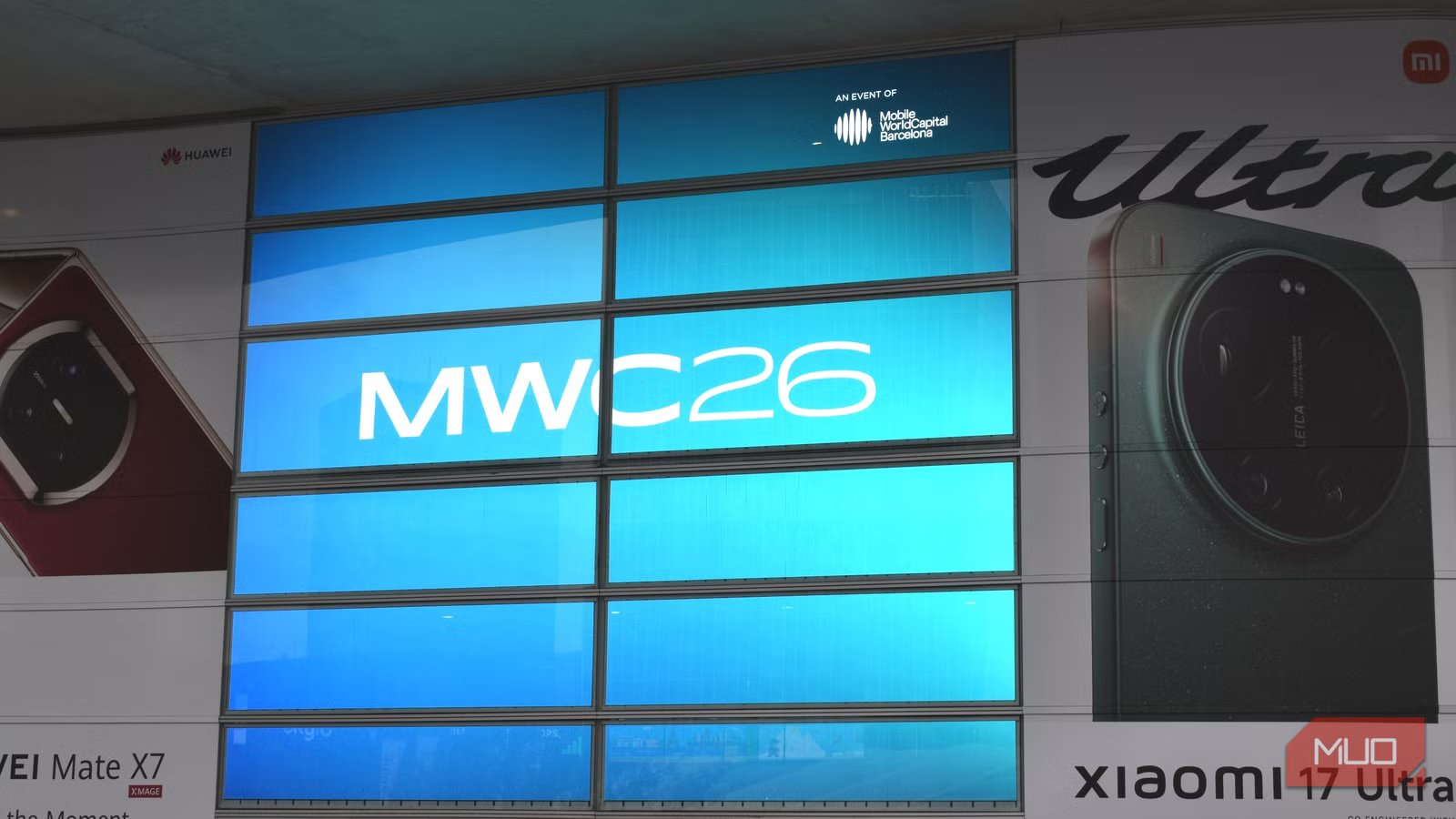
I’m always super excited about MWC, the world’s largest mobile-focused tech event. Hosted in Barcelona, Spain, MWC attracts more than 100,000 visitors each year and is often where tech companies launch their newest smartphones, tablets, and more.
MWC 2026 has delivered the goods, and these are the best bits of hardware we’ve seen while stalking its enormous halls.
Lenovo ThinkBook Modular AI PC Concept
Building on previous designs, but much more powerful
Lenovo has been toying with modular designs for a little while now, showing us laptops with an array of magnetic attachments at MWC 2025.
It has now taken that idea to a whole new level with the ThinkBook Modular AI PC Concept, which combines an ultra-thin 14-inch laptop with an integrated secondary display that can be mounted on the base device or placed alongside for a second screen to massively expand your screensize when you’re on the go. The total combined viewing area can expand up to 19 inches, a huge expansion on the base 14-inch screen.
It has other modular elements, too, such as the Bluetooth keyboard, but what’s really cool is that you can also swap out the various ports, switching between USB-A, USB-C, and HDMI, with the potential for other modules to come later.
Of course, this is far from the first modular laptop concept. Framework’s laptops have a very decent following and go from strength to strength, but it’s encouraging to see a more mainstream hardware manufacturer picking up the modular baton and running with it. On that, I’m excited to see where Lenovo’s concept will go, because so often, they become actual production hardware and not just pie-in-the-sky fun ideas for the design department.
Tecno Camon 50 Ultra
Incredibly lightweight for so much tech
I’ve been using the Tecno Camon 50 Ultra as my daily-driver for the last week or so, and despite some teething issues, I’ve been impressed with Tecno’s latest offering, particularly the screen.
The Tecno Camon 50 Ultra comes equipped with a really tidy 6.78-inch 1.5K AMOLED screen with a 144Hz refresh rate (1208×2644) and 428 dpi, which makes everything you watch look sublime. It also has 2160Hz PWM dimming, making the whole screen feel ultra-responsive.
It also makes the images you snap on the Camon’s 50MP Sony LYT-700C main sensor look wonderful. The 1/1.56″ sensor is excellent for a range of photos, with great night photography performance. It also features a 50MP 3x telephoto lens, a 50MP front camera, and Tecno’s AI auto-zoom and AI LightMaster 2.0 tech. The telephoto lens supports up to 60x zoom, with AI Super Zoom supporting beyond 20x.
I’m also a big fan of the 6500mAh battery, which delivers all-day battery life. It also features 45W fast charging, which is super useful when you’re on the go.
Hardware-wise, the Camon 50 Ultra uses a Dimensity 7400, which isn’t the latest in hardware, but it’s more than capable of delivering the Camon Ultra 50’s AI tools, such as FlashSnap, MindHub, Writing 2.0, and similar.
Soundcore Space 2
ANC that just works
Soundcore has become one of the mainstays of quality-focused headphones on a budget, and the Soundcore Space 2 absolutely hits that angle.
They’re great for a few reasons.
I took the Soundcore Space 2 cans for a spin against the noisy backdrop of an MWC event, filled with people chatting and eating. Within seconds, the entire noise of the room was gone, and the Soundcore Space 2 had done its job.
But the ultra-focused ANC didn’t come with a sound compromise. While the Space 2 headphones follow the company’s typical bass-forward approach to sound engineering, I was super impressed with the ANC quality straight off the bat. I connected my phone to the headphones and took Papa Was a Rollin’ Stone for a spin, and found that I couldn’t hear any of the background noise.
They’re far from the only headphones with ANC, but from what I’ve experienced so far, the Soundcore Space 2 are going to be some of the best budget-focused ANC cans of the year.
Honor Magic V6
Folding in all the right places
I’ve been skeptical of all folding smartphones; I’ve even had the Magic V5 for a long time to experience what it’s like to live with a fold. But Honor’s Magic V6 takes foldables to another level, in a few areas that actually make it important.
The actual design isn’t all that different from the Honor Magic V5, which was all about being the slimmest foldable in existence. Don’t get me wrong: the Magic V6 is still crazy slimline (just 8.75mm when folded, 4mm when opened) and looks absolutely sublime (the red colorway is wonderful), but Honor has set its focus elsewhere this time around, leaving the ding-dong slimline foldable battle with Samsung alone (but probably not forever).
This time out, Honor is pushing power and performance, stacking the Magic V6 with the best chipset on the market, the Qualcomm Snapdragon 8 Elite Gen 5. It’s a performance beast, backed up by Honor’s next big advancement: the whopping 6,660mAh battery.
I’ve tried a few smartphones with 6,500mAh+ batteries, but they’re typically standard designs. Honor has blown the competition away with this enormous upgrade, and it really sets a new standard for its competitors. For reference, Samsung’s Galaxy Z Fold 7 comes equipped with just 4,400mAh, which looks positively terrible in comparison.
It also has 80W wired and 66W wireless charging—it’s just a beast all over, and well worthy of one of our Best of MWC 2026 awards.
Lenovo Legion Go Foldable Concept
I kinda love this one already
Lenovo’s concept game is strong, so strong that most of the time, its outlandish designs eventually blossom into full production devices. And this time, we have multiple fingers crossed, because its Legion Go Foldable Concept is a belter.
Lenovo has basically combined an 11.6-inch flexible OLED screen with removable Legion Go controllers, creating a strange yet awesome hybrid portable gaming device that can also function as a laptop with a Bluetooth keyboard.
At first glance, it does seem a little odd. The form factor of the 11.6-inch screen folding down to 7.7 inches doesn’t look intuitive. But as a whole, transitioning between the various form factors is quite effective, especially when you include a Bluetooth keyboard for easy typing.
As this was a very early concept prototype, it wasn’t completely up and running; it felt like a development device. But under the hood, the initial outline specs look good, and there is room for improvement, too. The Legion Go Foldable Concept was powered by an Intel Core Ultra 7 258V processor and 32GB, which is a pretty hefty combo and comparable to some of the previous generations’ handhelds.
While the CPU is last generation, Lenovo told me that this isn’t locked in and could change before the concept makes a full production run.
Related
Why people are still buying this 2018 laptop in 2025
It’s the dream combination for so many reasons.
Nothing Phone 4a
Best bargain phone of 2026?
Nothing is on to a real winner here. The Nothing Phone 4a looks like a real bargain when you take a gander at its specs and projected price.
It packs in a Snapdragon 7s Gen 4, plus 256GB storage and up to 12GB RAM. It’s not the latest chipset generation, but the Snapdragon 7s Gen 4 is a solid mid-range chip that can deliver decent performance for AI, gaming, and productivity.
On that, it has a 6.78-inch 120Hz AMOLED display, which looks great, and the whole thing is powered by decently-sized 5080mAh battery with 50W wired charging.
One of the biggest changes to the Nothing Phone 4a, though, is the iconic glyph interface, which has completely changed. Instead of the various light-up LEDs, the Phone 4a has six white LEDs and one red LED arranged into a bar configuration. It’s a more subtle approach than the disco-strobe effects we’ve seen on older Nothing handsets, and I’m a big fan of the evolution of the glyph interface into a more mature visual design.
Of course, it does still light up, and you can program the lights and use them as a timer and so on, but this design is definitely taking Nothing into what I think is a new phase of design. Adding to that are colors: the Phone 4a is available in blue, pink, white, and black—but not the yellow color teased alongside Nothing’s new headphones.
While Nothing hasn’t confirmed the price as yet, there are some leaked and projected figures putting the Phone 4a as low as $350, but I’ve also seen some higher numbers pushing above 400 bucks. At the lower end, the Nothing Phone 4a is shaping up to be a great budget option.
Tecno Modular Phone Concept
My favorite modular phone concept so far
I wasn’t really sure what to make of Tecno’s modular smartphone concept when it first landed in my inbox. The email and press release I saw used a mocked-up set of images to show the hardware, and I couldn’t properly envisage how it would function, or even really how it would look stylistically.
My actual experience with Tecno’s Modular Phone Concept was all the better for this, though, because the magnetic modules and ultra-slimline base device are really something, and definitely felt more like a production unit rather than a rough outline for a concept.
The base smartphone unit measures a remarkable 4.9mm slim. It feels wafer-thin, yet strong and well-made. On its rear are two sets of magnetic connectors that you can attach any of its companion modules, sticking straight to the smartphone and connecting near instantly.
It’s the array of modules that really surprised me about this concept, though, covering a telephoto lens, an ultrawide lens, a periscopic telephoto, and an action cam, all of which you can slip on and off with ease. But that’s not all. There is also a module with an antenna that turns the phone into a walkie-talkie, allowing it to communicate without Wi-Fi or cell service.
Then there is also a stackable 3,000 mAh power module, of which you can combine three for up to 10,000 mAh, which basically beats most other smartphones.
The idea of a modular phone has been done before, and in most cases, it doesn’t work out. But Tecno’s is one of the best looking, and the modules appeal to a broad range of uses, so here’s to hoping this actually hits the shelves and we get to see it in proper action.
TCL Nxtpaper 70 Pro
TCL finally brings AMOLED to Nxtpaper tech
TCL’s Nxtpaper devices are always interesting, blending a proper smartphone with its eye-comfort-focused paper-reader modes, and doing it well. Eye-fatigue is a huge problem affecting millions of us, with most folks spending far too long on a smartphone each day, myself very definitely included.
Now, TCL is bringing AMOLED to the Nxtpaper 70 Pro, a significant upgrade to the “other” side of what a Nxtpaper device offers. The biggest draw is, of course, the integrated paper modes, but keeping up with display tech in all areas is equally important. And the Nxtpaper 70 Pro’s AMOLED screen is really delightful, fully bright in daylight, and very responsive.
There is also a dedicated Nxtpaper Key that lets you switch between the device’s Ink Paper, Color Paper, and Max Ink modes — however, this wasn’t actually working on the demo unit I had some hands-on time with. Still, it’s a handy option that means you can switch between the various modes without delving into your Settings app each time.
Using the various paper modes makes a huge difference to your battery life, too. I doubt you’ll end up spending all of your time in Max Ink Mode, but TCL says it’ll last for up to 26 days on standby when enabled, which is pretty wild all things considered. Given you’re more likely to switch between paper and AMOLED, don’t expect nearly a month of battery life, but it’s a good omen for the Nxtpaper 70 Pro.
At the same demo, TCL also showed me how much of a difference its screen makes to blue light output, frequently cited as a problem affecting our sleep. The Nxtpaper 70 Pro reduces blue light output as low as 3-ish percent, a reduction that should help you actually get to bed on time after that late-night, pre-bed doomscroll.
Xiaomi 17 Ultra Leica Edition
Expensive, but it’s the smartphone photography dream
Xiaomi has always had a strong focus on smartphone photography, but in recent years, this has gone a step further, with the Xiaomi Ultra range catering towards the higher-end of this category.
The Xiaomi 17 Ultra Leica Edition continues this form, combining a whopping 200MP periscope telephoto lens with 75-100mm optical zoom and 1/4-inch sensor, a 50MP main camera with an enormous 1-inch LOFIC sensor and f/1.67 lens, and a 50MP ultra wide, all powered by Leica, basically guaranteeing high-quality all around.
I also like that the Ultra 17 now has two different Photography Kits to choose from. The regular one, the Photography Kit, is more slimline and feels like a regular case with some additions, like the classic physical shutter buttons for still images and videos.
Then, the Photography Kit Pro is more advanced, with a larger camera grip, slightly larger build, more protection, and importantly, an integrated 2,000 mAh battery that can keep you going during long photography sessions.
I tried both on the MWC 2026 floor, and while limited, it’s clear that both have heaps of potential.
Elsewhere, the Ultra 17 packs in the power, with a best-in-class Snapdragon 8 Elite Gen 5 chip, a 6,000 mAh silicon-carbon battery with 90W wired and 50W wireless charging, and up to 1TB and 16GB RAM.
The only stumbling block is the price, which starts at an eye-watering $1.4k.
Honor MagicBook 14 Pro
A performance powerhouse in an ultra-portable body
I used an Honor MagicBook 14 for years. It was a fantastic laptop, but I recently upgraded to an ASUS. But if, perhaps, I’d known about this new Honor MagicBook 14 Pro five months ago, I’d have held on and bought this instead, because it has everything I need in a portable laptop.
It starts with the sublime 14-inch 3.1K OLED screen, which is super bright and responsive. It’s actually similar to the screen on my current laptop, which is fast becoming the go-to standard for 14-inch machines. The only real difference is that the MagicBook 14 Pro has a slightly glossy finish, which I feel makes it a little reflection-prone, but it still looked clear under the bright lights of the MWC 2026 hall.
It’s also wonderfully lightweight at just 1.36kg, which is lighter than the MacBook Pro, but it still packs in a super-powerful Intel Core Ultra X9 388H, delivering some serious graphical performance, which is rare at this size. I haven’t had a chance to play personally, but Honor reckons the MagicBook 14 Pro can handle the notoriously demanding Cyberpunk 2077 and deliver more than 60FPS, which is rather wild.
The MagicBook 14 Pro has a 92Whr battery, which puts it among the class leaders, and Honor reckons it’s good for 15.5 hours of use.
Overall, this is a great laptop — I just wish it had come a little earlier for me!
Related
Tablets are fine, but serious notetakers use this instead
The reMarkable 2 paper tablet is the ultimate writing device for avid notetakers.
MWC 2026 always delivers the mobile-focused goods
It’s been another whirlwind MWC 2026, and we’re only just getting going; I’ve barely scratched the surface on the smartphones at the show, and there are so many awesome devices waiting to be uncovered.
Stay tuned for more MWC 2026 news!
