

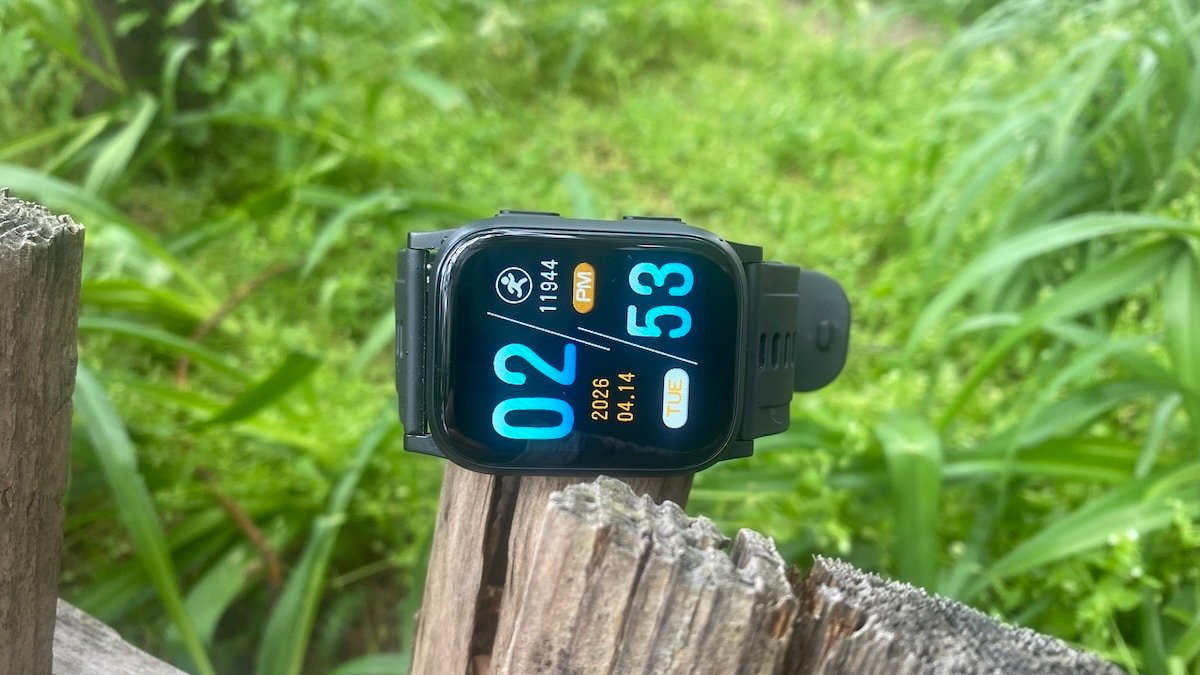
The Wellue BP Watch, also referred to as the Wellue Smart Blood Pressure Watch (model BPW1), takes a different approach from most so-called blood pressure smartwatches on the market. It doesnt rely on optical sensors to estimate readings. Instead, it uses an inflatable micro air cuff built into the strap, bringing it much closer in principle to a traditional cuff-based monitor.
That alone makes it an interesting device to test. The real question is not whether it can display blood pressure numbers, but how closely those readings match a clinically validated upper-arm cuff in day-to-day use. In this review, I’ll be looking at accuracy, consistency and whether this is genuinely practical as an everyday wearable.
One minute review
The Wellue BP Watch gets an important thing right: blood pressure tracking. The cuff-based system delivers reliable readings and, in my testing, this is where the device really stands out. The automatic hourly reading option is particularly useful, making it easy to build a picture of how blood pressure changes through the day without having to remember manual spot checks.
A traditional upper-arm blood pressure monitor will still remain the gold standard for absolute accuracy, but the BP Watch comes closer to that experience than standard smartwatches that claim blood pressure monitoring through sensors and calibration. That makes it far more useful for anyone who needs to keep a close eye on their numbers.
Outside of that core feature, the overall experience is limited. The wider health tracking is quite basic, sleep data can be inconsistent, sports tracking is minimal and the smartwatch features are sparse. It is also a chunky plastic device that looks and feels much more like a medical tool than a lifestyle wearable.
The other main cuff-based options are the Huawei Watch D2 and the older Omron HeartGuide. The Huawei comes in at roughly $450, so it is considerably more expensive than the Wellue’s $179, but it offers a much more complete smartwatch experience with better sleep, fitness and smart features. The Omron typically sits even higher, anywhere up to $500 depending on where you buy it.
That actually makes the Wellue BP Watch look pretty competitively priced. At $179, it undercuts both of the other proper inflatable-cuff watches by a fair margin, while still delivering the key feature, blood pressure readings.
If you are after a more rounded smartwatch or sports watch experience, you are better off looking elsewhere. But for users who prioritise blood pressure readings and want to track from the wrist, this is easy to recommend.
Wellue BP Watch can be purchased from Wellue’s website*
What works
Better BP accuracy than cuffless smartwatches
No calibration required
CE/FDA cleared
Automatic hourly measurements
Large, easy-to-read display
Very competitive $179 price
What doesn’t
Chunky and thick design
Feels more medical than smartwatch-like
Very basic health and fitness extras
Smartphone app could be improved
Jump to
Design, hardware
Look & feel
The first thing that hits you with the Wellue BP Watch is the sheer thickness of the device. This is not just about the strap housing the inflatable cuff, the watch body itself is chunky too. On the wrist it has a noticeably tall profile, and that gives it more of a dedicated health device feel than a regular smartwatch. At 54 grams, it is not excessively heavy, but the thickness makes it feel more substantial than the number alone suggests.
The plastic construction reinforces that impression. It feels solid enough for everyday use, but there is little attempt to disguise its purpose as a health-focused device. More than anything, it comes across like a wrist-worn medical monitor, and in this case that is not necessarily a drawback. The design feels driven by function rather than aesthetics.
The 1.83-inch display is a good fit for this kind of device. The large screen makes readings easy to view at a glance, whether you are checking blood pressure values, pulse rate or stored measurements. It also helps the watch avoid looking disproportionately bulky, as the larger display gives the front face a more balanced appearance.
Two physical buttons can be seen on the right side of BP Watch. You use these, in combination with the touchscreen, to navigate the menus.
One thing that takes a bit of getting used to is the strap. This is not your usual smartwatch band. Instead, it uses a more specialised fastening mechanism that feels a little unfamiliar at first, but once you get used to it, it does a good job of keeping the device securely in place. Also, parallel to the strap itself is a thin inflatable piece for taking blood pressure measurements.
Overall, the BPW1 gives off a distinctly clinical feel. Between the thick case, plastic finish and its sheer wrist presence, it feels closer to a compact medical device than a conventional smartwatch. That is likely to be the immediate first impression for most people taking it out of the box.
Under the hood
The real technology inside the device revolves around its cuff-based blood pressure system. Rather than relying on software estimation, the watch integrates a micro air pump, inflatable airbag and a high-precision pressure sensor directly into the device.
When you start a reading, the cuff inflates and the internal pressure sensing system captures the oscillations in blood flow to generate systolic and diastolic values. Wellue specifies an accuracy of ±3 mmHg, which puts it much closer to a proper home blood pressure monitor than a conventional smartwatch.
Beyond blood pressure, the watch also includes an accelerometer for movement tracking, along with heart rate and blood oxygen monitoring. These extra sensors help broaden its day-to-day health tracking capabilities.
What makes this interesting from a wearable tech perspective is that the engineering focus is very different from most wrist devices. This is first and foremost a medical-style sensing platform built around pressure measurement hardware, with smartwatch-style health tracking added around it.
Battery life
Battery life is decent. Wellue quotes up to 15 days of standby time from the 330mAh battery, with around 7 days under more regular use. The latter is likely the more realistic figure for anyone taking multiple blood pressure readings throughout the day.
In real-world use, longevity will depend heavily on how often the cuff inflates. This is not like a standard smartwatch where battery drain mainly comes from the display and optical sensors. Here, every blood pressure reading activates the micro air pump and pressure sensing system, so more frequent checks will naturally have a noticeable impact on battery life. If you are using hourly scheduled monitoring, expect it to sit closer to the lower end of the quoted range.
Charging is handled via a magnetic charger and a full top-up takes around two hours. For a device that may be used repeatedly during the day, that feels like a reasonable turnaround.
Technical specs
Specification
BP Watch
Model
BPW1
Display
1.83-inch
Weight
54g
Wrist size
13.5 to 21.5 cm
Sensors and technology
Oscillometric blood pressure system, micro air pump, inflatable airbag, pressure sensor, accelerometer, heart rate, SpO2
Blood pressure range
30 to 230 mmHg
Cuff pressure range
0 to 229 mmHg
Pulse rate range
40 to 180 bpm
Accuracy
±3 mmHg (BP), ±5% (pulse)
Storage
80 readings
Battery and charging
330mAh, magnetic charger, 2-hour charge time
Operating conditions
10 to 40°C, 15 to 90% RH
Blood pressure tracking
As you’d expect, blood pressure measurements are where this device separates itself from the vast majority of smartwatches. Most watches that claim blood pressure tracking use optical sensors, essentially the same light-based sensors used for heart rate monitoring, and then apply algorithms to estimate blood pressure from changes in blood flow.
These systems are useful for spotting general trends, but they are still estimates and need regular calibration against a standard cuff monitor. Studies on cuffless smartwatch methods have also shown a tendency to drift toward the calibration point, which can make them less reliable at higher or lower pressures.
The BP Watch takes a very different approach. It uses a proper cuff-based oscillometric system built into the strap, with a micro air cuff that inflates during each reading. This is the same core measurement principle used by conventional upper-arm blood pressure monitors, just miniaturised for the wrist.
Which means that instead of estimating pressure from optical signals, it directly measures pressure oscillations in the artery. This is why the readings tend to be much closer to what you would expect from a home monitor. That medical focus is also reflected in its regulatory credentials, with the device carrying both CE marking and FDA clearance.
The difference is immediately noticeable in day-to-day use. It feels like taking a proper measurement and, in my testing, the readings were in line with a traditional blood pressure monitor. At times a few points off – but not by much.
Even the sensation is familiar, with the small cuff inflating around the wrist in a way that feels very similar to using a standard blood pressure monitor. It slowly tightens around your wrist – but not too tight that it feels uncomfortable.
But what I particularly like is the automatic reading option. You can set it to take a measurement every hour. For anyone monitoring hypertension or trying to understand how stress, activity or time of day affects their numbers, this is far more useful than the trend-style estimates most smartwatches offer. It moves the experience much closer to a wearable medical device than a standard health watch feature.
Another thing I like is that the device only takes measurements when you are at rest. If there is too much movement, it discards the reading rather than logging unreliable data, which makes the results far more useful. For the best accuracy, you should also keep your wrist roughly at heart level. That happens naturally when you are lying down, so taking readings in that position work well.
Wider health & sports tracking
Now for the less impressive part. Outside of blood pressure tracking, the wider health and sports features are much less polished. Step counting is generally fine for everyday use and gives a reasonable picture of daily movement, but beyond that the experience is a bit hit and miss.
Sleep tracking in particular was not always reliable in my testing. On a few occasions, the sleep statistics ended up with gaps if I did not sync the watch the following day, which is frustrating if you are trying to build up a continuous picture of your sleep patterns. That makes it feel noticeably less dependable than the core blood pressure functionality. And when it worked, it tended to overestimate mu sleep time.
Blood oxygen monitoring is also more limited than on many mainstream smartwatches, as it is only available on demand rather than as continuous background tracking. Heart rate monitoring works, but the sampling interval appears to be around once every minute or so. And while this is fine for general wellness checks it is not ideal if you are expecting detailed workout-style heart rate curves or more granular overnight trends.
Sports tracking is also very limited and clearly feels like an afterthought rather than a core feature. If you start a workout from the smartphone app, it will log your distance using connected GPS, but it will not record your heart rate. If you start a workout from the watch itself, connected GPS is not used, so distance tracking is missing, while heart rate is recorded directly on the device.
The problem is that those heart rate figures are often not very accurate, which makes them difficult to trust for anything beyond very casual activity. Workout syncing from the watch to the app is also inconsistent. Sometimes sessions transfer without issue, other times they simply do not, which adds another layer of frustration.
So this is not really a device I would recommend for anyone who cares about workout tracking or serious fitness use. This is not what this watch is about.
That really sums up the device quite well. As a blood pressure watch, it does its main job well. As a broader health and sports wearable, not so much, with the additional tracking features serving more as extras than reasons to buy it.
App experience & smartwatch features
The BP Watch does include a handful of smartwatch-style features, but this is very much a basic experience rather than anything close to a modern smartwatch platform. Notifications come through to the wrist, which is useful for quickly checking calls, messages and app alerts without reaching for the phone. In day-to-day use this works well enough for simple glanceable information.
Beyond that, the feature set is fairly limited. You get the essentials such as alarms, basic reminders and access to stored health data, but there is very little here in terms of apps, watch customisation or smart tools. This is not the sort of device you buy for productivity features or an extended app ecosystem.
Q&A
Is the Wellue BP Watch accurate?
Yes, in my testing the blood pressure readings were in line with a standard home monitor. This is helped by the fact that it uses a proper inflatable cuff and oscillometric method rather than relying on estimated readings. Of course, traditional upper arm devices still remain the gold standard for accuracy.
Does the Wellue BP Watch take automatic readings?
Yes, and this is one of its best features. You can set it to take automatic readings at regular intervals, such as every hour, which makes it much easier to track blood pressure trends throughout the day.
Is it a good smartwatch?
Not really, at least not in the conventional sense. The smartwatch features are fairly basic, with limited smart functions, very basic sports tracking and wider health tracking that is serviceable rather than impressive. This is much more of a dedicated health device than a lifestyle smartwatch.
Is it comfortable to wear?
It is wearable, but it is definitely chunky. The watch itself is thick and the overall plastic design gives it more of a medical-device feel than a regular smartwatch.
What other options are there?
The main alternatives with proper inflatable cuffs are the Huawei Watch D2 and the older Omron HeartGuide. The Huawei is much more expensive at around $450, but offers a far more complete smartwatch experience. The Omron usually sits in the $300 to $500 range and leans even more toward the medical device side. At $179, the Wellue undercuts both by a fair margin.
Who is it best for?
This is best suited to anyone who needs regular blood pressure monitoring and wants the convenience of having that on the wrist. If accurate blood pressure readings are your priority, it is a strong option. If you want a more rounded smartwatch experience, there are better alternatives, but outside of the small number of cuff-based devices, most of them will not do a particularly good job of delivering reliable blood pressure readings.
Wellue BP Watch can be purchased from Wellue’s website*
*We are a review site that receives a small commission from sales of certain items, but the price is the same for you. Purchasing items by clicking on links in this article allows us to run this website. We are independently owned and all opinions expressed here are our own. See our affiliate disclosure page for more details.
Like this article? Subscribe to our monthly newsletter and never miss out!
