

Portable power stations have become one of those products that seem indispensable once you start reading about them. Jackery, EcoFlow, Bluetti — there’s a whole category built around the idea that you need a dedicated battery bank to keep the lights on during a storm or charge your phone at a campsite. Some of those products are excellent. They’re also $150 on the low end, closer to $400 if you want real capacity, and they require their own charging ecosystem. If you already own Ryobi ONE+ tools, you may already have most of what you need. The Ryobi 18V ONE+ 150W power source costs $49 as a bare tool and snaps directly onto the batteries you already own. It changed how I think about portable power.
Why power stations are harder to justify than they look
The math changes when you already own the batteries
The appeal of a dedicated power station is understandable. One device, self-contained, fully charged and ready on a shelf. Pull it out during a blackout, done. The problem is the price, and more specifically, where that price is going. A significant portion of what you pay for any portable power station is the built-in battery. Strip that out and you’re left with an inverter — which is exactly what the Ryobi 150W power source is.
If you’ve been building out a Ryobi ONE+ collection for any length of time, you likely have two, four, maybe six batteries sitting on a shelf right now. They charged up last weekend when you were using the circular saw or the leaf blower. They’re already there. The 150W power source gives those batteries a second job. You’re not buying into a new ecosystem or adding another thing to charge. You’re just unlocking what your existing batteries can already do. For anyone who’s already put time into building out a Ryobi ONE+ setup, the value math is hard to argue with.
What the RYi150BGA actually does
One AC outlet, two USB ports, and a light you’ll actually use
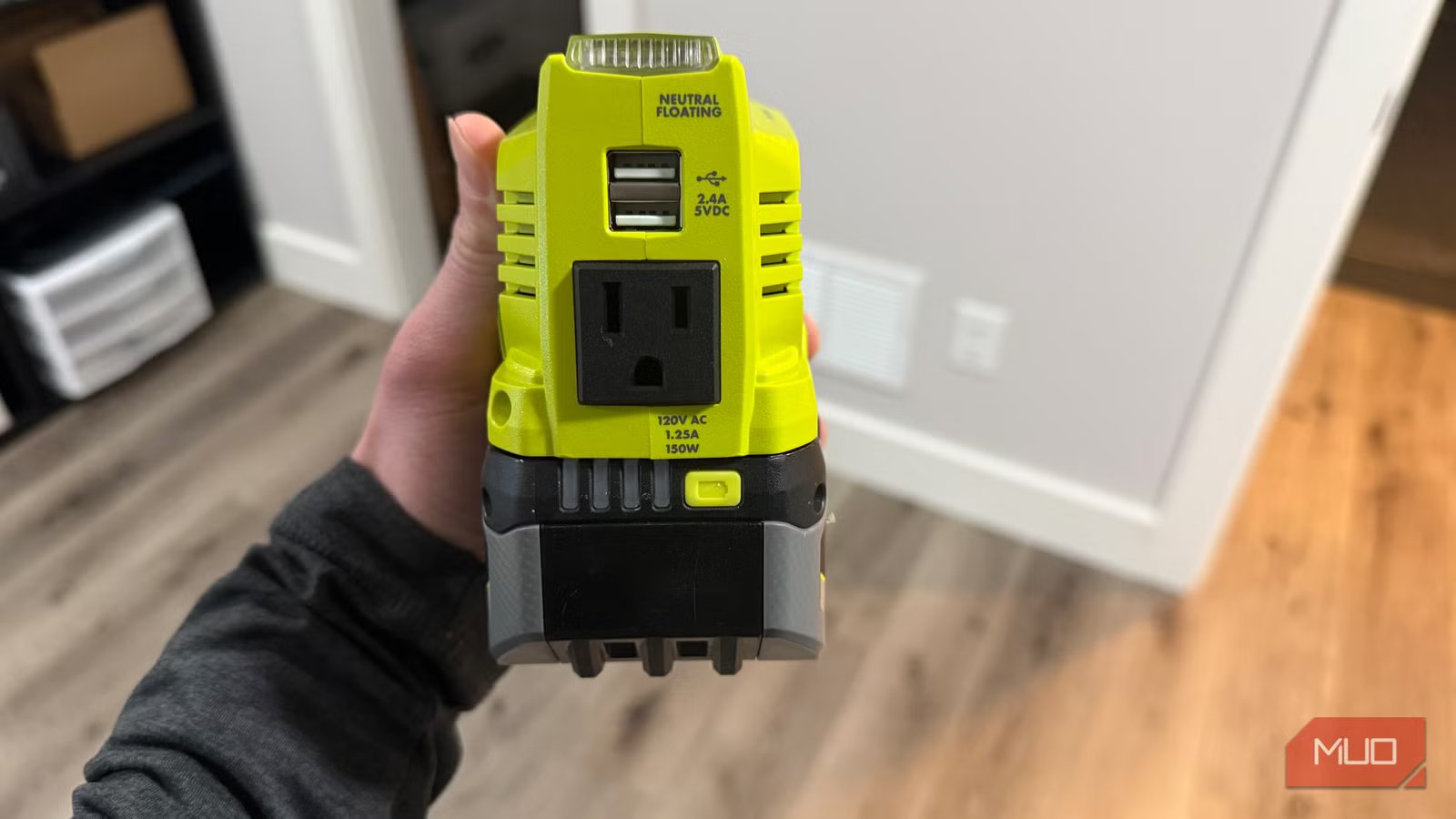
The unit is stripped down in a good way. There’s a 120V AC outlet on the front, two USB-A ports beside it, and an LED task light built into the top. The whole thing is about a pound. It clips onto any 18V ONE+ battery from underneath — no wires, no dongle, nothing loose to lose.
Runtime depends on the battery and what you’re running. Ryobi’s own numbers put phone charging at six-plus cycles on a 4Ah battery, which tracks with what I’ve seen. I’ve gotten well over an hour out of a desk fan on that same charge. Heavier draws like a 32″ TV pull the battery down faster — somewhere in the 90-minute range before it starts showing strain. Stepping up to a larger battery obviously helps, and if you have 6Ah or 9Ah packs already in rotation, those are worth reaching for here. One actual limitation: no USB-C port. At this point most devices expect USB-C, so pack an adapter or you’ll be rummaging through a bag at the wrong time.
The situations where it earns its keep
Power outages, job sites, and a garage that’s short on outlets
Credit: Jonathon Jachura / MUO
We lost power last winter for close to four hours during a storm. I had batteries on the charger from the weekend, pulled the power source off the shelf, and we ran a fan in the bedroom and kept a lamp going without touching a single extension cord. Phones stayed charged all night.
Day-to-day in the garage, it solves a specific problem I kept running into — needing power somewhere that doesn’t have an outlet. The back corner of the shop, the middle of the driveway during a project, the attic when I’m up there and need both hands free and a light nearby. The built-in LED does real work in those situations. It’s also done two camping trips, keeping a CPAP running overnight on a 6Ah battery with charge to spare. It fits the same category as a lot of tools I’ve come to rely on — the ones that seemed like overkill right up until the first time I actually needed one. These tools prove their worth on the first use and then some.
Related
4 ways a portable power station is more useful than a generator
Portable power stations are infinitely more useful.
What it can’t do — and what to buy if you need more
150 watts has a ceiling, and it’s lower than you think
Credit: Jonathon Jachura / MUO
Plug in a space heater, a microwave, a refrigerator, or a sump pump and nothing happens — the inverter shuts off before anything gets damaged, but the appliance won’t run. That’s not a flaw, just physics. The wattage ceiling is 150, and anything that draws more than that simply won’t get power. The modified sine wave output is also worth a moment of your time before you rely on this for anything medical. Older CPAP hardware and certain sensitive equipment can behave unpredictably on modified sine wave — check your manual rather than assuming it’ll be fine.
Ryobi’s 40V lineup and their larger inverter options exist if your needs go beyond this. For most homeowners dealing with a short outage, spotty job site power, or a camping trip, though, this covers the realistic list.
Your batteries are already doing more than you think
Most Ryobi ONE+ owners buy into the platform for the tools and never think much about the batteries themselves. They charge, they work, they go back on the shelf. The 150W power source reframes those batteries as something closer to a portable power infrastructure. Before spending $200–$400 on a standalone power station, check what’s already sitting on your charger. Chances are, it goes further than you’ve given it credit for. If you want to keep building out a toolkit that punches above its price, there are more Ryobi tools worth owning for the long haul.
