

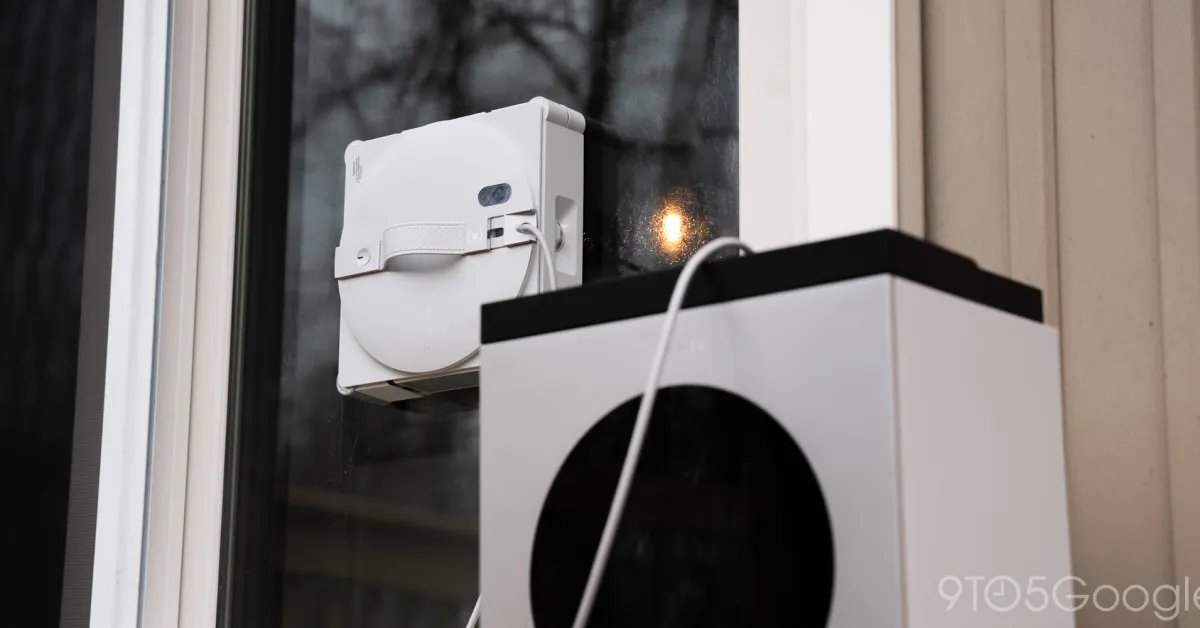
Window cleaning robots have never really taken as much of the spotlight as robotic vacuums or, more recently, lawn mowers. Still, the new W3 Winbot from Ecovacs is worth your attention if you have any windows that are taller than you are.
In reality, most can get away without a robot vacuum roaming the halls of their home. Floors are easy enough to clean, though the sheer time it takes to mop or vacuum makes the case for an automated system more compelling.
Windows are even easier to clean. Spray, wipe, repeat. Over and over again until you’ve cleaned each window in your home. What ends up being a drain is the effort to clean larger windows. If you have windows that can be cleaned without a ladder, you probably wouldn’t empathize with a smart robot designed specifically to clean windows.
I’ve been using the Ecovacs Winbot W3 Omni for a few weeks now. But the funny thing is, I don’t have massive floor-to-ceiling windows in and around my home. I have normal two-pane units throughout the house, along with a couple of glass doors. On paper, I shouldn’t find any reason to like the Winbot.
But I do.
At its core, the W3 Omni is a small suction-secured roving washing pad that traverses windows to clean from edge to edge. It has several modes, which we’ll get to, but it’s marketed for users who have large windows and can’t clean them regularly. In that case, simply attach the Winbot and let it fly back and forth, just like a robot vacuum.
Unlike the last model I tried, the Winbot W3 Omni is powered by a portable power/docking station. There’s no need to plug it in and run a safety rope. It’s attached by a dual power/safety cord that winds up automatically when you’re done.
When not in use, the bot hangs off the back on a little storage hook, and the front of the station houses a sort of washing machine. Before and after washes, the pad gets placed inside, and a washing cycle is selected. With a clean pad attached, you place the Winbot on the window and let it clean.
The system is as all-in-one as you can get. A small battery sits in the back, and a display on the top gives a rough estimate of usage time before it needs to be recharged.
Performance
The startup process usually goes like this: I head over to the Winbot’s docking station and hit the power button. A couple of seconds later, I release the front washing door and remove the dry pad from the bottom of the robot. I scroll through the small onboard display and start the washing cycle. A minute goes by, and then I grab the wet pad and stick it on the robot. I find the window I want to start cleaning, and I place the Ecovacs W3 Omni Winbot somewhere on it. After holding the top button, it gives me a little wiggle when it has sufficient suction, and it starts cleaning.
I use the app sometimes, but this model feels so self-sufficient that I only ever need to use the built-in display for quick cleaning. Beyond that, there are some deeper cleaning modes that take advantage of the bot’s strengths. For instance, “thorough cleaning” means more passes and edge cleaning, but it uses more solution and takes more time. It’s meant to be used on outside-facing glass, so it can clean off pollen and other debris that’s built up over time.
There’s also a heavy-duty mode that requires the app. It cleans in sections, with prompts to wash the pad. The box comes with two cleaning pads, so this is a little easier. It’s also not something you’ll often need to make the robot do.
Edge cleaning works really well because of the W3 Omni’s new “True Edge” scrubbers. The robot has two rotating pads that get as close as possible to the edge of the window. They add a little mechanical action to spots where grime builds up the most.
If you do it in the right order and start with thorough cleaning on outer windows, the Winbot W3 Omni does a fantastic job of getting those hard-to-reach spots. I used the heavier cleaning mode and the included solution, which seems to work just like glass cleaner, though it’s built for whatever internal pumps Ecovacs uses.
Ecovacs provides a small amount of cleaning solution with the robot, which gets used up pretty fast. You can get away with just water in the on-board water tank, since the microfiber washing pads do a lot of the work for you. But if you want the best cleaning performance, a cleaning solution is your best bet. It’s unclear if other solutions can be used other than the company’s proprietary fluid.
The one issue I have with the Winbot’s build is the washing pad’s tendency to leave a little “goodbye present.” At the end of its cleaning cycle, some of that dust and dirt from the pad stays on the window, and it leaves a mark in the silhouette of the washing pad. You can use a paper towel or cloth to wipe it off in one stroke, but that takes away from the automated magic. At least, a little bit.
Overall, though, it does a great job of cleaning any window I put it up against.
On top of that, I was surprised at how long it could go without needing a charge. Remember that the battery is powering the robot itself and regular washing cycles. One charge gets you 120 minutes of cleaning according to Ecovacs. Since most windows make up very little actual runtime, the docking station hardly needs to be charged. If you’re using this regularly like me, I would estimate one charge a month.
The portable nature of the Winbot really drives the convenience home. If it has a charge, just carry it around wherever you need to and let it do all the work. If you have kids, make it a fun game! I would have loved to operate this little bot as a kid, even if it was a “chore.”
Who is this for?
At the outset, I caveated a lot of this with the fact that most people won’t need something like the W3 Omni Winbot.
But for those who have homes or apartments with large windows, Ecovacs’ W3 Omni Winbot actually makes a lot of sense. With the nearly 20ft power cord from the base station, you can reach high windows without worrying about grabbing a ladder. Throughout the entire process, the W3 Omni sprays and wipes for a streak-free clean. And when it’s done, it returns to right where you left it.
Even in my home, I’ve found that it saves a good chunk of not only time, but also energy. I can start it on my sliding door or other larger windows and walk away to get something done. If I’m not back in the 4 or so minutes it takes to finish cleaning, it’ll hang on the window until I turn it off. Take it off, move it to the next window. It’s simple and effective.
But it’s also $750.
Where robot vacuums are similar in price, I get it. Still, $750 is a big ask for a very specific product. I can see many cases where the asking price is worth it for windows that are regularly spotless. For those who have smaller windows throughout their home, the W3 Omni Winbot might not resonate as much. On the other hand, the W3 Omni Winbot is a game-changer for large windows and might be worth the genuine saved effort and energy.
FTC: We use income earning auto affiliate links. More.
