

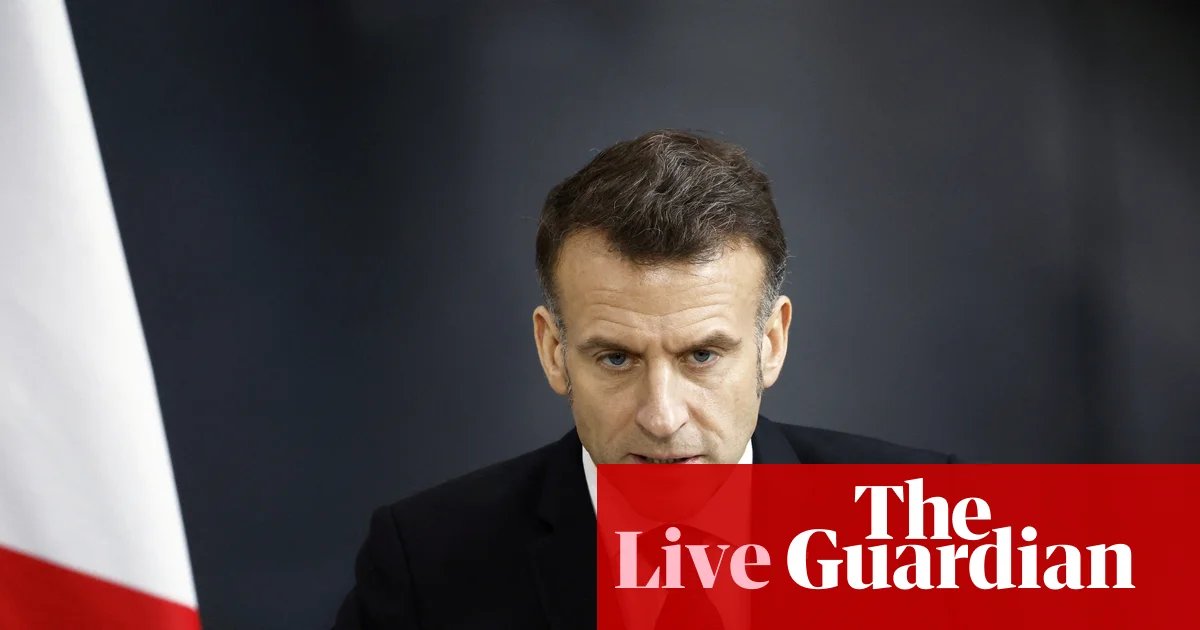
France to increase the number of nuclear warheads, Macron says
In his speech, Macron warns that since the last speech in 2020, “our competitors have evolved, as have our partners,” and this requires a change in the French nuclear doctrine.
He says the deterrent element needs to be “strengthened,” brought “forward” in a more preventative way, and considered in the European context, while respecting the French sovereignty and that the ultimate responsibility for its use will always lie with the French president of the day.
But he says that in recognition of the new challenges, France will need to increase the size of its nuclear arsenal.
He says he has ordered the increase in the number of warheads available to France, but will not reveal the exact number.
Share
Updated at 14.34 GMT
Key events
1m ago
‘Most significant update to French nuclear deterrence policy in thirty years,’ expert says
13m ago
UK continues to focus on ‘defensive actions’ regarding Iran, Starmer insists
20m ago
Four Greek F-16s land in Cyprus to bolster air defence, deter drone attacks
26m ago
Sweden’s Kristersson confirms talks with France, stresses need to deter Russia
39m ago
Concrete plans to advance French-German nuclear cooperation by end year, Merz says
45m ago
Poland involved in talks with France, others regarding advanced nuclear deterrence programme, Tusk confirms
1h ago
French government will turn Macron’s principles on ‘advance deterrence’ into actions, PM Lecornu says
1h ago
Major moment for European defence cooperation as France seeks to increase number of nuclear warheads, work with more EU partners – snap analysis
1h ago
France to work with UK, Germany on ‘very long-range missile projects’ as part of ‘advanced’ deterrence
2h ago
Number of European allies could participate in nuclear deterrence exercises, Macron says
2h ago
Macron repeats that ‘to be free, one must be feared’ as he speaks of need to step up defence spending, readiness
2h ago
France to increase the number of nuclear warheads, Macron says
2h ago
Macron speaks about France’s nuclear doctrine
3h ago
US defence secretary Hegseth briefing media on US operations in Iran
3h ago
US aircraft leave Spain after government says bases cannot be used for Iran attacks
4h ago
Evacuation of Paphos airport in Cyprus over, authorities say
4h ago
Spain’s Sánchez warns against ‘spiral of violence’ in Middle East
4h ago
Greece to send frigates, F-16 fighter jets to support Cyprus
5h ago
Aktoriti area, Paphos airport being evacuated, Cyprus says
5h ago
Larnaka airport in Cyprus reporting disruptions
5h ago
Two unmanned drones headed to RAF Akrotiri ‘intercepted in time,’ Cyprus says
5h ago
Another security alert at UK base in Cyprus, evacuation at civil airport in Paphos – media reports
6h ago
EU’s von der Leyen calls for lasting ‘diplomatic’ solutions as she urges de-escalation of conflict in Middle East
6h ago
Spain calls for US-Iran talks, warns against further destabilisation in Middle East
6h ago
Italy’s opposition calls for sacking of defence minister after he got stranded on holiday in Dubai hours before war
6h ago
Hundreds more flights cancelled as world faces worst travel chaos since Covid pandemic
7h ago
Stay in place, Ireland tells its citizens, as land evacuation routes not recommended
7h ago
Meeting of EU ministers in Cyprus delayed after last night’s drone incident
8h ago
Czech Republic, Slovakia looking to run limited evacuation flights from Middle East
8h ago
Morning opening: EU meets to consider its response as countries look at feasibility of evacuation plans
Show key events only
Please turn on JavaScript to use this feature
‘Most significant update to French nuclear deterrence policy in thirty years,’ expert says
Deputy director of the French FRS thinktank, Bruno Tertrais, has offered a very helpful analysis of Macron’s speech on nuclear deterrent, saying it amounted to “the most significant update to French nuclear deterrence policy in thirty years.”
“A major step forward: ‘forward’ deterrence with the possibility of deploying strategic forces (including, but perhaps not limited to, Rafale fighter jets) to the east of mainland France as part of a reassurance and/or deterrence manoeuvre, in partnership with willing countries,” he said.
Share
UK continues to focus on ‘defensive actions’ regarding Iran, Starmer insists
UK prime minister Keir Starmer has been speaking about the UK’s response to Iran and the attacks against its airbase on Cyprus too.
Here are the key lines from his address to the House of Commons:
The UK was not involved in the initial wave of attacks on Iran, and will not join any offensive strikes, but focus on “defensive actions.”
“It is clear that Iran’s outrageous response has become a theat to our people, our interests and our allies and it cannot be ignored.”
Starmer insisted “our bases in Cyprus are not being used by US bombers,” minutes after UK defence secretary said the government was moving families who live at RAF Akrotiri to temporary accommodations in Cyprus as a precaution.
For more details, check our live blog following the UK debate:
Share
Four Greek F-16s land in Cyprus to bolster air defence, deter drone attacks
Going briefly back to Cyprus, four Greek F-16 have landed in the country over the last half hour as part of the Greek government’s response to overnight drone attacks, the Cypriot government’s spokesperson said.
Share
Sweden’s Kristersson confirms talks with France, stresses need to deter Russia
Swedish prime minister Ulf Kristersson also confirmed Sweden’s intention to take part in the discussions on broadening the nuclear deterrence programme, as per Macron’s speech.
In a five-minute video on X, he said:
“On behalf of the Swedish government, I have informed president Emmanuel Macron that Sweden is ready to participate with others in the important talks, and we will do so in good company with close allies and neighbours, such as Denmark. …
Strengthening Europe’s overall defence capability has not been as important since the second world war as it is right now. Secondly, we are keen to keep all Nato countries together. That is why we appreciate that France has prepared these talks in dialogue also with the United States and with the Nato system of the United States. …
Sweden’s nuclear doctrine does not change as it was formulated when we entered the alliance. It rests on the principle that we fully participate in all Nato planning, including the one dealing with nuclear weapons, but that in peacetime we see no reason to have nuclear weapons on Swedish soil. …
Of course, we would prefer to see a world completely free of nuclear weapons. But as long as Russia has these weapons and threatens its neighbors, democracies must be able to deter attacks and safeguard our own security and freedom.”
Share
Updated at 16.13 GMT
Concrete plans to advance French-German nuclear cooperation by end year, Merz says
German chancellor Friedrich Merz also confirmed the plans.
Remember, Macron said that Germany was a “key partner” in the programme, and both leaders had previously hinted at their cooperation in this area, most recently in their Munich Security Conference speeches.
Merz said on X:
“[Emmanuel Macron] and I have established a nuclear steering group in which we coordinate on deterrence issues. We intend to take concrete steps before the end of this year, including conventional German participation in French nuclear exercises.”
Share
Updated at 15.51 GMT
Poland involved in talks with France, others regarding advanced nuclear deterrence programme, Tusk confirms
Poland’s prime minister Donald Tusk has just responded to Macron’s speech, confirming Poland’s involvement in the proposed new doctrine.
In a post on X, he said:
“Poland is in talks with France and a group of closest European allies on the programme of advanced nuclear deterrence. We are arming up together with our friends so that our enemies will never dare to attack us.”
Share
Updated at 15.46 GMT
French government will turn Macron’s principles on ‘advance deterrence’ into actions, PM Lecornu says
On the back of Macron’s speech, the French prime minister, Sébastien Lecornu, said his government will “translate” the principles outlined by the president into actions in terms of “budgetary allocations, modernised capabilities, and increased support for our industrial and technological defence base.”
He says the new proposal on “advanced deterrence” will define the new framework, which “strengthens collective security while maintaining the ultimate decision at the national level.”
Share
Major moment for European defence cooperation as France seeks to increase number of nuclear warheads, work with more EU partners – snap analysis
Jakub Krupa
This is an important moment for European deterrence, and one which will have significant domestic consequences for a number of European countries which Macron said want to be a part of this new “advance deterrence” strategy.
French president Emmanuel Macron delivers a speech next to the submarine ‘Le Temeraire’ (The Temerarious) at the Nuclear submarines Navy base of Ile Longue in Crozon, France. Photograph: Yoan Valat/AP
To remind you, that’s Belgium, Denmark, Germany, Greece, Poland, Sweden, the Netherlands, the United Kingdom.
There will be many questions as to how exactly all of this is going to mean and how it is going to work, so expect to hear more in the coming weeks.
For one, the Danish government – despite technically being fully in the campaign mode ahead of next month’s parliamentary elections – has just called an emergency press conference to discuss the implications for Denmark.
Share
Updated at 16.13 GMT
France to work with UK, Germany on ‘very long-range missile projects’ as part of ‘advanced’ deterrence
Macron also says that France will work with the UK and Germany on “very long-range missile projects” as part of this closer, enhanced cooperation.
He also laments Europe “becoming accustomed to their security depending on rules made by third parties.”
He makes a point warning about the dramatic changes regarding the use of nuclear deterrent, saying “everyone has taken liberties,” with the US and Russia withdrawing from some treaties or letting them lapse, and Iran and North Korea seeking to establish their own programmes.
He ends a speech with a strong call to act, saying that France needs to keep alive the “precious legacy” of nuclear deterrence and make it fit to today’s challenges, before ending with his customary:
Long live the Republic, long live France!
The audience then proceeds to sing the French national anthem.
ShareJakub Krupa
By the way, it’s quite a backdrop for his speech, as he stands in front of the Triomphant-class ballistic missile submarine of the French Navy, Le Temeraire.
French president Emmanuel Macron delivers a speech next to the submarine ‘Le Temeraire’ (The Temerarious) at the Nuclear submarines Navy base of Ile Longue in Crozon, France. Photograph: Yoan Valat/APFrench president Emmanuel Macron delivers a speech next to the submarine ‘Le Temeraire’ (The Temerarious) at the Nuclear submarines Navy base of Ile Longue in Crozon, France. Photograph: Yoan Valat/APFrench president Emmanuel Macron delivers a speech at the Nuclear submarines Navy base of Ile Longue in Crozon, near Brest, France. Photograph: Yoan Valat/EPAShare
Number of European allies could participate in nuclear deterrence exercises, Macron says
Macron says that France leads discussions on how the French nuclear system could work more broadly to protect Europe as part of what he defines as “advanced deterrence”, with other countries potentially involved in relevant exercises and temporary deployment of France’s nuclear-armed aircraft on their territory.
He says the work on this is being conducted in “full transparency” with the US and “in coordination” with the UK.
He lists a number of countries involved in discussions, including Germany – “a key partner” – but also Belgium, Denmark, Greece, Sweden, the Netherlands, Poland.
The ultimate decision for using the system would still at all times remain with the French president, he says.
Share
Updated at 15.12 GMT
Macron repeats that ‘to be free, one must be feared’ as he speaks of need to step up defence spending, readiness
In his remarks, drawing among other on Russia’s activities in Ukraine and Europe, Macron also stressed the need to improve France’s – and the continent – broader ability to detect threats and acts against them as he says that “to be strong in our nuclear deterrence, we must be strong in our conventional capabilities.”
He stresses his regular point that Europe needs to step up its defence capabilities.
“To be free, one must be feared, and to be feared, one must be powerful. This increase in our arsenal is proof of that.”
Share
