

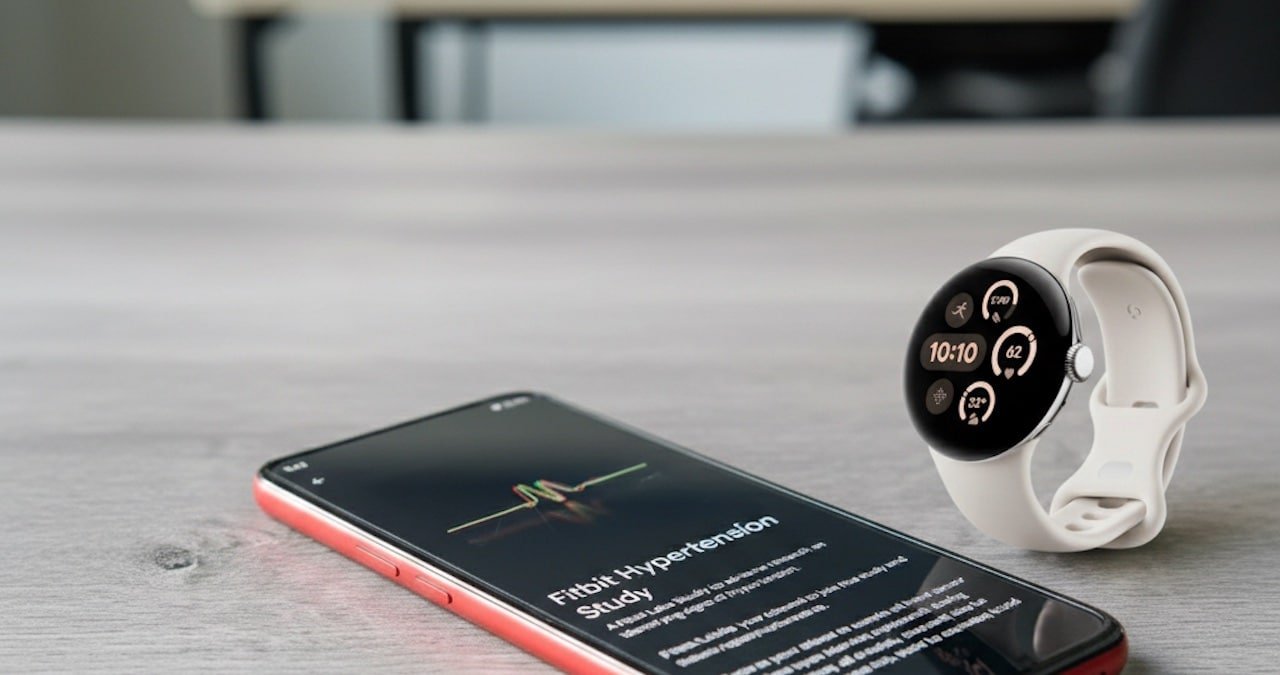
Google is launching a large-scale study using the Pixel Watch to explore how wearables can detect signs of high blood pressure. The project is part of a new Fitbit Labs initiative aimed at early identification of hypertension trends. Most likely, this will lead to a hypertension alert in a future Pixel Watch.
This is more than just another health stat
The research program, dubbed the Fitbit Hypertension Lab, is not about replacing a blood pressure cuff. Instead, it looks to develop a predictive system that can flag if your blood pressure may be running high based on sensor signals from the wrist. This kind of passive detection, if it works well, could form the basis of future watch-based alerts, along the lines of what Apple recently introduced in its own ecosystem.
The study is broken into two layers. First, Google is recruiting up to 10,000 people in the United States, aged 22 and older, who already own a Pixel Watch 3. Participants need to wear the device daily over a 180-day period while using the Fitbit app in English. That’s the baseline group.
Essential reading: Top fitness trackers and health gadgets
Then there’s a smaller subset of that group. If selected, these users will receive an Ambulatory Blood Pressure Monitoring (ABPM) cuff to wear for 24 hours. This is the kind of equipment typically used in clinical settings to get a clearer picture of blood pressure variation over a full day. It’s not the most comfortable experience, but it gives researchers hard data to compare against what the Pixel Watch picks up from its own sensors. Those who return the cuff as instructed will get a $25 gift card as a thank you.
Fitbit devices have long included features like heart rate variability and resting heart rate, and more recently started dabbling in skin temperature and electrodermal activity. But high blood pressure is different. It’s a silent risk factor, often symptomless, yet responsible for serious complications if ignored. A prompt that nudges users to seek formal testing could be a helpful middle ground.
Requirements narrow the field
This research is limited to the Pixel Watch 3. Earlier models like the Pixel Watch 1 and 2 are excluded, and interestingly, so is the unannounced Pixel Watch 4. Eligible participants must also be running software version BP3A.250905.014 or newer on the watch, with both the Fitbit app and Pixel Watch app updated to recent versions.
To check if you’re able to join, open the Fitbit app and look under the “You” tab for a section called Fitbit Labs. If the study appears there, you’ll be guided through the consent and setup process. If it doesn’t, it likely means your account hasn’t been invited yet.
The announcement doesn’t promise a release timeline for actual blood pressure alert features. This is early-stage research, not a beta rollout. But the direction is clear. Apple is already moving in this space, and Google appears to be following suit with its own sensor platform and data models. The goal seems to be less about providing numerical blood pressure readings and more about identifying meaningful deviations that warrant medical attention.
There is a note that enabling the study may reduce battery life slightly, though Google says the Pixel Watch 3 should still last a full day on a charge. That’s a reasonable tradeoff for those who want to contribute to the science behind better passive health tracking.
Subscribe to our monthly newsletter! Check out our YouTube channel.
And of course, you can follow Gadgets & Wearables on Google News and add us as a preferred source to get our expert news, reviews, and opinion in your feeds.
