

Gore Verbinski has made some of the biggest, most expensive movies of all time. From the Pirates of the Caribbean franchise to The Lone Ranger, the director understands what money can and cannot buy on a film set. Which is why he’s still so stunned that his latest film, the Los Angeles-based sci-fi epic Good Luck, Have Fun, Don’t Die, had to shoot in South Africa to get made.
“That’s how bizarre our industry is,” Verbinski told io9 on video chat. “You have to take this movie that takes place [in Los Angeles] at Norm’s and shoot it on the other side of the world.”
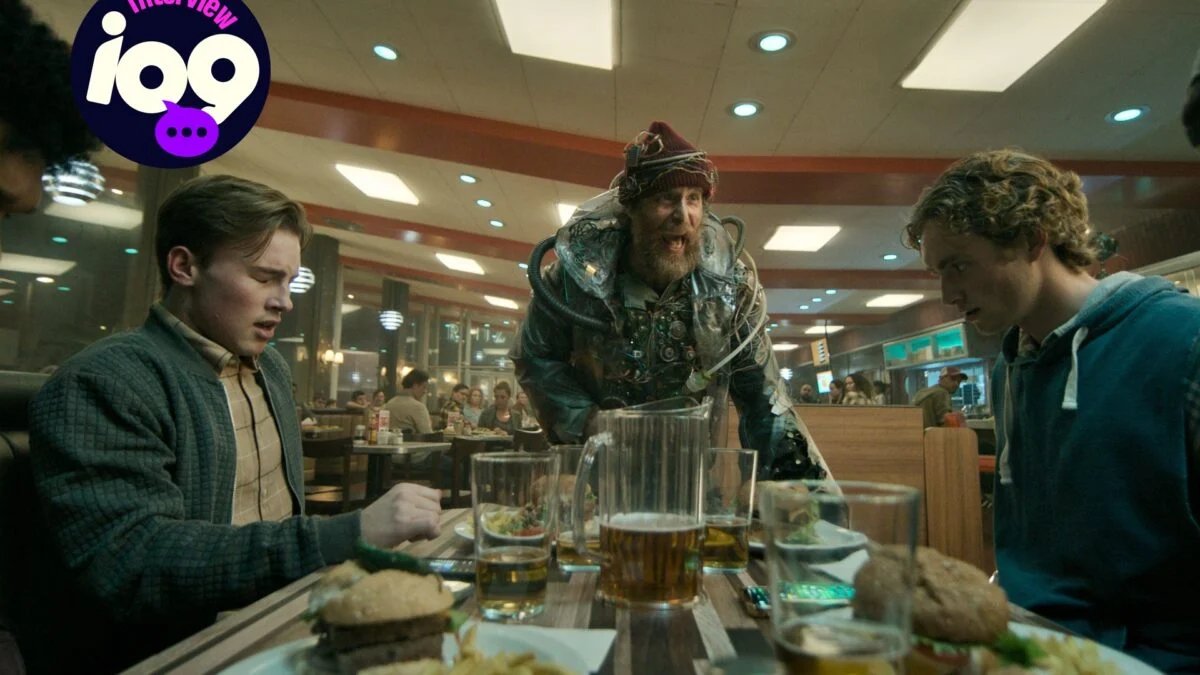
To be fair, though, part of that is also because Good Luck, Have Fun, Don’t Die is so weird and out there that no major Hollywood studio wanted to make it. The film is about a man (played by Sam Rockwell) who busts into a Norm’s restaurant in Los Angeles late at night and tells the customers that he’s from the future and needs a group of them to come with him, right now, to save the world from a killer AI that’s about to be made. Oh, and he’s already tried and failed at this over 100 times.
Think The Terminator meets Groundhog Day, but way stranger than both, in the best possible way. It co-stars Juno Temple, Michael Pena, Zazie Beetz, and Haley Lu Richardson and will be in theaters next week. Below, read our full conversation with Verbinski, where we talked about not just the struggles to make this out-there movie but also keeping it current with modern technology, his thoughts on AI, the rules of its world-building, and more.
Gore Verbinski for Good Luck, Have Fun, Don’t Die. – Briarcliff
Germain Lussier, io9: First off, I thought the movie was great. It’s so much fun, and there’s so much to think about. But I’m wondering, what was it about the script that first spoke to you?
Gore Verbinski: I think that opening monologue. I think that when I first read Matthew [Robinson]’s draft, I just was immediately compelled and a little nervous about starting a film with an 11-page monologue. But I’m always drawn to the things I’m not sure I’m able to do, or certainly curiosity is a motivator.
io9: I read in the press notes that it was in 2020 or so. Technologically speaking, so much has changed in the world since then. Like ChatGPT wasn’t a thing at the time. How did the speed of technological evolution impact this, or did you think the script was future-proofed in that way?
Verbinski: No, no, we definitely had to future-proof it. I mean, right up until the moment we were shooting in 2023, we were still cogitating on what is this thing coming? What is AI gonna mean in our daily lives? Because it was turning so fast. I think Matthew originally wrote the screenplay in 2017, and that version, we knew we immediately had to do some work on our antagonist. So we spent about two years working on the script before sending it to Sam, and everything sort of moved pretty quickly after that.
io9: Can you give an example of something that changed?
Verbinski: Yeah, I mean, I think in the case of AI, we had to look at what’s more relevant, what’s happening, what you’ll be able to do, what’s gonna show up on phones. We have to think about what actually is gonna be appearing on social media as it makes its way through. And also, for me personally, thinking about the villain not as some Skynet killing machine, but this idea that it’s much worse. It wants us to like it. It wants to keep us engaged. I think that was a big change. And then working on Sam’s character. On his want. I think when you have a rogue character or a picaresque narrative, it’s important that his want be true. And you could stop at any moment and go, “Okay, I see that deeper pain.”
Rockwell in the film. – Briarcliff
io9: One of my favorite things about this movie is its world-building. Movies like this are great because you have the story, but there’s so much else you could think about around that story. Like, we never get to see the time and place Sam’s character is from or find out anything about how time travel was created or anything like that. Was any of that ever in the movie, or did it just kind of get away from the point?
Verbinski: I think if things are okay, if things work out, maybe we can make two more, and I can answer some of those questions. I think it was a lot to bite off. So we wanted to dance around that, certainly in this one.
io9: Absolutely, and I would love that very, very much. The movie also goes to a lot of weird places and takes a lot of risks. Did you guys have any self-imposed rules about what was too far? Was anything too unbelievable or too exaggerated?
Verbinski: Yeah, I think humor is a really interesting form of criticism when it’s used correctly. And certainly, when we’re dealing with Juno Temple’s backstory, I think there are some things where the audience is starting to laugh in an uncomfortable way. And I think that’s when you start to say, “Look how we’ve normalized this insanity.” I think it’s important that you have a character who’s grounded. I think Juno’s performance is very human in an increasingly inhuman world, and that’s the sort of Franz Kafka of it. I think that’s the anchor. If her performance was not honest, then it would be a farce, and I think that would be a mistake.
io9: At its core, the movie is very basically about humans fighting an AI. Does that line up with your personal feelings on it? Do you think it’s something we have to combat, or do you think it’s something we need to embrace?
Verbinski: I’m kind of in between. I think there are those who are living in fear, and there are those who are in denial. And I think there’s a tsunami coming, but the rest of us are gonna have to surf it. I think that’s the sort of mantra of our time. “Good luck, have fun, don’t die.”
Juno Temple in Good Luck, Have Fun, Don’t Die – Briarcliff
io9: [Laughs] Exactly. So, I’m in LA and I love that the restaurant Norm’s plays such a big role because it’s so LA. How did that collaboration become a thing? Was that in the original script, and did they have any pushback or anything?
Verbinski: No, they were pretty great, actually. So Matthew had sort of conceived the movie in Norm’s. When I first moved to LA, I went to Norm’s a lot. I was going to film school at UCLA. There was one on Pico. There was one on La Cienega. So I’m a big Norm’s fan, and I think everything we did was sort of a love letter.
Look, I mean, the future didn’t send us Arnold Schwarzenegger. It sent us Sam Rockwell. That’s how screwed up things are. And I think he’s not going to the Navy SEAL Academy in San Diego. He’s going to Norm’s to find heroes. The people who are gonna save the world are in a Norm’s diner. I just think that’s beautiful.
io9: Yeah, I agree. Though I wanna know how he figured that out. Maybe movie two or three will get into that. Speaking of sequels, though, you made some of the biggest movies of all time, obviously, with Pirates and Lone Ranger. If you had that kind of budget to make this movie, what would have been different right off the top?
Verbinski: Wow, that’s a good question. We probably would have shot it in Los Angeles.
io9: There you go. Because this was shot in South Africa, right?
Verbinski: Yeah, so in order to get to the number, I mean, you have to remember, no studio wanted to make this movie.
io9: Right.
Verbinski: And they’d all read the script, and I think it was just too out there. So we found some partners with Constantine and Briarcliff, and we tried to get to a very, very low number. We got the California Tax Incentive, but we still couldn’t shoot in LA. We budgeted Vancouver. We were gonna shoot in Winnipeg at one point. The movie went down about five times and then ended up in South Africa. And that’s how bizarre our industry is. You have to take this movie that takes place in La Cienega and in Norm’s and shoot it on the other side of the world.
Norm’s heroes. – Briarcliff
io9: Yeah, that’s pretty terrible. Two more things. One is after watching this and also a trip to Disneyland, I rewatched the first Pirates of the Caribbean, and it’s still absolutely excellent. That’s obviously a movie inspired by a ride, so I’m wondering, if you were to reverse engineer this film into a ride, what would that ride be?
Verbinski: Wow, that’s a really good question. I’m gonna have to get back to you. I mean, I would say there’s a lot of gaming ideas in the movie. Just in terms of leveling up. In terms of the frustration of getting to a certain level, and you can’t get across the street. Or what is he gonna do? Like what happened on the 37th time he tried to do this? What’s he learned along the way? And what is the game throwing at him in terms of adapting as he’s progressing? I think that’s part of the paranoia. So when I think of a ride, I think it’s more of a holodeck experience than a physical ride because I think there are so many cascading mind fucks.
io9: [Laughs] That would be a good title for this movie as well. Last thing, original, high-concept movies like this rarely get theatrical releases anymore. You talked a little bit about Hollywood. Was that always the intention? Theaters or nothing? And how were we able to get that done?
Verbinski: I think it was always the intention on this one. And I gotta say, we showed the movie at Fantastic Fest and Beyond Fest and some of these smaller festivals, and to really see the crowd respond… I think there’s something about that collective experience where you’re like, in the case of humor, maybe one person’s like, “Is it okay to laugh?” And then you hear somebody else laugh, and then somebody else laughs, and then everybody is jumping in. I think how you might feel about one moment, somebody else feels slightly different about that moment. But when you’re in a room together, you sense that, and I think the whole thing sort of moves and ebbs and flows, and it’s just so nice to see it with 500 strangers. It really makes a difference.
See Good Luck, Have Fun, Don’t Die in theaters on February 13.
Want more io9 news? Check out when to expect the latest Marvel, Star Wars, and Star Trek releases, what’s next for the DC Universe on film and TV, and everything you need to know about the future of Doctor Who.
